


What additional institutional failures preceded the Odisha student’s self-immolation on campus?
Days before she set herself ablaze inside the premises of Fakir Mohan Autonomous College in Balasore, Odisha, a 20-year-old student issued a formal written complaint on July 1 to the institution’s authorities, alleging sustained sexual harassment by an assistant professor. In the letter, she described herself as being under “mental stress” and warned of taking an “extreme step” if the situation continued. According to the student’s complaint, the harassment intensified after she denied the professor’s demands for sexual favours. He allegedly retaliated by threatening to fail her and delay her graduation by a year.
Despite the severity of the allegations, institutional response was delayed. The student subsequently approached the police, who in turn asked the college for a report. Balasore Superintendent of Police Raj Prasad stated that the college promised to reply within five days, but failed to do so. When the report was not received, police issued another request, but no meaningful response followed.
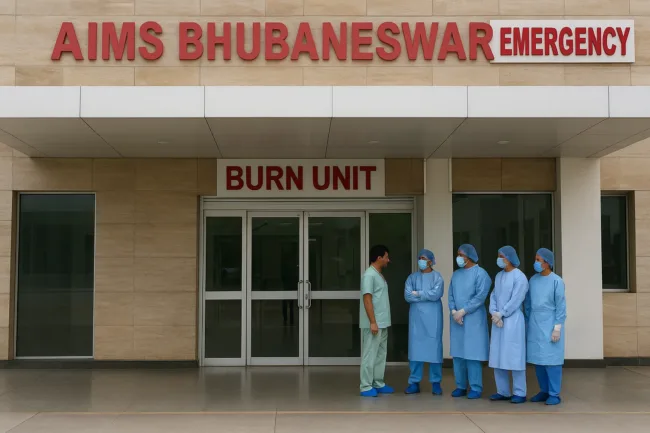
The situation escalated on Saturday when the student, after meeting the college principal, staged a sit-in protest and then poured a flammable substance on herself before setting herself on fire. CCTV footage captured the moment other students rushed to douse the flames. She sustained 90–95 percent burns and was immediately transferred to AIIMS Bhubaneswar, where she remains on ventilator support in critical condition.
What broader institutional patterns in Odisha signal systemic inaction on harassment complaints in colleges?
This incident is not isolated. Odisha has seen multiple reports in recent years of students—particularly women—raising harassment complaints against faculty, often facing slow or inadequate responses. In January, a third-year college student in Jajpur threatened self-immolation after alleging an attempted rape by a lecturer. Similarly, students from Sambalpur and Utkal universities have reported delays in complaint redressal and insufficient internal committee action in prior cases.

Observers point to the recurring failure of Internal Complaints Committees (ICCs), as mandated under the UGC’s 2015 guidelines, which are either inactive, inadequately staffed, or influenced by faculty hierarchies. As student populations grow, especially among women from vulnerable backgrounds, institutional readiness to respond to such crises appears increasingly inadequate.
What are the latest developments in the response from political parties, government authorities and regulatory bodies?
The fallout from the Balasore incident has triggered political and institutional upheaval. The assistant professor named in the complaint has been arrested and suspended. The college principal has also been suspended by the state government. Additionally, the Higher Education Department has formed a three-member panel led by Director Kali Prasanna Mohapatra to investigate whether the college followed appropriate procedures under the Sexual Harassment of Women at Workplace Act, 2013.
Chief Minister Mohan Charan Majhi visited AIIMS Bhubaneswar and announced that all treatment costs would be borne by the state. He also stated that the student would be airlifted to AIIMS Delhi if her condition improved. However, AIIMS doctors have confirmed that her condition is too unstable for such a transfer at this time.
The National Commission for Women (NCW) has taken suo motu cognizance of the incident and directed the Odisha Director General of Police to ensure a “fair and time-bound” probe. The Commission demanded that a detailed action report be submitted within three days, underscoring the national-level scrutiny the case has now drawn.
How has the public responded and what does social media reflect about campus safety narratives?
Social media reaction has been swift and emotionally charged. The student had recently opened a profile on X (formerly Twitter), where she posted warnings that she might take her own life if action wasn’t taken. “Will end life if I don’t get justice,” she wrote in a post days before the incident.
Student bodies and women’s rights groups have staged demonstrations across Bhubaneswar, demanding policy reform and accountability. Civil society activists have criticized the failure of colleges to provide safe reporting channels. The fact that the student was associated with ABVP—the BJP’s student wing—added further complexity, with critics alleging that even political affiliations did not insulate her from systemic failure.
Former Chief Minister Naveen Patnaik, representing the BJD, sought the Governor’s immediate intervention and cited a pattern of state-level negligence. The Congress party echoed these concerns and held street protests demanding resignations from the Education Minister and CM.
What is the role of AIIMS Bhubaneswar in the medical response to this case?
AIIMS Bhubaneswar, a leading super-specialty medical institute in eastern India, has taken over the student’s care with an eight-member expert committee formed to oversee treatment. The panel includes specialists in plastic surgery, critical care, nephrology, and pulmonary medicine.
Dr. Ashutosh Biswas, Director of AIIMS Bhubaneswar, confirmed the patient is receiving maximum care but noted the prognosis remains extremely serious. The facility’s burn trauma capacity, one of the most advanced in the region, has become a focal point in this case. The government has placed the student and her family under full institutional care with no financial burden.
How does this case compare to other student safety crises in India’s higher education system?
The case bears similarity to the February 2025 suicide of Prakriti Lamsal, a B.Tech student from KIIT University, who also accused the administration of inaction after harassment. That case led to a wide-ranging judicial inquiry and diplomatic involvement from Nepal. Similarly, the Balasore case reflects systemic lapses in enforcement of the UGC’s anti-harassment directives, highlighting the lack of sensitization and policy adherence at grassroots academic institutions.
Legal experts have now called for the state’s education regulatory body to audit ICC compliance across colleges and establish direct grievance reporting portals. The existing multi-tiered reporting hierarchy is seen as too slow and often untrustworthy by vulnerable students.
What preventive steps are being proposed and what could change after this case?
Odisha’s Education Department is now under pressure to enforce compliance reforms across all government colleges. The crime branch’s women and children wing is assisting in the probe, and state authorities are being urged to launch a centralized digital grievance platform for harassment cases.
Proposed reforms in the wake of the Balasore incident include a comprehensive overhaul of campus grievance mechanisms. Education policy advocates are calling for mandatory training of Internal Complaints Committee (ICC) members, along with periodic third-party audits to ensure compliance with national guidelines. There is also a push to introduce anonymous complaint dropboxes and digital reporting platforms that allow students to flag harassment without fear of retaliation. Additionally, experts recommend mandating student representation on ICC panels to increase transparency and accountability. Institutions would also be required to submit monthly reports to the Higher Education Department, detailing the status of harassment complaints and the resolution timelines. These reforms, if adopted statewide, could set a new standard for institutional accountability and student safety in higher education.
These measures, if implemented with transparency, could set a precedent not only for Odisha but also for other Indian states struggling with student safety issues.
What does this tragedy signal for future policy and public discourse?
The Balasore incident has become a flashpoint for national conversations around women’s safety in Indian educational institutions. As calls grow louder for judicial oversight, political intervention, and structural reform, this case could potentially serve as a policy watershed. The President of India, Droupadi Murmu, who is scheduled to visit Odisha soon, may be briefed on the case, especially if public sentiment and pressure remain high.
Educational stakeholders, policymakers, and rights organizations are now pushing for broader frameworks to monitor harassment redressal and mental health support in campuses. Without structural safeguards and empowered complaint redressal, many warn that the Balasore case may not be the last of its kind.
Discover more from Business-News-Today.com
Subscribe to get the latest posts sent to your email.