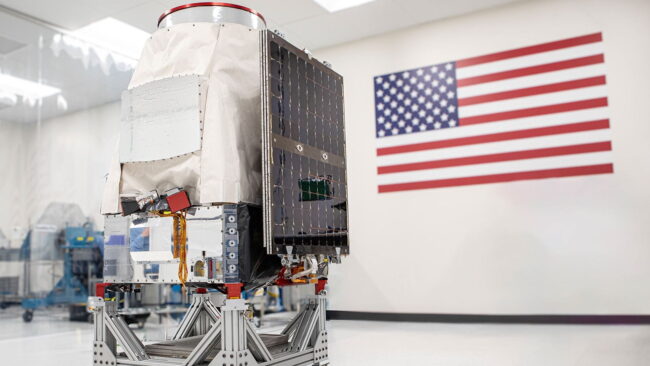
RTX Corporation (NYSE: RTX) has confirmed the successful deployment of a Saturn-200 minisatellite developed by its subsidiary Blue Canyon Technologies for NASA’s Pandora mission. The spacecraft will be used to study the atmospheres of more than 20 exoplanets, expanding RTX’s presence in advanced satellite platforms beyond defense and commercial aviation. The project also marks a strategic milestone for Blue Canyon Technologies, validating its capacity to support high-precision, science-grade space missions for the U.S. government.
How does the Pandora mission strengthen RTX’s position in modular satellite infrastructure?
The Pandora mission is designed to investigate the atmospheres of exoplanets by observing how light from a host star changes as a planet transits across it. By analyzing how starlight is absorbed and scattered through these planetary transits, NASA’s team aims to identify atmospheric composition, focusing particularly on hydrogen- and water-rich signatures that could indicate the potential for life. RTX Corporation’s Blue Canyon Technologies played a central role in this initiative by supplying the Saturn-200 spacecraft platform and supporting the mission with integration and commissioning services.
This is not just another launch for Blue Canyon Technologies. The Saturn-class minisatellite carried what RTX referred to as the largest telescope payload ever integrated onto a Blue Canyon spacecraft, underlining a new engineering milestone for the company. Its successful deployment highlights the increasing trust NASA is placing in non-traditional aerospace vendors and marks an important validation for RTX’s capabilities in modular satellite manufacturing. The Pandora satellite is now one of 87 spacecraft launched by Blue Canyon Technologies, with more than 160 units ordered, reflecting the company’s rapid ascent in the microsatellite segment.

The mission is led by NASA’s Goddard Space Flight Center and managed by Lawrence Livermore National Laboratory, with Blue Canyon Technologies providing both the spacecraft bus and post-launch bus commissioning. Importantly, the satellite includes advanced guidance, navigation, and control systems to meet the stringent precision requirements for this deep-space scientific study. Such specifications are typically reserved for larger, more customized spacecraft, making the use of a modular bus a notable shift in mission design thinking.
Why is RTX Corporation pursuing civil space opportunities beyond its core defense and aviation business?
RTX Corporation, best known for its defense primes Raytheon and aerospace divisions Pratt & Whitney and Collins Aerospace, has historically focused on propulsion, avionics, and advanced integrated systems. However, diversification into civil space infrastructure through Blue Canyon Technologies offers a strategic hedge as traditional government defense budgets fluctuate and commercial aviation faces longer-term uncertainty from both decarbonization mandates and macroeconomic cycles.
Participating in the NASA Science Mission Directorate’s small satellite program allows RTX to position itself as a dual-use systems provider. Blue Canyon Technologies already supports commercial and defense missions in low Earth orbit, but Pandora’s deep-space objective signals its readiness to handle high-value scientific missions that demand long-duration stability, optical sensitivity, and modular scalability. These capabilities are becoming increasingly relevant as both public and private sector clients seek standardized satellite platforms that can be rapidly customized and deployed.
This is particularly important as NASA shifts more of its satellite architecture away from bespoke, one-off vehicles toward plug-and-play platforms that can be used across multiple missions. Blue Canyon Technologies’ success here gives RTX Corporation a potential first-mover advantage in providing science-grade satellites on commercial timelines and cost profiles, something traditional defense contractors have struggled to deliver.
What does the Saturn-200 bus reveal about Blue Canyon’s evolving technical roadmap?
The Saturn-200 represents a significant technical step up from previous Blue Canyon Technologies platforms. Its payload integration and pointing capabilities make it suitable for a broader class of missions, from astrophysics to Earth observation to commercial hyperspectral imaging. The inclusion of precision guidance, navigation, and control in a small-form bus typically used for low-cost missions challenges the traditional assumption that high-end missions require large, fully custom spacecraft.
Chris Winslett, General Manager of Blue Canyon Technologies, highlighted the platform’s stability and precision as key enablers of Pandora’s objectives. In transit spectroscopy missions, even the slightest pointing error can undermine data quality. This mission demonstrates that modular satellite buses can now meet those stringent performance thresholds, expanding their relevance across both science and surveillance use cases.
With more than 160 spacecraft orders and a rapidly expanding mission portfolio, Blue Canyon Technologies is increasingly positioned to lead the modularization trend in satellite manufacturing. Rather than building from scratch for each mission, government agencies and commercial operators alike may turn to flexible platforms like the Saturn-200 to reduce development time and mission risk.
If RTX continues to invest in this architecture, it could eventually support a stack of satellite buses covering a wide range of payload classes, from optical and infrared instruments to synthetic aperture radar and space weather sensors. This vertically integrated platform strategy would allow the company to compete more effectively with emerging players like Rocket Lab, Firefly Aerospace, and Terran Orbital, all of which are attempting to scale into full mission architecture providers.
How does this advance RTX Corporation’s broader aerospace diversification strategy?
RTX Corporation ended 2024 with more than $80 billion in annual sales and a global workforce of over 185,000 employees. However, its commercial aviation and defense systems businesses face long-term pressure from budgetary constraints and evolving regulatory mandates. Entering the scientific satellite segment not only allows RTX to tap new markets but also to extend its aerospace engineering core into adjacent applications with more predictable funding.
By leveraging Blue Canyon Technologies’ modular approach, RTX can potentially unlock new government contract types, especially as NASA and other agencies move toward procurement models that emphasize commercial capabilities and performance-based contracting. In this framework, the value is placed not just on cost but also on time-to-orbit, flexibility, and upgrade potential—areas where Blue Canyon’s track record is becoming increasingly competitive.
In addition, RTX’s participation in a NASA-led scientific initiative adds symbolic credibility to its civil space portfolio. Rather than entering the market through purely commercial payloads or government tactical communications, RTX is positioning itself as a reliable provider for some of the most technically complex and scientifically important missions on the current calendar. This offers long-term branding and trust advantages that may translate into future contract wins in data relay, Earth observation, climate monitoring, and national security space.
There is also a potential ecosystem angle. As RTX further integrates capabilities across its business lines—from Collins Aerospace’s avionics to Raytheon’s sensor fusion technologies—it may be able to offer multi-domain solutions that blend air, space, and ground systems into cohesive platforms. The ability to field smaller, agile, and modular satellites that align with these larger systems-of-systems initiatives will be increasingly critical as warfare and intelligence architectures evolve in the next decade.
What competitive signals does this send to the broader space and satellite sector?
The successful integration of a large telescope payload into a compact bus underscores the growing maturity of commercial satellite platforms and their ability to meet mission-grade specifications. This has implications for legacy aerospace firms and new entrants alike. Traditional satellite prime contractors, which have relied on expensive, long-lead contracts, may find themselves losing ground to more nimble vendors like Blue Canyon Technologies that can rapidly deliver high-performance systems at lower cost.
It also puts competitive pressure on firms like Northrop Grumman, Boeing, and Lockheed Martin, which have tried to establish modular satellite lines but have yet to prove them across multiple scientific domains. Meanwhile, startups and growth-stage firms looking to enter this space will need to demonstrate not only innovation but reliability and integration maturity, especially if they are targeting NASA or defense procurement channels.
On the policy side, the success of Pandora may encourage further budget allocation toward modular, science-driven small satellite missions. That could open the door for additional public-private collaboration models, data-as-a-service offerings, and standardized mission platforms that blend commercial innovation with government mission assurance.
For RTX, this mission serves not just as a technical demonstration but as a positioning tool for deeper participation in the emerging hybrid space infrastructure ecosystem.
Key takeaways on what this means for RTX Corporation, its peers, and the satellite infrastructure industry
- RTX Corporation has successfully expanded its satellite portfolio into deep-space science missions through the Pandora project, deploying the Saturn-200 platform via Blue Canyon Technologies.
- The spacecraft supports high-precision exoplanet atmospheric analysis, proving Blue Canyon’s capability to handle telescope-class payloads on a compact bus.
- The development underscores NASA’s shift toward commercially sourced, modular satellites for complex scientific missions.
- RTX is leveraging this opportunity to diversify away from cyclical defense and aviation revenues into space infrastructure with long-term strategic upside.
- Blue Canyon’s growing launch record and standardization push could shape future procurement models across scientific, defense, and commercial segments.
- Competitors in both the legacy and startup segments will face pressure to match Blue Canyon’s combination of reliability, precision, and rapid deployment.
- RTX’s deeper entry into science-grade satellite platforms enhances its credibility as a dual-use systems provider capable of blending civil, commercial, and military space capabilities.
- Pandora’s launch serves as a proving ground for the feasibility of standardized satellite architectures supporting high-value missions at lower cost and shorter timelines.
Discover more from Business-News-Today.com
Subscribe to get the latest posts sent to your email.