



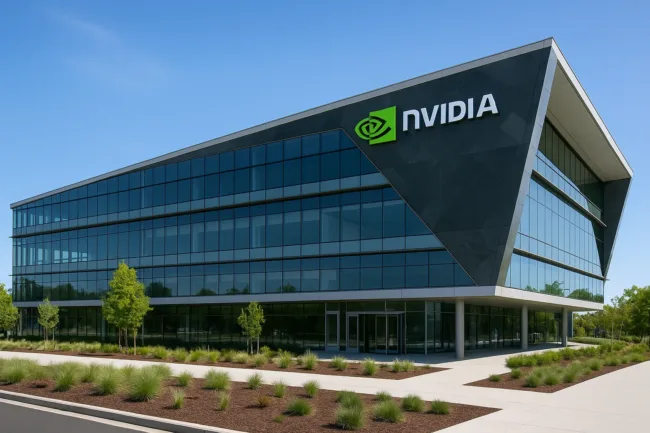
Nvidia Corporation has formalized an expansive collaboration with the United States Department of Energy to build seven artificial intelligence supercomputers, reinforcing its role as a critical enabler of sovereign-scale computing infrastructure. The announcement, delivered by Chief Executive Officer Jensen Huang during a high-profile presentation, marks a new strategic era where Nvidia is positioning itself not only as the dominant supplier of AI chips but also as a national infrastructure partner for artificial intelligence-led science, defense, and energy transformation.
According to Huang, Nvidia currently has approximately 500 billion US dollars in forward bookings for its latest-generation Blackwell and Rubin AI chips across the next five quarters. Among the systems planned under the Department of Energy engagement, the largest supercomputer will be constructed in partnership with Oracle Corporation and will reportedly house nearly 100,000 of Nvidia’s flagship Blackwell GPUs.
This move anchors Nvidia Corporation at the center of U.S. AI public infrastructure ambitions. It aligns with the U.S. government’s broader mandate to enhance scientific compute capabilities, energy systems optimization, and secure digital defense. The systems are expected to be deployed across federal laboratories, with use cases spanning nuclear weapons simulation, climate modeling, advanced materials research, and AI-powered energy transition analytics.
Jensen Huang emphasized that these systems will be built entirely in the United States. Nvidia’s chip manufacturing footprint has expanded in Arizona, while system integration and assembly work is expected to be handled across facilities in Texas and California. The commentary underscored a clear commitment to onshoring, aligning with Biden-era industrial policy that rewards U.S.-based chip manufacturing and AI infrastructure development.
What does Nvidia’s public push to re-enter China reveal about its long-term global AI strategy?
While celebrating a significant federal partnership in the United States, Nvidia is simultaneously making strategic overtures to regain access to China’s AI developer market. Huang acknowledged that China, despite export restrictions, still accounts for nearly half of the world’s AI developer community. During the same public presentation, he suggested that cutting off engagement with such a large developer base could be counterproductive for the broader AI ecosystem, noting that such policies could ultimately “hurt us more.”
However, Huang clarified that Nvidia has not formally applied for export licenses for its new-generation AI chips, including Blackwell and Rubin, due to clear signals from Chinese authorities indicating reluctance to allow the company back into the country. Nvidia’s position in China remains constrained by U.S. Department of Commerce export controls, which have barred the shipment of its most advanced chips to Chinese data centers and government-linked entities. These restrictions emerged from concerns about AI’s potential military applications and surveillance deployments.
Despite the regulatory headwinds, Huang’s message was clear. Nvidia wants to return to the Chinese market, and the company views it as a critical pillar of its global AI growth strategy. From a commercial standpoint, the company has likely left billions in revenue on the table by being locked out of China’s hyperscale and enterprise AI buildout since 2022. The statement that “we need to be in China” reflects a deeper geopolitical balancing act: cultivating public trust and investment in U.S. infrastructure while preparing the ground for renewed engagement with the second-largest AI economy globally.
How are investors reacting to Nvidia’s combined U.S. and China positioning?
Markets responded positively to Nvidia’s U.S. government win and forward bookings disclosure. Following the announcement, shares of Nvidia Corporation gained approximately 5 percent, helping push its market capitalization toward the 5 trillion US dollar threshold. The bullish momentum came as investors absorbed the implications of a 500 billion US dollar forward order book, as well as the expanding moat around Nvidia’s AI chip and system design dominance.
For institutional investors, the U.S. Department of Energy contract was seen as an affirmation that Nvidia is becoming more than just a component supplier. The transition toward full-stack sovereign compute partnerships effectively elevates Nvidia into a national-scale AI infrastructure provider, with longer-term revenue visibility and potential pricing leverage on chip supply, systems, and software licenses. It also sends a strong signal that federal and quasi-federal AI infrastructure in the United States is increasingly built around Nvidia’s ecosystem, which includes its CUDA software stack, DGX platforms, and emerging Rubin system-on-chip architecture.
However, investor sentiment around China remains more nuanced. While some viewed Huang’s comments as constructive, others flagged the continued lack of clarity on whether Blackwell or future chips will be allowed into China. The risk of permanent market exclusion persists, as does the threat of accelerated domestic AI chip development by Chinese firms like Huawei and Biren Technology. From a risk-adjusted growth perspective, investors will be watching whether Nvidia can eventually deploy compliant chips into the Chinese market under a new licensing or segmentation framework.
What challenges and execution risks could Nvidia face as it scales government AI infrastructure?
While the headline figures are impressive, Nvidia faces a series of complex execution risks as it embarks on this multi-supercomputer deployment for the United States Department of Energy. Building systems with up to 100,000 GPUs requires tight supply chain coordination, reliable foundry output from partners such as Taiwan Semiconductor Manufacturing Company, and stable onshore manufacturing workflows in the U.S. Southwest.
System integration for such large-scale AI workloads also introduces significant architectural and software dependencies. Power consumption, cooling, memory interconnects, and GPU-CPU balancing must be optimized to achieve usable throughput. If the Rubin architecture or system-level bottlenecks delay deployment or inflate costs, margin realization could be affected.
Beyond hardware, Nvidia must also ensure long-term software adoption. While its CUDA platform dominates today, emerging open-source alternatives and custom stack developments (especially from hyperscalers or defense contractors) could erode some of its proprietary leverage. Moreover, as Nvidia embeds itself more deeply in public-sector AI deployments, scrutiny around software security, model neutrality, and intellectual property risks could intensify.
Finally, geopolitical flashpoints remain ever-present. With Nvidia’s fate partially tethered to the U.S. government’s stance on export controls and strategic semiconductor competition, any regulatory shifts could impact product eligibility, supply lines, and future growth in constrained regions.
What does this dual-track strategy mean for Nvidia’s long-term positioning in the AI race?
Nvidia is now navigating a two-front strategy that blends national loyalty with global ambition. On one side, it is helping the United States secure AI leadership by building massive AI supercomputers that will power next-generation science, energy modeling, and defense applications. On the other, it is signaling a desire to re-engage with the world’s second-largest AI market, China, even as tensions remain high.
This positioning transforms Nvidia from a chipmaker into a geopolitical actor. As AI becomes a strategic resource akin to oil or rare earth minerals, Nvidia’s systems will increasingly define the boundaries of scientific capability, energy optimization, and national defense simulation. At the same time, failure to re-enter China could limit Nvidia’s exposure to one of the few remaining mega-growth frontiers in AI infrastructure.
From a business model standpoint, Nvidia’s forward bookings, government anchor clients, and software stack lock-in provide multi-quarter visibility. But the valuation now demands perfection. Any delay in supercomputer delivery, compression in AI accelerator margins, or long-term exclusion from China will be scrutinized heavily by institutional investors and hedge funds tracking the high-beta AI trade.
What are the key takeaways investors and policymakers should note from Nvidia’s DOE supercomputer deal and china comeback comments?
- Nvidia Corporation will build seven artificial intelligence supercomputers for the United States Department of Energy, anchoring the company in sovereign-scale compute projects.
- Chief Executive Officer Jensen Huang disclosed roughly 500 billion US dollars in forward bookings for the Blackwell and Rubin AI chips across the coming quarters, signalling sustained institutional demand.
- The largest planned system will be built with Oracle Corporation and is expected to include about 100,000 Blackwell GPUs, highlighting very large system scale and integration complexity.
- Nvidia Corporation is publicly seeking to regain meaningful market access to China because the country represents roughly half of the world’s AI developer base, even though export controls and Chinese regulatory signals currently block its newest chips.
- Financial markets reacted positively with Nvidia Corporation shares rising on the news and the company’s market capitalisation moving toward the 5 trillion US dollar level, reflecting investor confidence in multi quarter demand visibility.
- Material risks include execution challenges on massive system builds, supply chain dependencies on foundries such as Taiwan Semiconductor Manufacturing Company, competitive pressure from Advanced Micro Devices and others, and geopolitical or regulatory shifts that could limit market access.
- Strategically, the announcement shifts Nvidia Corporation’s profile from a component supplier to a national infrastructure partner, increasing software and systems importance while raising expectations for flawless delivery and margin preservation.
Discover more from Business-News-Today.com
Subscribe to get the latest posts sent to your email.
