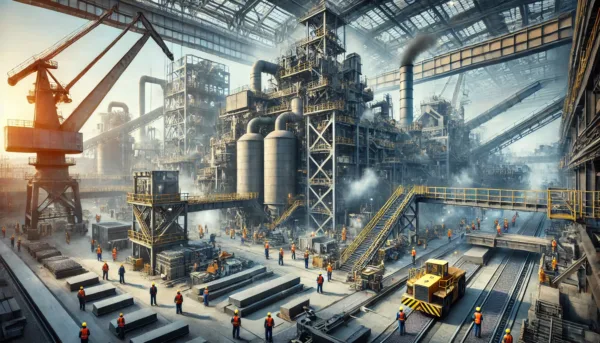
Nucor Corporation (NYSE: NUE), the largest steel producer in the United States and a bellwether for the industry, saw its stock tumble after releasing third-quarter 2025 guidance that fell short of Wall Street’s expectations. The company projected diluted earnings in the range of $2.05 to $2.15 per share for the third quarter, representing a steep decline of around 21 percent compared with the $2.60 per share it delivered in the second quarter. For a company that had recently been praised for strong utilization rates and resilient demand across some of its downstream businesses, the guidance marked a sharp reset of investor sentiment. Shares of Nucor dropped close to 5 percent in the immediate aftermath of the announcement, underscoring the gap between market expectations and management’s forward-looking assessment.
The core reason behind this decline is concentrated in Nucor’s steel mills segment, which accounts for the majority of its earnings power. Margin compression, weaker order volumes, and rising input costs are expected to weigh heavily on results in the upcoming quarter. While the company’s steel products and raw materials businesses are expected to remain broadly stable, they are unlikely to offset the anticipated contraction in the mills division. For institutional investors who had been positioning for a continuation of the second quarter’s momentum, this guidance was received as a disappointment that points to structural pressures in the near term.
What are the primary factors driving Nucor’s weaker earnings outlook?
Nucor’s lowered third-quarter outlook stems from a combination of internal cost dynamics and external market pressures. Within its core steel mills business, the company is projecting reduced margins due to rising scrap and substitute raw material costs, higher energy expenses, and softer realized pricing for sheet and plate products. The mills had been operating at around 85 percent utilization in the second quarter, up from 80 percent in the first, but that momentum has not translated into sufficient pricing power to maintain profitability. When input inflation outpaces the ability to pass costs onto customers, earnings compression becomes inevitable.
The steel products segment, which includes engineered steel structures and fabricated products, is forecast to remain profitable but faces rising average cost per ton. While sales volumes are expected to hold steady, cost inflation will erode margins, leading to muted earnings contributions. In parallel, Nucor’s raw materials segment, which processes scrap and supplies feedstock for its electric arc furnaces, is expected to post weaker results due to a fall in profitability in scrap processing operations. Taken together, these dynamics illustrate how Nucor is squeezed from multiple angles—high costs on one side and pricing pressures on the other.
Beyond company-specific factors, external conditions are amplifying these challenges. Global steel demand has been resilient in infrastructure and select manufacturing sectors, but pricing pressure is mounting from oversupply, import competition, and cautious order activity from distributors. The steel industry has always been cyclical, with earnings highly sensitive to macroeconomic conditions such as inflation, energy markets, and interest rates. The current environment resembles past down cycles, including those in 2008–09 and 2015–16, where steelmakers grappled with cost volatility and weaker demand. In those instances, Nucor’s strong balance sheet and disciplined cost management allowed it to navigate through turbulence, but investors are questioning whether similar resilience will hold in 2025.
How does Nucor’s guidance compare with recent performance and sector peers?
The third-quarter guidance stands in contrast to Nucor’s performance earlier in the year. In the second quarter of 2025, the company reported net sales of $8.46 billion, up about 8 percent year-over-year. Diluted earnings of $2.60 per share reflected relatively stable pricing and higher utilization, and order backlogs were viewed as healthy. That optimism translated into bullish sentiment, with some analysts raising estimates heading into the third quarter. Against that backdrop, the revised earnings outlook has landed with greater force, as it implies a reversal of momentum rather than a continuation.
Relative to peers such as Steel Dynamics, Inc. and Cleveland-Cliffs Inc., Nucor retains structural advantages through scale, integrated downstream operations, and investments in sustainable steelmaking. Its electric arc furnace model and recycling leadership position it favorably on emissions and energy intensity compared with blast furnace producers. However, the near-term challenge of margin compression is not unique to Nucor. Competitors are also dealing with high scrap costs, volatile energy expenses, and softening pricing power. What differentiates Nucor is the scale of its downstream footprint and its history of capital discipline, which typically provide buffers. Yet, when the largest U.S. steelmaker signals earnings weakness, the entire sector tends to face sentiment headwinds.
What is the market reaction telling us about institutional sentiment?
The immediate drop of roughly 5 percent in Nucor’s share price reflects disappointment among institutional investors who had been anticipating stable or even slightly improved earnings. The Zacks Rank currently places the stock at Hold, underscoring the limited near-term upside unless cost dynamics improve or pricing power strengthens. Some analysts have trimmed earnings estimates for both the third quarter and the full year 2025, citing inflation in raw materials and energy costs as key risks.
From a valuation standpoint, Nucor trades at a forward price-to-earnings multiple modestly above many of its peers. That premium has historically been supported by its scale, operational efficiency, and shareholder-friendly capital allocation. However, when forward earnings expectations are reduced, the premium becomes harder to justify. Should margins deteriorate further, institutional flows could tilt toward profit-taking rather than accumulation. Foreign institutional investors, who often view cyclical steelmakers through a global commodity lens, may scale back exposure until pricing visibility improves. Domestic institutional investors, however, could hold positions, banking on Nucor’s long track record of delivering strong returns across cycles.
One important signal is the company’s commitment to shareholder returns despite near-term headwinds. In the third quarter alone, Nucor repurchased approximately 0.7 million shares at an average price of $140.46. Year-to-date, the company has returned close to $1 billion to shareholders through dividends and buybacks. These actions send a message of confidence in the long-term strength of the business, even as quarterly earnings guidance trends lower. Some value-oriented funds may interpret the stock decline as an entry opportunity, while growth-oriented funds are likely to remain cautious until earnings inflection points are visible.
Why does Nucor’s outlook matter for the broader steel industry?
As the largest steel producer in North America, Nucor’s guidance is not just about one company but about broader steel sector dynamics. The industry remains acutely sensitive to global scrap markets, freight costs, and policy actions such as tariffs and import quotas. Over the past year, rising scrap prices, inflation in electricity and natural gas, and logistical bottlenecks have created a difficult operating environment. Nucor’s reliance on electric arc furnaces, which makes it one of the largest recyclers on the continent, provides an efficiency advantage but does not fully shield it from raw material inflation.
Downstream demand adds another layer of complexity. Infrastructure spending tied to government programs has been a relative bright spot, but residential construction has softened due to higher interest rates, and certain manufacturing sectors have shown signs of slowing. This mix places pressure on steel producers to adjust volumes, manage costs, and balance customer relationships. For Nucor, the near-term earnings reset is a signal that industry dynamics are challenging even for the strongest player.
Environmental and regulatory trends are also shaping the sector’s trajectory. Nucor has invested heavily in decarbonization and green steel initiatives, which position it for long-term competitiveness as global customers demand lower-emission materials. However, those investments add to capital expenditure needs at a time when earnings visibility is clouded. For investors, the trade-off between near-term margin pressure and long-term sustainability positioning is becoming central to valuation discussions.
What should investors and analysts watch in the quarters ahead?
The key question now is whether Nucor can stabilize margins through cost discipline and pricing action. Monitoring scrap steel and energy prices will be critical, as these inputs have outsized impact on profitability. Analysts will also closely watch utilization rates at the steel mills. Under-utilization can quickly erode margins, while maintaining high operating rates helps spread fixed costs. In addition, the ability of the steel products segment to offset part of the weakness in mills earnings will determine the extent of overall earnings erosion.
The company is scheduled to release third-quarter results on October 27, 2025. Investors will be looking not only at whether actual results meet the guided range but also at commentary on order backlogs, pricing trends, and capital expenditure plans. Trade policy developments could also be decisive. Tariffs, import restrictions, and anti-dumping measures often play a pivotal role in supporting domestic steel pricing. Meanwhile, government infrastructure spending programs provide a medium-term demand floor.
For the longer term, Nucor’s emphasis on recycling and green steel may support premium pricing opportunities. Analysts also anticipate potential sector consolidation, where smaller or less efficient producers could become targets in a margin-compressed environment. Nucor’s history of opportunistic acquisitions suggests that it could emerge as a consolidator if valuations in the sector fall further. Such moves could create additional upside potential for patient investors.
Nucor’s third-quarter 2025 guidance represents a meaningful pivot for the steel sector. Instead of extending second-quarter momentum, the company has warned of lower earnings due to margin compression, rising costs, and softer volumes. The immediate stock reaction highlights investor disappointment, but the long-term picture remains more nuanced. Nucor’s scale, balance sheet strength, and shareholder return policies provide stability in a volatile sector, while its investments in sustainable steel position it well for future demand shifts. Whether the current earnings dip proves a temporary trough or a prolonged downtrend will depend on cost trends, pricing discipline, and macroeconomic conditions. For investors, the stock may present both risks and opportunities, depending on appetite for cyclical volatility and confidence in Nucor’s ability to navigate yet another cycle in the steel industry.
Discover more from Business-News-Today.com
Subscribe to get the latest posts sent to your email.