

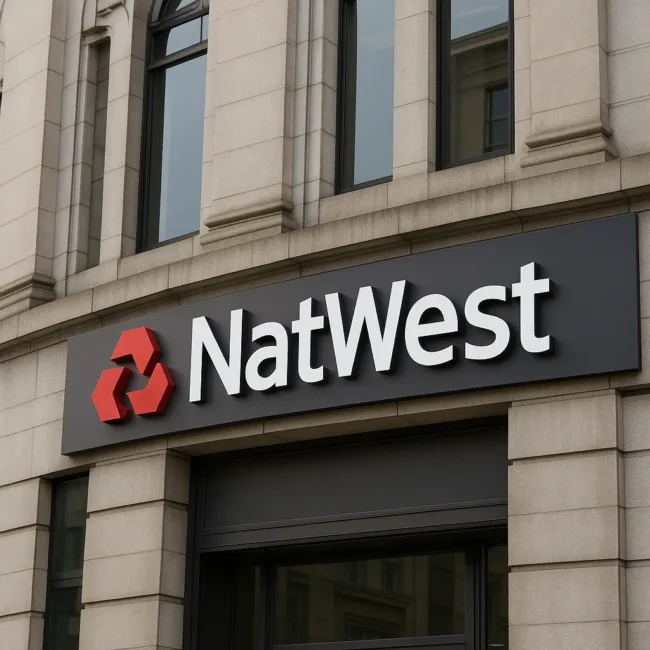
Shares of NatWest Group plc (LSE: NWG) rose nearly 5% on 25 October 2025 following the release of the British banking group’s third-quarter results for fiscal year 2025. Investors appeared encouraged by the continued improvement in earnings quality, lending volumes, and capital return metrics, with the group delivering a 22.3% return on tangible equity for the quarter. The stock closed at 572.40p, recovering ground lost in prior months amid uncertainty over UK interest rate direction and deposit repricing pressures.
The strong quarterly update also saw attributable profit reach £1.6 billion for the three months ended 30 September 2025. This took year-to-date earnings to £4.1 billion, marking a 24.9% increase compared with the same nine-month period in 2024. With its common equity tier 1 ratio rising to 14.2% and risk-weighted assets shrinking to £189.1 billion, NatWest Group plc is signaling that its simplification efforts and balance sheet optimization strategies are beginning to yield meaningful operating leverage.
How did NatWest Group plc outperform expectations in its Q3 2025 results across income, profitability, and margins?
In terms of topline performance, NatWest Group plc reported total income of £4.33 billion for the third quarter, an 8.2% increase over Q2 2025 and a 15.7% rise compared to Q3 2024. Excluding notable items, core income reached £4.17 billion, up 3.9% quarter-on-quarter. This growth was largely driven by net interest income of £3.27 billion, reflecting a 9 basis point expansion in group net interest margin to 2.37%. That expansion was helped by favourable deposit margin dynamics and an additional calendar day in the quarter, allowing the group to outperform market forecasts on spread income resilience.
Non-interest income also contributed meaningfully, climbing to £1.06 billion in Q3 2025 from £911 million in Q2. This included gains from foreign exchange risk management derivatives and profits from NatWest’s Business Growth Fund participation, partially offset by foreign exchange recycling losses. Importantly, all three core business lines—Retail Banking, Private Banking and Wealth Management, and Commercial and Institutional—contributed positively to the group’s income base.
On the cost side, total operating expenses fell by 2.1% to £1.99 billion from £2.04 billion in the prior quarter. This reduction included the tapering off of one-time integration costs linked to the acquisition of certain Sainsbury’s Bank assets. The cost-to-income ratio, excluding litigation and conduct charges, improved to 45.8% in the quarter versus 49.1% in Q2 2025, indicating stronger efficiency ratios now embedded across the bank’s digital and operational infrastructure.
Which NatWest Group segments saw the most robust growth in lending, deposits, and profit contribution in Q3 2025?
Retail Banking remained the strongest profit contributor, delivering an operating profit of £850 million in Q3, up from £735 million in Q2 2025. The segment saw net loans to customers rise by £1.7 billion, primarily through increased mortgage lending. Its return on equity jumped to 26.4%, reflecting favourable funding mix dynamics and deposit margin expansion. Customer deposits in this segment declined slightly to £195.8 billion due to lower savings balances, although current account balances helped offset some of the outflow.
Private Banking and Wealth Management generated an operating profit of £108 million and delivered a return on equity of 23.4%. Assets under management and administration rose by 8.1% during the quarter to £56.0 billion, supported by strong net inflows, positive market movement, and deeper digital engagement. The group noted improved customer satisfaction in mobile platforms, with net promoter scores reaching 54, indicating progress on NatWest’s simplification and service digitization agenda.
The Commercial and Institutional division also performed solidly, reporting £1.04 billion in operating profit, an increase from £964 million in the previous quarter. Lending in this unit rose by £2.5 billion, led by corporate and commercial mid-market demand, while deposits increased marginally to £198.3 billion. Net interest income reached £1.55 billion, up from £1.50 billion in Q2. Notably, this segment accounted for £6.3 billion of climate and transition finance during the quarter, aligning with NatWest’s broader ESG lending commitments.
What institutional sentiment and valuation signals are emerging around NatWest Group plc after Q3?
Sentiment around NatWest Group plc’s valuation has improved in recent weeks, particularly following confirmation that RoTE for FY2025 is now expected to exceed 18%, up from earlier guidance. The group’s tangible net asset value per share increased by 11 pence to 362 pence, underpinned by profit accretion and continued capital generation. Analysts point to the group’s 51p in earnings per share for the nine months ended September 2025—a 32.4% YoY increase—as a strong basis for improved dividend visibility and potential future buybacks.
The bank’s CET1 ratio of 14.2% is now at the upper end of its target range, supported by 101 basis points of capital generation in Q3 alone, including £2.2 billion of risk-weighted asset optimization. While deposits remained largely flat overall, the loan-to-deposit ratio improved by 2 percentage points to 88%, indicating balanced growth with limited funding strain.
Despite external headwinds from a potentially softer UK rate environment in H1 2026, institutional appetite appears to be improving for FTSE 100 banks with strong capital buffers and diversified income engines. NatWest Group plc’s differentiated strength in housing finance, commercial credit, and AUMA-driven fee income positions it well to maintain earnings momentum through year-end.
How are market participants evaluating potential risk factors in NatWest’s FY26 earnings outlook?
NatWest Group plc is expected to introduce formal guidance for FY2026 and new strategic targets for FY2028 during its full-year earnings release on 13 February 2026. For now, management reaffirmed its expectations of reaching £16.3 billion in income (excluding notable items) and operating costs of £8.1 billion for the full year 2025. Loan impairment charges are expected to remain below 20 basis points, while risk-weighted assets should land in the £190 billion to £195 billion range.
Among potential watchpoints, deposit outflows in Retail and Private Banking will be monitored closely. The bank has attributed these to seasonality and reallocation to AUM products, but a prolonged trend could affect funding mix and pricing. Additionally, cost discipline in Q4 remains important, particularly as the group invests further in simplification and software engineering capacity to support future scalability.
Management has reiterated its capital return strategy of paying out approximately 50% of attributable profit via ordinary dividends. Share buybacks will continue to be considered based on earnings strength and macroeconomic developments. Given the bank’s low payout volatility and improved RoTE performance, investor consensus currently leans towards a hold-to-buy stance, especially for income-focused portfolios.
What investors should know about NatWest’s performance heading into the final quarter of FY2025
The third quarter of 2025 confirmed that NatWest Group plc has successfully transitioned into a phase of balanced growth and efficient capital deployment. With earnings per share growth outpacing the broader FTSE 100 banking sector average and its RoTE exceeding 22% for the quarter, the group has entered the year-end period with solid investor momentum. Its ability to expand margins while maintaining liquidity coverage above regulatory thresholds adds to the positive outlook.
Nonetheless, the evolving interest rate environment, ongoing regulatory scrutiny, and customer behavior around deposits and savings products will remain critical for sustaining valuation re-rating. Markets will be closely watching whether NatWest Group plc can sustain deposit growth in 2026 and deepen its retail ecosystem integration following its strategic partnership with Landbay in the buy-to-let segment. If these levers hold, the group’s FY2026 could open with a more confident capital return story and further upside for long-term shareholders.
What are the key takeaways from NatWest Group plc’s Q3 2025 results and investor reaction?
- NatWest Group plc reported a 22.3% return on tangible equity for Q3 2025, significantly ahead of its full-year target of over 18%.
- Attributable profit for the quarter rose to £1.6 billion, bringing year-to-date earnings to £4.1 billion, up 24.9% from the same period in 2024.
- Group net interest margin expanded by 9 basis points to 2.37%, while total income excluding notable items grew 3.9% quarter-on-quarter.
- Retail Banking led segment performance with £850 million in operating profit and mortgage lending growth of £1.7 billion.
- Commercial and Institutional delivered £1.04 billion in profit, supporting £6.3 billion in ESG-aligned climate and transition lending.
- Private Banking and Wealth Management reported £108 million in operating profit and an 8.1% rise in AUMA to £56.0 billion.
- The CET1 ratio improved to 14.2%, helped by £2.2 billion in RWA management actions and £1.6 billion in quarterly profit.
- Deposits remained stable overall at £434.7 billion, though Retail and Private Banking saw minor seasonal outflows.
- Earnings per share climbed 32.4% year-on-year to 51p, with TNAV per share up 11p to 362p.
- Management reaffirmed full-year 2025 guidance and will introduce FY2026 and 2028 targets during the February 2026 results.
- The stock rallied nearly 5% post-results as institutional sentiment turned more constructive around valuation, capital return potential, and earnings resilience heading into Q4.
Discover more from Business-News-Today.com
Subscribe to get the latest posts sent to your email.