

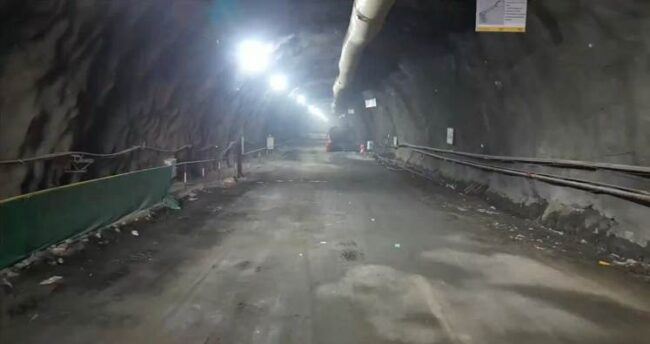
India’s Mumbai–Ahmedabad High Speed Rail (MAHSR) project achieved a major construction milestone with the breakthrough of the first mountain tunnel in Palghar, Maharashtra. Union Minister for Railways, Information & Broadcasting, and Electronics & Information Technology Ashwini Vaishnaw confirmed the successful completion of excavation works on the 1.5-kilometre tunnel (MT-5), located between Virar and Boisar stations. The development marks the first tunnel breakthrough of its kind in Maharashtra and advances India’s broader vision of delivering high-speed intercity connectivity through Japanese Shinkansen technology.
How does the MT-5 tunnel breakthrough fit into the broader bullet train infrastructure buildout?
The MT-5 tunnel is one of eight mountain tunnels planned along the 508-kilometre MAHSR corridor, which spans Gujarat, Maharashtra, and the Union Territory of Dadra and Nagar Haveli. Seven of these tunnels are located in Maharashtra, with a combined length of approximately 6.05 kilometres. The remaining 350-metre tunnel falls in Gujarat. The MT-5 breakthrough is notable not just for its engineering significance, but for the fact that it was completed in just 18 months using the drill and blast method—a conventional tunneling technique involving controlled explosions and real-time geotechnical monitoring.

The excavation began simultaneously from both ends, incorporating safety systems such as shotcrete, rock bolts, lattice girders, and modern ventilation and fire safety features. This method is particularly useful in hilly terrains with mixed geological strata and has been widely adopted in Japanese and European high-speed rail projects. Its successful execution in Palghar strengthens confidence in India’s ability to manage complex underground infrastructure projects across varied topographies.
This milestone follows the earlier completion of the first major underground tunnel segment—roughly 5 kilometres long—between Thane and the Bandra Kurla Complex (BKC), completed in September 2025. Together, these breakthroughs are incrementally de-risking a project that has faced early-stage land acquisition delays, cost inflation concerns, and political resistance.
What is the current construction status of other mountain tunnels in Maharashtra?
According to the latest updates provided by the Ministry of Railways, the physical progress of the remaining six mountain tunnels in Maharashtra is advancing in parallel. MT-1, spanning 820 metres, is at 15 percent completion, while MT-2 (228 metres) remains in preparatory stages. MT-3, the longest tunnel at 1,403 metres, has recorded 35.5 percent progress. MT-4 (1,260 metres) is at 31 percent completion, followed by MT-6 (454 metres) at 35 percent and MT-7 (417 metres) at 28 percent. These tunnels are expected to cumulatively support uninterrupted high-speed movement through mountainous terrain in the Palghar region.
Importantly, each tunnel segment uses context-specific engineering designs to address slope stability, seismic risks, and drainage challenges. These efforts are part of a broader risk mitigation strategy to keep construction timelines within projected bounds, especially as the 2028 operational launch target remains ambitious but politically significant.
How will the bullet train transform travel and connectivity in western India?
Once operational, the MAHSR will cut the travel time between Mumbai and Ahmedabad to just under two hours—1 hour and 58 minutes, to be precise—compared to the current 6–8 hour train journey and 1–1.5 hour flight including airport procedures. This will substantially shift modal preferences for business and regional travel, particularly along key commercial hubs such as Surat, Vadodara, and Thane.
The route passes through 12 stations, including Sabarmati, Ahmedabad, Anand, Vadodara, Bharuch, Surat, Bilimora, Vapi, Boisar, Virar, Thane, and Mumbai. The strategic placement of these stations is designed to connect dense urban clusters, industrial belts, and rising IT corridors.
The project is likely to benefit both long-distance commuters and local economies by enabling same-day business returns, encouraging regional tourism, and reducing pressure on airports. Moreover, it is expected to create a multiplier effect across the supply chain—especially in sectors like steel, cement, construction equipment, tunneling services, and electrical systems.
What are the broader economic and employment implications of the MAHSR project?
Beyond passenger convenience, the MAHSR has been positioned as a catalytic infrastructure investment that will create new jobs, support industrial development, and promote urban renewal. The Union Minister noted that the construction phase alone has already generated substantial direct and indirect employment, with further gains expected once operations begin.
The rail corridor is also intended to act as a linear economic zone, spurring the growth of satellite townships, logistics parks, and IT hubs along its path. Given India’s history with such corridor-led development around the Delhi–Mumbai Industrial Corridor and the Eastern Freight Corridor, the MAHSR is being closely watched as a template for future high-speed rail projects, including proposed extensions to Delhi and Hyderabad.
From a climate and ESG perspective, the government estimates that the bullet train system will reduce carbon dioxide emissions by 95 percent compared to road transport over equivalent distances, owing to its full electrification and energy-efficient design. This is particularly relevant as India seeks to balance rapid infrastructure expansion with net-zero transition goals.
What are the risks to completion and political continuity of the project?
While the Palghar tunnel breakthrough demonstrates operational momentum, the MAHSR project continues to face notable risks. Land acquisition remains a flashpoint in parts of Maharashtra, especially in tribal and semi-urban zones. Any delay in completing the remaining tunnels or viaducts could disrupt rolling stock trials and integrated system testing.
Cost escalations remain a latent threat given fluctuating input prices, currency movement (as components are procured under Indo–Japanese agreements), and potential labor shortages. Execution misalignment across state agencies, contractors, and technology suppliers could also hinder smooth integration.
However, with a general election cycle approaching in 2029, and the MAHSR increasingly framed as a symbol of India’s modernization, political will appears aligned to prioritize its completion. Ashwini Vaishnaw’s consistent visibility on the project—including his inspection visits and media briefings—underscores this positioning.
What does this breakthrough signal for India’s long-term high-speed rail strategy?
India’s first high-speed rail project is not just about point-to-point travel—it is a systems test for the country’s ambition to build a nationwide network that connects key growth corridors at speeds exceeding 300 km/h. Japan’s Shinkansen ecosystem has served as the model for safety, signaling, and operational reliability.
The MT-5 tunnel breakthrough indicates that Indian contractors and public-sector project management bodies are building the execution capabilities needed for future expansion. This experience will likely shape subsequent projects like the Delhi–Varanasi and Mumbai–Nagpur corridors, where feasibility studies are already underway.
Moreover, the project is likely to set standards for procurement transparency, ESG compliance, and digital project monitoring across other large-scale infrastructure undertakings. It also opens up industrial policy opportunities for domestic rail manufacturing clusters as part of the “Make in India” strategy.
What are the key takeaways from the Mumbai–Ahmedabad bullet train tunnel milestone?
- The Palghar mountain tunnel breakthrough marks the first such achievement in Maharashtra, de-risking a critical segment of the Mumbai–Ahmedabad High Speed Rail corridor.
- The MT-5 tunnel was completed within 18 months using drill and blast methods, signaling strong engineering execution in a geologically complex zone.
- Seven more mountain tunnels are under construction in Maharashtra, with progress ranging from 15 to 35 percent across segments.
- Once operational, the bullet train will reduce Mumbai–Ahmedabad travel time to 1 hour and 58 minutes, supporting regional connectivity and economic integration.
- The corridor is designed to generate long-term economic value by fostering industrial development, logistics hubs, and new IT townships along its route.
- Carbon emissions are expected to decline by up to 95 percent over equivalent road travel distances, positioning the project as a green infrastructure flagship.
- Execution risks remain around land acquisition, cost escalation, and contractor coordination, but political alignment currently favors timely completion.
- The tunnel milestone strengthens India’s institutional and technical readiness for future high-speed rail expansions under a national rail modernization agenda.
Discover more from Business-News-Today.com
Subscribe to get the latest posts sent to your email.