
Minesto AB (Nasdaq First North: MINEST), the Swedish ocean energy innovator, has built its reputation on a unique subsea kite system known as Deep Green. Unlike traditional tidal turbines that require powerful currents and heavy infrastructure, Minesto’s kites are designed to generate electricity even in slow-moving ocean streams. With the company recently refreshing its financial leadership, institutional attention has sharpened on whether this approach could represent a smarter bet for investors seeking exposure to marine renewables.
What makes Minesto’s Deep Green technology different from conventional tidal turbine systems?
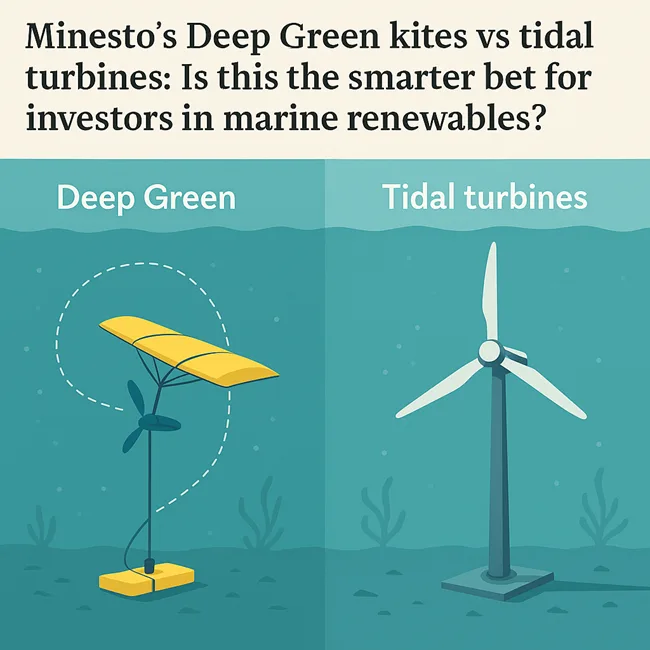
Traditional tidal turbines resemble underwater wind turbines. They are anchored to the seabed or mounted on floating platforms and rely on high-velocity currents to spin blades and produce electricity. This model has seen progress in places such as Scotland’s Pentland Firth and Canada’s Bay of Fundy, but its deployment is restricted by geography. Only a handful of sites globally provide the necessary current speed and flow consistency for commercial viability, and installation costs remain steep due to the size and weight of the infrastructure.
Minesto’s Deep Green system introduces a different engineering principle. Each unit consists of a wing-like kite tethered to the seabed. A turbine is mounted beneath the kite, and the device is steered in a figure-of-eight pattern, increasing the relative flow of water through the turbine several times above the ambient current. This means that sites with flow speeds of just 1.2 to 2.5 meters per second—too weak for conventional turbines—can still be harnessed effectively. In practical terms, Minesto opens up a vastly larger map of potential deployment sites, particularly in Asia, the Caribbean, and parts of Europe where moderate currents are abundant but previously untapped.
This distinction between high-flow dependency and low-flow adaptability has become central to the debate about which technology pathway offers the better long-term return for investors. While turbines are more familiar, Minesto’s system is aimed at scalability across many more locations worldwide.
How do the cost projections of Deep Green compare with the economics of tidal turbines?
One of the most critical questions for investors revolves around cost, and here Minesto’s projections have generated interest. The company believes that once cumulative installed capacity reaches approximately 100 megawatts, its Levelized Cost of Energy (LCOE) could fall to around €100 per megawatt-hour. In optimal sites with consistent ocean currents, the cost could drop further toward €50 per megawatt-hour. These figures, if achieved, would place ocean current energy in the same cost bracket as offshore wind projects from a decade ago, which have since attracted mainstream capital.
Conventional tidal turbine projects still tend to have higher costs. Early installations have carried LCOEs well above €150 to €200 per megawatt-hour, largely due to the heavy materials required, complex installation logistics, and limited site options. While costs will decline as more turbines are deployed, progress has been slower compared with the rapid learning curves of wind and solar. For investors, the question is whether Deep Green’s unconventional design will achieve cost parity faster than turbine farms can scale down their expenses.
Deployment profiles also highlight differences. Minesto has already transitioned from tank testing to ocean pilots, with devices such as the DG500, Dragon 4, and most recently the 1.2 MW Dragon 12 tested and connected to the grid in the Faroe Islands. By contrast, many tidal turbine developers remain in early pilot phases, though some large floating designs have shown promise. The race is less about theoretical efficiency and more about which model demonstrates reliable, low-cost production in real-world arrays.
What are the engineering and operational trade-offs between kite systems and turbine systems?
The engineering complexity of the two approaches differs significantly. Tidal turbines are mechanically straightforward, with fixed blades driven by current. Their risks lie in structural durability, corrosion resistance, and the difficulty of conducting maintenance in strong currents. Their scale makes them costly to transport, install, and repair, but they have the advantage of mechanical simplicity once operational.
Deep Green’s design reduces reliance on high-flow sites, but its motion introduces added complexity. The figure-of-eight trajectory requires advanced control systems to maintain precision. Tethers, steering mechanisms, and hydrodynamic forces all introduce points of potential wear. Maintenance strategies must account for moving parts and dynamic loads, making reliability a crucial question for investors. Analysts often note that scaling from a few units to arrays of 50 or 100 adds exponential complexity, not just in hardware but in synchronization, grid connection, and servicing logistics.
Environmental impact is another consideration. Conventional turbines can disrupt seabed habitats due to their heavy foundations. Minesto’s kites are lighter and occupy smaller footprints, which may help reduce environmental permitting challenges. Still, kite motion creates new variables in marine ecosystems that regulators will assess closely. For investors, technology risk and permitting risk go hand in hand.
Where does each technology find its best use case, and what does this mean for market opportunity?
Tidal turbines excel in high-flow, shallow sites with limited depth variation. They are well suited to a handful of global locations where currents exceed 2.5 meters per second and where heavy foundations can be anchored. These sites, while few, can deliver strong capacity factors and concentrated power output. For investors seeking targeted, location-specific projects, turbines offer a clear, if limited, path.
Deep Green is optimized for moderate currents and deeper waters, enabling deployment across a much broader geography. This translates into a significantly larger addressable market. Countries in Southeast Asia, with archipelagos and steady currents, could become prime candidates. Island nations in the Caribbean and Pacific, facing high fuel import costs, also represent compelling opportunities. In Europe, where energy diversification is a priority, Minesto’s system could complement offshore wind by providing predictable generation during periods of low wind.
The strategic difference is stark. Tidal turbines may deliver high yields in fewer, high-energy locations, while Deep Green aims for wider coverage across lower-energy but more abundant sites. For institutional investors, the former represents a concentrated bet, while the latter suggests a scalable portfolio opportunity.
How are institutional investors viewing the risks and rewards of Minesto’s approach?
Investor sentiment toward marine renewables remains shaped by past disappointments. Several wave energy companies and tidal turbine developers promised commercialization in the 2000s but failed to cross the so-called commercialization cliff, where pilot success did not translate into profitable arrays. As a result, many generalist funds remain cautious.
However, ESG-focused investors and sovereign funds are showing renewed interest, especially as policy frameworks shift. The European Union’s Blue Economy strategy, the United Kingdom’s Contracts for Difference scheme, and Asia-Pacific programs supporting ocean energy pilots all provide capital channels that can de-risk early projects. Analysts suggest that Minesto’s ability to align with these frameworks will determine whether its Deep Green kites transition from niche technology to mainstream asset class.
For now, institutions are watching three key indicators: the reliability data from the Dragon 12 project in the Faroe Islands, the pace of Minesto’s cost reduction curve, and the company’s ability to structure project finance deals that reduce shareholder dilution. The recent appointment of a new CFO, Alexander Jancke, has been interpreted as a step toward sharpening the financial narrative to meet these institutional expectations.
What future pathways could define the success of Deep Green in the global marine energy sector?
The next decade will be decisive. If Minesto can demonstrate commercial arrays with LCOEs near its €50 to €100 per megawatt-hour target, the technology could join offshore wind and floating solar as part of the mainstream renewable mix. Analysts note that the predictability of tidal currents is a strategic advantage, offering baseload stability to complement intermittent renewables. For grid operators facing integration challenges, that predictability may become a selling point worth premium pricing.
Risks remain, from scaling challenges to supply chain constraints. Subsea manufacturing, tether durability, and long-term maintenance costs will require proof. For investors, the choice between turbines and kites is not binary. Some portfolios may benefit from exposure to both approaches, with turbines delivering concentrated yield in select sites and kites offering diversified growth potential across more regions.
For Minesto, the question is whether it can convince investors that its design is not only technically sound but also financially scalable. The CFO shift signals intent, but execution across engineering, finance, and policy alignment will ultimately decide if Deep Green becomes a mainstream investment play or remains a niche curiosity.
Discover more from Business-News-Today.com
Subscribe to get the latest posts sent to your email.