


Minesto AB (Nasdaq First North: MINEST), the Swedish marine energy developer, has appointed Alexander Jancke as its new Chief Financial Officer, effective October 2025. The transition, which comes as outgoing CFO Gustav Kvibling steps down, has sparked fresh attention on whether the finance function can help Minesto transform its Deep Green subsea kite technology from a grant-supported innovation into a bankable asset class within the renewable energy sector.
The move underscores a broader shift for Minesto: from engineering-led research and demonstration projects to capital-intensive global deployment. Investors and analysts suggest that the company’s next phase will hinge less on technical feasibility—already proven in pilot sites like the Faroe Islands—and more on financial structuring that can unlock commercial-scale adoption.
Why does the CFO transition matter for Minesto’s move from grants to investor-backed project finance?
In its early years, Minesto leaned heavily on European Union innovation funds and national research grants to develop its Deep Green system. These resources enabled the company to move from concept to in-sea pilots, but they also locked Minesto into a funding model tied to research cycles and milestone-based disbursements. For a company now eyeing commercial rollouts, that model is unsustainable.
Jancke brings a blend of compliance and growth finance expertise. After nearly a decade at KPMG as a certified auditor and financial adviser, he went on to serve as CFO of Griffeye Technologies AB, a Swedish data and intelligence company that successfully scaled its business internationally. Minesto’s board highlighted this dual experience—financial rigor on one side and commercialization strategy on the other—as critical for steering the company into investor-grade financing models.
Outgoing CFO Kvibling leaves behind a strong foundation, having introduced project-level financial controls and reporting structures suited to grant-heavy funding. Yet analysts note that future success depends on reorienting the finance function toward project bonds, export credit facilities, and blended finance structures that can appeal to institutional investors.
How does Minesto’s Deep Green technology position the company within the broader ocean energy sector?
Ocean energy remains one of the smallest contributors to the global renewable energy mix, dwarfed by offshore wind and solar. But it offers one advantage that few others can: predictability. Unlike wind and sun, tidal and ocean currents follow highly reliable patterns, making them attractive for baseload power supply.
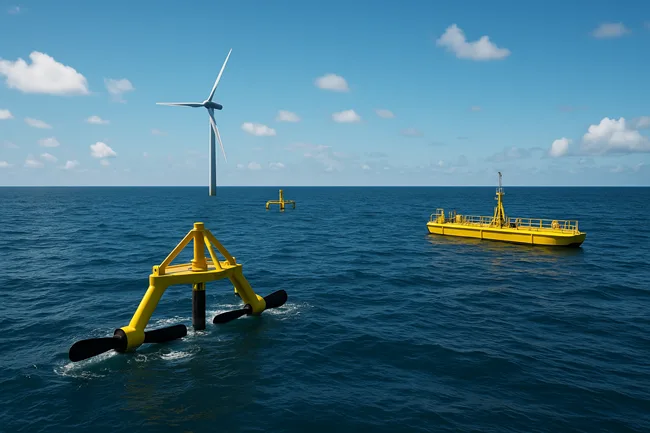
Minesto’s Deep Green system differentiates itself further by targeting low-flow tidal and ocean currents—sites often overlooked by conventional tidal turbines that require high-flow conditions. Each kite-like device uses hydrodynamic lift to “fly” in a controlled trajectory, harnessing energy even in relatively slow-moving waters. This opens up geographies from Southeast Asia to the Caribbean, creating a global opportunity set if the technology can be deployed at scale.
Industry observers believe that technology differentiation has never been Minesto’s weakness. Instead, the bottleneck lies in proving that these systems can be financed, deployed, and operated in a way that delivers steady, long-term returns to investors.
What are institutional investors signaling about Minesto’s shift from grant reliance to project-level funding?
Sentiment from institutional investors has been cautiously optimistic. ESG-focused funds and clean-tech specialists see Minesto as a niche pioneer with first-mover advantage. However, generalist investors often remain wary, recalling the high-profile failures of wave and tidal developers like Pelamis Wave Power and Verdant Power, where technical promise could not overcome financing and commercialization barriers.
Analysts suggest that Minesto’s CFO transition will be scrutinized less for continuity in reporting and more for Jancke’s ability to create financing pathways acceptable to banks, utilities, and development finance institutions. In particular, sovereign wealth funds, export credit agencies, and green bond markets are emerging as key pools of capital for marine projects. Investors expect Minesto to position itself to tap these channels under Jancke’s leadership.
The timing also matters. With Europe’s Green Deal accelerating and Asia-Pacific nations exploring blue economy strategies, institutional appetite for ocean energy pilots is rising. If Minesto can bridge from grant-backed demonstrations to investor-backed deployments, it may find itself riding a wave of policy and investor alignment.
What financing challenges and opportunities define Minesto’s path to becoming bankable?
The central challenge for Minesto lies in balancing capital intensity with revenue visibility. Manufacturing subsea energy systems, securing deployment sites, and integrating with local grids all require significant upfront investment. Unlike software or modular solar, the pathway to cash flow in marine renewables is long and complex.
Analysts highlight three critical hurdles that Minesto will need to address under Alexander Jancke’s leadership. The first is securing non-dilutive capital, as the company’s reliance on grants must evolve into project-linked debt, export credit financing, or blended instruments that minimize shareholder dilution. The second challenge lies in building investor trust in cash flow models. While the predictability of tidal currents is a core selling point, investors will demand robust evidence from pilot deployments, including data on uptime, maintenance costs, and capacity factors, before committing significant capital. Finally, as Minesto expands into Southeast Asia, the UK, and the Nordic region, the firm will face the task of managing cross-border risks, which include navigating diverse regulatory regimes, handling currency fluctuations, and mitigating sovereign risk factors that could affect long-term project viability.
Opportunities, however, are substantial. Analysts see a growing appetite for diversified renewable portfolios, with marine energy offering an attractive hedge against intermittency risks in wind and solar. If Minesto can structure projects with reliable returns, the firm could attract utilities seeking to expand their renewable baseload or sovereign funds looking to showcase ESG investments.
How does Minesto compare to other marine energy developers pursuing commercialization?
Minesto is not alone in trying to move marine renewables into the mainstream. Competitors like Orbital Marine Power in Scotland and CorPower Ocean in Sweden are also scaling up their technologies, with different technical and financial strategies. Orbital’s floating turbine design has attracted attention for its simplicity, while CorPower’s wave energy devices are being tested under EU-backed frameworks.
What sets Minesto apart, according to observers, is its focus on low-flow currents and its emphasis on scalability across geographies. Yet, its challenges are also emblematic of the sector. All marine energy firms face the same hurdle: convincing capital markets that ocean energy can shift from grant-supported pilots to investor-grade portfolios. Minesto’s CFO appointment is being closely watched as a litmus test for whether this transition is finally within reach.
What does the future hold for Minesto’s growth and investor positioning under Jancke’s leadership?
Looking forward, Jancke’s immediate priorities are expected to include refining Minesto’s investor communications, structuring new financing instruments, and ensuring that project development timelines are matched with capital availability. Observers note that this could mean exploring partnerships with utilities or even sovereign ESG funds that can provide both capital and credibility.
Longer term, success will hinge on how quickly Minesto can convert pilot projects into commercial arrays, demonstrating not only technical viability but also bankability. If successful, the firm could pioneer a model for marine energy deployment that other startups may follow. If not, it risks falling into the same commercialization cliff that has swallowed many marine energy innovators before it.
For institutional investors, the question is straightforward: can Minesto, under its new CFO, turn predictable ocean currents into predictable cash flows?
Discover more from Business-News-Today.com
Subscribe to get the latest posts sent to your email.