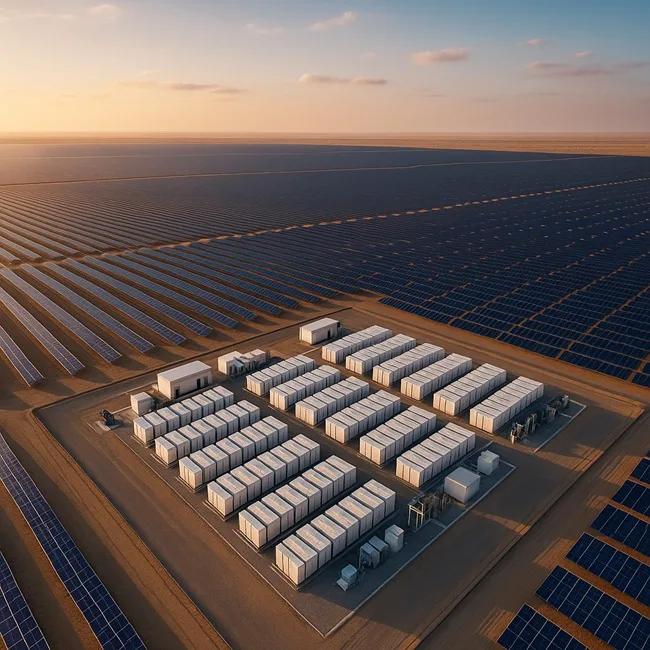
The United Arab Emirates has officially broken ground on what could become the most consequential clean energy project in the region—a massive 5.2 gigawatt solar photovoltaic installation paired with an integrated 19 gigawatt-hour battery energy storage system. Together, these assets are being engineered to deliver one gigawatt of renewable electricity continuously, 24 hours a day. This isn’t just another solar farm—it is being positioned as the world’s first “gigascale round-the-clock renewable energy project,” and the implications stretch far beyond the boundaries of Abu Dhabi.
Spearheaded by Abu Dhabi Future Energy Company PJSC – Masdar and Emirates Water and Electricity Company, the $6 billion investment aims to remove the single largest barrier to widespread adoption of renewable energy: its inability to provide reliable baseload power without support from fossil fuel-based systems. For the first time, a Gulf nation is attempting to prove that solar power, when scaled and paired with industrial-grade battery storage, can function not just as a supplementary source but as the backbone of a national energy grid.
Why does this project matter more than other large solar investments announced globally?
What makes this initiative stand out is its attempt to solve a core weakness in renewable energy: variability. Traditional solar installations generate power only when the sun is shining. Wind turbines are dependent on wind speeds. This project is designed to change that. By combining solar photovoltaic generation at a 5.2 gigawatt scale with batteries capable of storing and discharging 19 gigawatt-hours, the system is being structured to deliver one gigawatt of constant, grid-stabilized power around the clock.
According to executives at Abu Dhabi Future Energy Company PJSC – Masdar, this “solar plus storage” strategy is not merely about smoothing daily demand curves. It is about establishing renewable electricity as a dispatchable asset, capable of meeting baseload needs once reserved for natural gas or coal-fired power plants. This shift in classification—from intermittent to dispatchable—could fundamentally alter how renewables are modeled in utility planning, energy market pricing, and investment strategies worldwide.
How does this tie into the UAE’s digital economy and diversification playbook?
While the project is a major milestone in the country’s sustainability narrative, it is also a critical component of the UAE’s broader economic transformation. With ambitions to become a regional leader in artificial intelligence, data centers, electric mobility, and digital infrastructure, the UAE requires a new type of power system—one that is stable, clean, and scalable. The new renewable facility is intended to serve that demand.
Government sources have indicated that this development is aligned with long-term national plans, including the UAE Net Zero 2050 Strategy. It also supports the vision of building an energy-secure and digitally resilient economy. Unlike in the past, where oil and gas supported both domestic growth and export revenue, the next phase of energy strategy involves renewables directly powering the nation’s future industries—whether that is in AI inference clusters, manufacturing, or cloud services.
In effect, the power plant is not just a climate mitigation tool. It is a foundational infrastructure asset for the future of the UAE’s non-oil economy.
What are the cost, execution, and integration risks associated with this project?
At an estimated cost exceeding USD 6 billion, this is a high-stakes bet. While photovoltaic prices have dropped significantly over the past decade, integrating solar with long-duration storage at this scale is still a capital-intensive undertaking. The procurement of batteries alone—especially amid volatile prices for lithium, nickel, and cobalt—could present cost pressures or sourcing delays.
Additionally, grid integration at this scale is not a plug-and-play operation. The plant will require grid-forming inverters, black-start capabilities, and sophisticated AI-driven dispatch systems to ensure stability. According to project stakeholders, the design incorporates adaptive energy management to optimize discharge cycles and reduce battery wear.
If successful, the plant is expected to create over 10,000 jobs and anchor new industrial supply chains. However, delays in commissioning or challenges in synchronizing with the national grid could weaken the credibility of the 24/7 renewable power narrative. Moreover, global logistics bottlenecks or trade conflicts could impair timely equipment delivery, particularly for advanced battery systems.
How does this project position the UAE within the regional and global energy landscape?
The United Arab Emirates has long positioned itself as a forward-looking energy player. From leading nuclear deployment in the region to building one of the world’s largest solar farms at Al Dhafra, the country has moved swiftly to diversify beyond hydrocarbons. This latest project represents a further evolution—transitioning from intermittent clean energy experiments to full-scale, dispatchable, baseload renewables.
Regionally, this could prompt a new era of competitive clean energy investment. Saudi Arabia, for example, has announced massive green hydrogen and battery storage targets as part of its Vision 2030 plan. But the UAE’s head start in deploying solar-plus-storage for direct grid consumption puts it in a position to set standards for both performance and bankability.
Globally, this project arrives at a time when many emerging economies are seeking models for clean energy transition that can scale rapidly without compromising reliability. If the UAE proves that gigascale renewable assets can substitute fossil plants in energy planning, the ripple effects could touch everything from international development finance to corporate decarbonization pathways.
Why are investors and infrastructure developers paying close attention to this project?
From a capital markets perspective, the significance lies in the shift from renewable megaprojects as high-risk infrastructure plays to dependable, long-duration assets. The inclusion of a battery storage system at this scale adds a layer of complexity—but also predictability. If the UAE demonstrates that one gigawatt of continuous, carbon-free power is deliverable through renewables, it raises the investability ceiling for green infrastructure globally.
Institutional investors, including sovereign wealth funds and climate infrastructure funds, have expressed interest in replicating similar projects in regions like North Africa, South Asia, and Latin America. The key will be proving that the levelized cost of electricity (LCOE) from these integrated systems can compete with gas peakers and coal-fired baseload plants over a 20–30 year project life.
For global EPC contractors, energy storage companies, and AI-enabled grid management firms, the UAE project opens up a new category of “baseload renewables”—one that could drive demand for complex design-build-operate models, not just commodity hardware.
What lessons could India and other fast-growing economies take from this development?
India, in particular, has experimented with round-the-clock renewable energy tenders, but few have approached the ambition or complexity of the UAE model. With a rapidly growing demand profile, increasing reliance on data centers, and a heavy dependency on fossil peaker plants, India could benefit from observing the technological, financial, and regulatory frameworks being tested in this project.
The broader takeaway for emerging economies is that energy transition is no longer about deploying as much solar or wind as possible—it’s about integrating these resources in ways that match load demand profiles. That means grid stability, long-duration storage, and intelligent dispatch. If the UAE succeeds, it may offer a replicable blueprint not just for MENA but for any region where high growth meets climate urgency.
Key takeaways: What the UAE’s 24/7 renewable megaproject signals for global energy infrastructure
- The United Arab Emirates has launched the world’s first gigascale round-the-clock renewable energy project, combining 5.2 GW of solar power with 19 GWh of battery storage to deliver 1 GW of continuous clean electricity.
- The project is led by Abu Dhabi Future Energy Company PJSC – Masdar and Emirates Water and Electricity Company, with over USD 6 billion in capital investment and a commissioning target of 2027.
- This initiative marks a strategic shift in renewable energy deployment—moving from intermittent generation to fully dispatchable baseload capability using clean sources.
- It directly supports the UAE’s Net Zero 2050 strategy and digital economy ambitions by providing always-on green power for AI clusters, data centers, and industrial use.
- Execution risks include lithium supply chain volatility, battery procurement timelines, and grid synchronization complexities at scale.
- If successful, the project could serve as a global model for how emerging economies can leapfrog fossil fuels using integrated solar and storage systems.
- Institutional investors, ESG funds, and infrastructure developers are closely watching the project’s tariff structure and replicability in markets like India, Saudi Arabia, and Southeast Asia.
Discover more from Business-News-Today.com
Subscribe to get the latest posts sent to your email.