


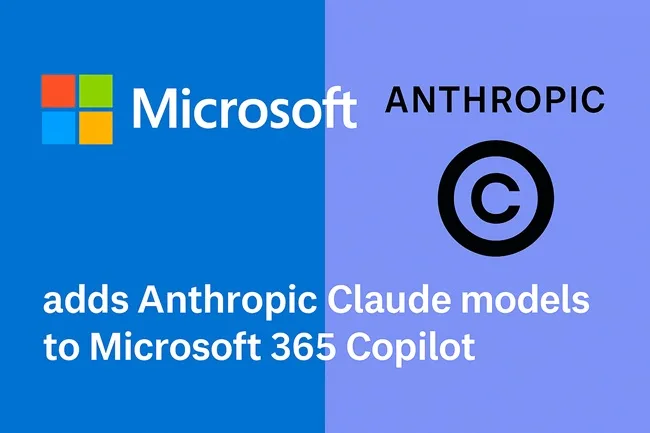
Microsoft Corporation (NASDAQ: MSFT) has expanded the backbone of its flagship Microsoft 365 Copilot platform by integrating Anthropic’s Claude models, introducing a fundamental change to how enterprises interact with artificial intelligence in the workplace. The addition of Claude Sonnet 4 and Claude Opus 4.1 allows users to switch between engines developed by OpenAI and Anthropic, marking the first time Microsoft has embedded a rival model alongside its long-standing OpenAI partnership. The change represents a wider shift in Microsoft’s artificial intelligence strategy as it seeks flexibility, competitive performance, and reduced dependence on a single supplier.
This update is now rolling out to Microsoft 365 Copilot license holders through an opt-in program known as the “Frontier Program.” Users who enable the feature can select Claude for reasoning-heavy tasks in the Researcher tool or for building agents in Copilot Studio. OpenAI’s models remain the default, but the option to switch signals Microsoft’s transition toward a multi-model environment where different engines can be matched to specific workflows.
Why is Microsoft integrating Anthropic models into Copilot and what does this mean for OpenAI dependency
For years, Microsoft positioned itself as the most prominent enterprise partner of OpenAI, backing the company with multi-billion-dollar investments and embedding its models across Bing, Azure, and Microsoft 365. But that strategy created dependency risks. Any change in licensing terms, governance disputes, or performance shortfalls could affect Microsoft’s productivity suite at scale. By integrating Anthropic models, Microsoft reduces lock-in and demonstrates that its productivity products can function across multiple large language model families.
Performance also plays a role. Anthropic’s Claude Opus 4.1 has earned recognition in independent benchmarks for excelling at multi-step reasoning, deep contextual analysis, and agentic workflows. This makes it particularly suitable for enterprise use cases such as financial research, compliance reviews, and strategy synthesis. By contrast, OpenAI’s models remain strong in creative generation, conversational depth, and integration maturity. Offering both allows Microsoft to cater to a broader spectrum of enterprise demands without positioning itself as exclusively reliant on a single partner.
The decision reflects a broader trend in the enterprise AI sector. Google, Amazon, and Meta are all advancing multi-model strategies that enable flexibility. Microsoft’s adoption of Claude highlights its commitment to aligning with this industry movement, even at the cost of technical complexity and competitive tension with Amazon Web Services, which hosts Claude’s infrastructure.
How will Copilot users experience the integration of Claude models
From an end-user perspective, the experience is designed to be seamless. Within the Researcher tool, Microsoft 365 users now see a “Try Claude” toggle, enabling them to route queries through Opus 4.1 instead of the default OpenAI reasoning model. This option is especially valuable for tasks requiring structured reasoning or detailed synthesis, such as evaluating industry reports or drafting investment summaries.
In Copilot Studio, the development environment used to build and deploy AI agents, business users and developers gain access to Claude Sonnet 4 and Opus 4.1 through a simple dropdown menu. This allows different agents to be powered by different engines, or even for subtasks within the same workflow to be assigned to distinct models. An enterprise might, for instance, design an agent that uses OpenAI for creative drafting while leveraging Claude for compliance analysis.
Administrators maintain control at the organizational level. If access to Anthropic is disabled through the Microsoft 365 admin center, agents built with Claude will automatically revert to OpenAI. This ensures continuity while allowing companies to experiment with model diversity in controlled environments. Although the interface remains familiar, users may notice differences in style, tone, or accuracy depending on which engine is active, reinforcing the idea that model selection itself becomes a new layer of user decision-making.
What is the historical context behind Microsoft’s AI diversification
Microsoft’s move is consistent with a decades-long pattern of balancing partnerships and in-house development. In the 1990s, the company extended its operating system dominance through hardware vendor partnerships while simultaneously investing in proprietary technologies. In the 2010s, its Azure cloud strategy combined Microsoft-built services with open-source adoption. In the 2020s, its embrace of OpenAI followed the same playbook—an external partner supplying breakthrough technology, later complemented by Microsoft’s own internal initiatives.
This Anthropic integration represents the next iteration of that strategy. Just as Microsoft balanced Intel with AMD in the PC era and Linux with Windows in the cloud era, it now balances OpenAI with Anthropic in the AI era. Analysts view this as a natural hedge, particularly as regulatory and market scrutiny increases around hyperscaler-startup dependencies in artificial intelligence.
The cross-cloud nature of the deal is especially notable. Claude is hosted on AWS infrastructure, meaning Microsoft is effectively routing workloads through a competitor’s cloud to strengthen its own software products. This underlines how strategic AI performance has become, outweighing traditional rivalries in the pursuit of enterprise adoption.
How are markets and investors reacting to Microsoft’s Anthropic announcement
The immediate stock market response was muted, with Microsoft shares trading slightly lower after the announcement. Investors appear to interpret the move not as a dramatic pivot but as a continuation of Microsoft’s long-term AI diversification strategy. Retail sentiment on trading platforms remained neutral, with discussion levels steady compared to previous product updates.
Institutional sentiment, however, carries a more analytical tone. Some observers suggest that Microsoft is enhancing resilience by avoiding over-dependence on OpenAI. Others point to potential cost inefficiencies, since routing requests through Anthropic’s API on AWS introduces both latency and external billing. The balance of benefits versus risks will depend on how Microsoft integrates and optimizes performance across engines.
For buy, sell, or hold considerations, the announcement alone is unlikely to shift ratings. Microsoft remains a core holding for most institutional investors due to its diversified revenue streams in cloud, software, and enterprise subscriptions. The addition of Anthropic strengthens its competitive positioning in AI but does not immediately alter financial fundamentals. FII and DII flows into Microsoft stock are more influenced by broader technology sector dynamics, such as cloud growth, AI adoption curves, and macroeconomic conditions, than by single product integrations. For investors, the integration underscores Microsoft’s ability to anticipate risk and diversify strategically—a quality typically rewarded over the long term.
What challenges could Microsoft face in making model choice work at scale
The introduction of multi-model capabilities introduces new challenges. Consistency of results becomes a primary concern, as switching between engines could yield different factual interpretations or writing styles. Enterprises accustomed to uniform outputs may find this variability confusing. Microsoft will need to develop robust alignment frameworks and transparent governance to assure users of output quality across models.
There is also the challenge of latency and cost. By accessing Claude through AWS infrastructure, Microsoft may face longer response times compared to natively hosted models on Azure. For enterprises with high-volume AI workloads, such inefficiencies could affect user experience. Microsoft’s eventual ability to migrate Claude workloads onto Azure will be a key milestone to watch.
Finally, security and compliance considerations will intensify. Enterprises are increasingly sensitive to how models process proprietary data. Having two external model families embedded in core productivity tools raises questions about governance, auditability, and data residency. Addressing these will be essential if Microsoft is to win trust at the highest levels of regulated industries such as finance, healthcare, and government.
What is the broader outlook for enterprise AI following Microsoft’s move
The significance of this announcement extends beyond Microsoft itself. It signals to the enterprise market that the era of single-model dominance is ending. Multi-model orchestration—where different engines are selected for different tasks—will likely become the standard across platforms. This could accelerate competitive differentiation, with vendors offering specialized routing, benchmarking, and optimization layers as part of their enterprise AI services.
For Microsoft, the future outlook is one of modularity and expansion. The company is expected to add more third-party models to Copilot, refine task-based routing recommendations, and eventually integrate its own in-house models at parity with OpenAI and Anthropic. Analysts see this as a way for Microsoft to position Copilot not just as an AI assistant but as an orchestrator of multiple reasoning engines—a potentially defensible moat in the AI productivity market.
For investors, the integration reaffirms Microsoft’s long-term thesis: it remains one of the few technology giants capable of combining cloud scale, enterprise distribution, and leading AI capabilities under a single umbrella. Whether the stock reflects short-term volatility or not, the long-term trajectory remains tied to Microsoft’s ability to execute on this modular AI vision.
Microsoft’s move to bring Anthropic’s Claude into Microsoft 365 Copilot is less about a shiny product feature and more about how the enterprise AI market is maturing. Companies no longer want to be tied to a single model, and the ability to choose between engines reflects that shift. It also shows Microsoft playing to its strengths: building platforms that work across different technologies rather than betting on one horse.
By combining OpenAI’s established presence with Anthropic’s growing reputation for reasoning and reliability, Microsoft is trying to give Copilot a broader appeal to enterprise users who prize stability as much as innovation. The approach looks less like a gamble and more like insurance—a way of spreading risk while keeping pace with the rapid evolution of AI. In many ways, it echoes how Microsoft has navigated past transitions in software and cloud: hedge the risks, diversify the options, and keep the ecosystem big enough that customers stay inside it.
Discover more from Business-News-Today.com
Subscribe to get the latest posts sent to your email.