




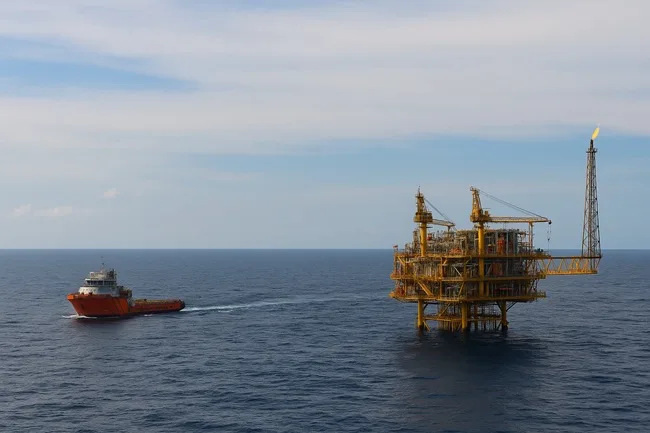
India’s energy story gained a dramatic new chapter with the announcement that state-run Oil India Limited has struck natural gas in the Andaman Sea. The find, reported from the Sri Vijayapuram-2 well located off the east coast of the Andaman Islands, revealed gas samples with 87 percent methane purity. While officials are cautious to describe the occurrence as a “discovery” until commercial viability is fully assessed, the development has already sparked conversations about energy security, import substitution, and India’s long-term role in the Bay of Bengal hydrocarbon map.
The find arrives at a time when India has intensified its deepwater exploration push under the National Deep Water Exploration Mission, known as Samudra Manthan. For policymakers and investors, this could be more than a geological success—it might be the opening act of a strategic energy shift.
How does the Andaman Sea discovery fit into India’s deepwater exploration push?
The Sri Vijayapuram-2 well sits approximately 17 kilometers off the east coast of the Andaman Islands in 295 meters of water, with drilling depths extending to around 2,650 meters. During production testing, the well recorded intermittent flaring of gas from reservoir zones between 2,212 and 2,250 meters. Gas samples transported to Kakinada were analyzed, revealing 87 percent methane composition.
Geologists have long believed that the Andaman basin forms part of a hydrocarbon-rich arc stretching from Myanmar to Indonesia. Yet India’s exploration track record in these frontier blocks has been thin. Most domestic production still comes from mature basins such as the Krishna-Godavari and Mumbai offshore fields. The Andaman results, though preliminary, affirm the geological thesis that the basin holds promise for hydrocarbons.
Government representatives have underscored that further appraisal drilling, reservoir modeling, and flow testing are required before the find can be classified as commercially recoverable reserves. In exploration parlance, it is still an “occurrence” rather than a certified “discovery.” That distinction matters because investors and policymakers will calibrate expectations accordingly.
Why is 87 percent methane purity significant for commercial prospects?
Methane is the principal component of natural gas, and its proportion determines processing economics and usability. An 87 percent methane content indicates a relatively clean gas stream with limited impurities such as carbon dioxide or heavier hydrocarbons like propane and butane. This matters because cleaner gas requires less processing before being fed into pipelines, liquefaction trains, or fertilizer plants.
High methane purity also improves the energy value per cubic meter, making the gas more attractive for power generation and industrial use. In effect, the find reduces concerns about costly gas treatment infrastructure. For India, which faces high LNG import bills, this purity level strengthens the case for domestic development should volumes prove sufficient.
Still, methane purity alone cannot determine viability. Reservoir continuity, permeability, pressure, and overall resource size are equally critical. Deepwater production requires massive upfront capital for subsea infrastructure, floating platforms, and export pipelines. Without large reserves, even high-quality gas can remain stranded.
What are the broader implications for India’s energy security strategy?
India currently imports more than 50 percent of its natural gas requirements through liquefied natural gas cargoes, mainly from Qatar, Russia, and the United States. A successful Andaman development could modestly reduce this reliance and help shield India from price volatility in global gas markets.
Beyond import substitution, the find could become a catalyst for attracting international oil majors back into Indian deepwater. Global players such as BP, Shell, and ExxonMobil have the technical capability to de-risk frontier basins, but their appetite for Indian acreage has waned due to regulatory hurdles and past exploration disappointments. A promising Andaman result may reignite interest and bring capital back into offshore India.
Strategically, the Andaman basin sits in a sensitive geography. The Bay of Bengal is flanked by shipping lanes that carry much of Asia’s oil and LNG trade. A domestic production hub in these waters could give India not only supply security but also geopolitical leverage in regional energy negotiations.
The discovery also supports India’s clean energy transition. Natural gas is positioned as a bridge fuel to lower emissions in power generation, fertilizer production, city gas distribution, and industrial processes. Adding new domestic volumes aligns with the government’s goal of raising the share of gas in the primary energy basket from 6 percent to 15 percent by 2030.
What challenges and risks could undermine the Andaman gas potential?
Deepwater exploration is one of the costliest segments of the oil and gas industry. Each additional appraisal well costs tens of millions of dollars, and subsea infrastructure can push project budgets into billions. The Andaman basin also presents logistical challenges, from difficult weather patterns to limited local supply chains.
Environmental sensitivities around the Andaman and Nicobar Islands could trigger stricter regulatory clearances, slowing project timelines. Additionally, the proximity to strategic defense zones raises security considerations that could influence the scale and speed of development.
On the geological front, frontier basins often disappoint. Reservoirs may be small, fractured, or discontinuous, which undermines commercial recovery even when gas quality is high. Until multiple wells establish continuity, optimism must be tempered with caution.
How are investors and institutions likely to interpret the Andaman discovery?
From a market perspective, the announcement positions Oil India as a potential beneficiary of frontier success. Institutional investors will weigh the discovery against the company’s broader portfolio, which still relies heavily on onshore assets in Assam and Rajasthan. If the Andaman basin proves productive, Oil India could transform its perception from a largely domestic onshore player to a frontier deepwater explorer.
For policy institutions, the announcement validates the government’s push for Samudra Manthan. It also bolsters India’s narrative of reducing import dependence and enhancing energy self-reliance. Development finance institutions and sovereign wealth funds interested in the energy transition may see a viable case to co-fund infrastructure if environmental concerns are managed.
That said, investor sentiment will remain cautious until resource estimates are certified and development economics presented. Memories of previous deepwater disappointments in Indian basins will keep institutions from rushing in without data.
What does the Andaman Sea methane find reveal about India’s deepwater ambitions and future energy security roadmap?
The 87 percent methane occurrence in the Andaman Sea may be one of the most significant signals from India’s exploration portfolio in years. While still at the early stage, it carries potential to alter the country’s energy equation by reducing import reliance, attracting international partners, and opening a new exploration frontier.
For now, optimism must be balanced with the realities of deepwater costs, geological risk, and regulatory complexity. Yet if India leverages global expertise, accelerates approvals, and integrates this find into its broader transition strategy, the Andaman basin could emerge as a pivotal energy province.
The discovery is not just about hydrocarbons; it is about reshaping the contours of India’s energy security, diplomacy, and industrial competitiveness. Whether it evolves into a commercial jackpot will depend on the next round of wells and the political will to fast-track offshore development.
Discover more from Business-News-Today.com
Subscribe to get the latest posts sent to your email.

