


Why did Masdar acquire 50% of the Big Beau solar and storage project in California from EDF Renewables?
United Arab Emirates-based renewable energy investor Masdar announced that it has acquired a 50% stake in the Big Beau solar and battery storage project located in California’s Kern County. The acquisition comes through a joint venture arrangement with EDF Renewables North America, which originally developed the site and continues to co-own it. While the financial terms of the transaction were not disclosed, the deal significantly enhances Masdar’s presence in the U.S. renewables market.
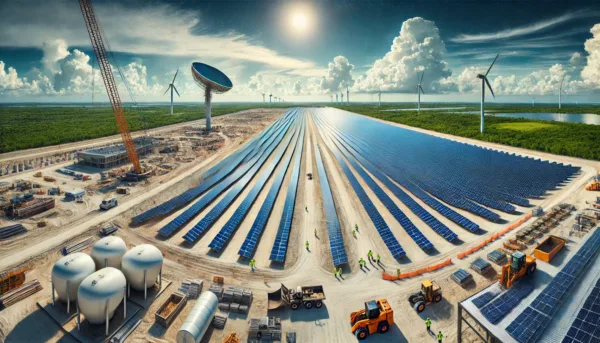
The Big Beau project features a 128-megawatt alternating current (MWac) photovoltaic solar facility coupled with a 40MW/160MWh battery energy storage system (BESS), designed to provide flexible, grid-supportive clean energy in a high-demand region of California. It is one of eight joint clean energy ventures between Masdar and EDF Renewables North America, collectively targeting over 1.6 gigawatts (GW) of solar, wind, and energy storage capacity across the United States.
This strategic partnership reinforces the momentum behind the UAE–U.S. Partnership for Accelerating Clean Energy (PACE), a bilateral framework unveiled in January 2023, which commits $20 billion in investments toward 15GW of new clean energy capacity in the United States by 2035.
What makes the Big Beau solar-plus-storage project strategically important for both partners?
The Big Beau project represents a new class of hybrid renewable infrastructure combining solar generation with large-scale battery storage, offering both baseload and dispatchable capacity for the California Independent System Operator (CAISO) grid. Located in Kern County—a major clean energy hub in the state—the project directly supports California’s mandate to reach 100% zero-carbon electricity by 2045 under Senate Bill 100.
Masdar’s entry as a 50% co-owner aligns with its broader expansion strategy in North America, while EDF Renewables North America benefits from the added capital injection and international visibility brought by the deal. For both entities, Big Beau is more than a single project—it is emblematic of the scale and structure of future clean energy developments that combine generation, storage, and smart grid technologies.
Dr. Sultan Al Jaber, UAE Minister of Industry and Advanced Technology and Chairman of Masdar, stated that joint ventures like Big Beau actively contribute to U.S. clean energy targets and symbolize the strengthening UAE–U.S. bilateral relationship under the PACE initiative. He emphasized the importance of international cooperation in the run-up to COP28, which will be hosted in the UAE later in 2023.
According to Al Jaber, “If we are to keep the objective of limiting global warming to 1.5 degrees alive, we need to see countries coming together in concerted action.” He also noted that partnerships between large-scale developers like Masdar and EDF Renewables are “vital in ensuring we hold back emissions, not progress.”
How does this deal fit into Masdar’s global energy and climate strategy through 2030?
Masdar, officially known as Abu Dhabi Future Energy Company, has rapidly evolved into one of the most active state-backed investors in global clean energy. The Big Beau stake acquisition is part of Masdar’s long-term goal of achieving 100GW of total renewable energy capacity by 2030, along with an annual production target of 1 million tonnes of green hydrogen.
The Emirati energy developer already operates across more than 40 countries and has stakes in major projects ranging from offshore wind in the UK to floating solar in Southeast Asia. With a track record of more than 15GW of clean energy capacity installed or under development, Masdar is also a key pillar of the UAE’s Net Zero by 2050 strategy.
The United Arab Emirates has committed to decarbonizing its domestic and international energy investments, balancing its hydrocarbon wealth with renewable energy leadership. By securing assets like Big Beau, Masdar is positioning itself as a long-term player in advanced markets that prioritize regulatory stability and infrastructure readiness.
Big Beau, along with the other joint ventures with EDF Renewables North America, is projected to eliminate more than 3 million tonnes of carbon dioxide emissions annually—an amount equivalent to taking approximately 650,000 cars off the road every year.
What is the scale and scope of EDF Renewables North America’s clean energy portfolio?
EDF Renewables North America, a subsidiary of France-based utility giant Électricité de France (EDF), has been active in the U.S. renewable energy market for more than three decades. The North American division has developed over 16GW of solar, wind, and storage projects to date and continues to manage 13GW under long-term operations and maintenance (O&M) contracts.
With expertise spanning utility-scale solar to electric vehicle infrastructure, EDF Renewables offers turnkey energy solutions across multiple sectors. In California, it has been a major developer and stakeholder in grid-scale storage, solar PV, and hybrid projects—critical assets as the state transitions away from fossil fuel peaker plants and builds a more resilient electricity grid.
The French energy major’s ongoing joint venture with Masdar reflects a strategy to leverage both domestic project development expertise and foreign investment inflows. Through this partnership, EDF Renewables maintains operational control and development continuity, while benefiting from Masdar’s long-term capital and global decarbonization mandates.
Big Beau is one of several hybrid infrastructure assets where this co-ownership model is being applied, creating a replicable template for cross-border clean energy collaborations in other U.S. regions and potentially abroad.
How does this acquisition align with recent U.S.–UAE clean energy commitments?
The UAE–U.S. Partnership for Accelerating Clean Energy (PACE), announced in January 2023, marked a major milestone in bilateral energy diplomacy. Under PACE, both nations pledged to catalyze $100 billion in investment and deliver 100GW of clean energy globally by 2035. Of this, $20 billion is earmarked for U.S.-based clean energy projects with a combined capacity of 15GW, to be developed before 2035.
Masdar’s acquisition of Big Beau’s 50% stake is one of the early manifestations of this transnational energy alliance. By expanding its role in American clean energy infrastructure, Masdar helps translate the high-level diplomatic agreement into tangible projects on the ground.
Furthermore, the timing is politically significant. The acquisition comes months ahead of the 28th Conference of the Parties (COP28), where the UAE is expected to play a leadership role in shaping the global decarbonization agenda. Clean energy deals like Big Beau demonstrate the country’s credibility and seriousness about meeting climate targets—not only at home but also on the international stage.
What could the Big Beau deal signal for future cross-border clean energy investments?
The deal highlights a growing trend in international renewable energy finance—co-investment models that combine local development expertise with sovereign-backed capital from energy-rich nations. For asset-rich utilities like EDF Renewables, this approach spreads financial risk and accelerates project timelines. For state-affiliated investors like Masdar, it opens pathways into regulated, technologically advanced, and politically aligned markets.
With the PACE framework in motion and Masdar’s 2030 targets in clear view, additional solar-plus-storage acquisitions, green hydrogen demonstrations, and wind project stakes across the U.S. can be expected in the coming quarters. Energy market analysts tracking transnational renewable flows view these types of partnerships as essential for scaling global clean power infrastructure quickly and at scale.
Given California’s aggressive renewable energy mandates and grid decarbonization timeline, the Big Beau project is likely just the start of a broader push for Emirati-backed renewables in North America.
What is the outlook for Masdar’s U.S. ambitions after the Big Beau acquisition?
Masdar’s foothold in California through the Big Beau project cements its credentials as a serious player in the U.S. clean energy ecosystem. Analysts expect that the Emirati developer will continue targeting high-value solar and battery assets in states with ambitious climate targets, including Texas, Arizona, and New York.
Additionally, Masdar is well-positioned to participate in upcoming U.S. green hydrogen initiatives, especially those eligible for incentives under the Inflation Reduction Act (IRA), which offers lucrative production tax credits and grants for clean hydrogen and storage deployment.
The deal also sends a signal to other Gulf Cooperation Council (GCC)-backed clean energy players that strategic co-ownership of U.S. infrastructure assets is not only viable but increasingly welcomed by American developers and regulators alike.
How could Masdar’s Big Beau acquisition influence future UAE–US clean energy deals?
Masdar’s acquisition of a 50% stake in the Big Beau project marks a key milestone in U.S.–UAE energy cooperation, setting the stage for more international capital flows into American clean infrastructure. As bilateral initiatives like PACE begin to translate into real assets, and as COP28 looms on the horizon, projects like Big Beau may prove to be foundational building blocks in a new era of transnational climate collaboration.
Discover more from Business-News-Today.com
Subscribe to get the latest posts sent to your email.