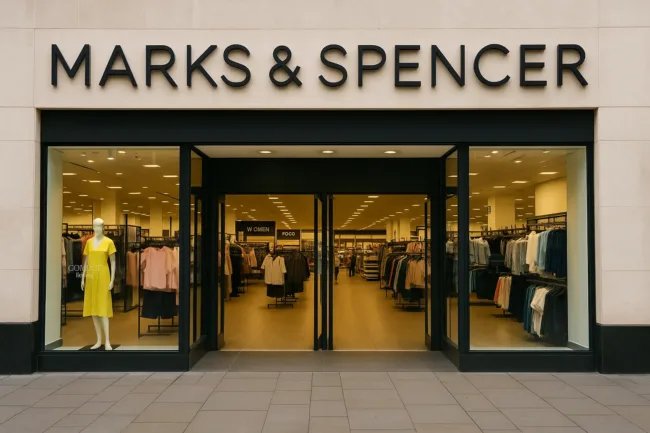
Marks & Spencer Group plc (LSE: MKS) is confronting one of its most challenging cybersecurity crises to date, with mounting concerns from investors, regulators, and customers about the retailer’s slow recovery from a devastating cyberattack that struck during Easter weekend 2025. While M&S has chosen a cautious approach prioritizing digital safety over operational speed, the delay in restoring its core services has triggered reputational fallout, financial losses, and legal exposure that could reshape its long-term standing in the British retail sector.

What happened to M&S during the Easter cyberattack?
The attack, attributed to the Scattered Spider hacking group, exploited credentials from a third-party IT vendor—reportedly linked to Tata Consultancy Services—allowing cybercriminals to infiltrate M&S’s digital infrastructure. The breach crippled online shopping services, disrupted in-store inventory availability, and exposed personal data of approximately 9.4 million customers. While payment credentials and passwords were not accessed, sensitive order histories and contact details were compromised, triggering concern over future phishing and identity fraud.
Initial recovery efforts focused on isolating compromised systems and enforcing account security, including mandatory password resets. However, the company made a strategic decision to completely rebuild core systems instead of negotiating with the attackers or paying a ransom—consistent with U.K. government cybersecurity guidance but significantly more time-intensive.
How has M&S responded and why is the recovery taking so long?
M&S has engaged leading cybersecurity experts and national security advisors to conduct a full-stack reconstruction of its IT infrastructure. New encryption protocols, zero-trust architecture rollouts, and network segmentation policies are reportedly being implemented. However, the depth of the breach and M&S’s legacy backend architecture have slowed full platform reactivation.
The company has publicly stated that its priority is the security of customer data and long-term operational integrity, even if that means prolonged disruption. Yet for many customers and analysts, the lack of immediate access to digital services and limited visibility into recovery timelines has become a source of frustration.
Retail technology experts point out that the hybrid nature of M&S’s transformation—combining legacy systems with cloud-based innovations—may have left it vulnerable to precisely this kind of supply chain and credential-based attack.
What is the financial and reputational impact on Marks & Spencer?
The financial repercussions are severe. M&S is estimated to have lost over £60 million in potential profits due to halted online orders and reduced foot traffic amid system confusion. More significantly, the company’s market capitalisation has dropped by nearly £1 billion since the breach became public, with its stock (LSE: MKS) falling approximately 11% from early April levels.
The reputational cost could be even more damaging. While M&S’s brand has historically benefited from consumer trust and product reliability, that perception has taken a hit. Sentiment on social media and retail investor forums has trended negative, with some customers threatening to abandon loyalty programs over fears of continued vulnerability.
Adding to the complexity, several U.K. law firms have begun exploring class-action lawsuits on behalf of affected customers. Regulators, including the Information Commissioner’s Office (ICO), are assessing whether M&S met its obligations under the U.K. GDPR. Should violations be found, fines could follow.
What does institutional sentiment reveal about investor confidence?
Institutional reaction has been mixed but cautious. The cyberattack has triggered modest but visible institutional outflows, with approximately £150 million withdrawn from M&S equity by active fund managers since late April. While passive index-tracking funds have largely maintained exposure, hedge funds have increased their short positions on MKS, anticipating further near-term downside as recovery lags.
Brokerage sentiment has shifted toward neutrality. Deutsche Bank and Barclays both revised their ratings to “Hold” post-incident, citing uncertainty around digital reactivation timelines and elevated legal risks. Shore Capital flagged execution delays and operational cost overruns as key concerns, though it did not revise its long-term outlook.
Despite the pullback, no major institution has called for a “Sell,” reflecting an underlying belief in M&S’s brand equity and physical retail footprint once operational normalcy resumes.
How has M&S stock performed since the cyberattack?
The MKS share price suffered an immediate 6.8% drop in the first session following the attack and has since trended downward, with heightened volatility driven by investor anxiety over regulatory exposure and earnings guidance risks. As of May 21, 2025, the stock remains depressed at a level nearly 11% below pre-Easter values.
Retail investor platforms such as AJ Bell and Hargreaves Lansdown reflect a “wait-and-watch” approach, with many investors holding positions but refraining from new accumulation. ESG-focused investors are closely monitoring how M&S addresses the incident in terms of governance and data ethics before adjusting their positions.
What are the broader industry and regulatory implications?
The incident has sounded alarm bells across the U.K. retail sector. Competing retailers are reassessing their own cyber risk exposure, particularly in relation to third-party IT providers and data supply chains. The vulnerability exploited in the M&S breach—trusted vendor credentials—has emerged as a key weakness in the broader retail digital ecosystem.
This attack is prompting a reevaluation of board-level cybersecurity oversight, with investors urging companies to elevate the status of CISOs and integrate cyber resilience into enterprise risk frameworks. Retail boards are increasingly being asked to simulate breach scenarios and report on preparedness, not just post-breach response.
From a regulatory standpoint, the breach could catalyze updated cybersecurity disclosure norms for U.K.-listed companies, similar to SEC guidelines introduced in the United States in 2023.
Is M&S’s digital transformation strategy at risk?
M&S has spent the last four years attempting to revamp its business through a multi-channel strategy blending e-commerce, physical retail, and data-driven customer engagement. Before the breach, its digital growth trajectory—particularly in clothing and homeware—was showing upward momentum, with online penetration nearing 30%.
However, the cyberattack threatens to stall this progress. The disruption has arrived at a critical seasonal transition point, with summer and back-to-school periods representing major revenue windows. Any delay in restoring full platform capabilities risks customer migration to competitors and operational bottlenecks in supply chain execution.
If costs from legal liabilities and regulatory fines mount, M&S may be forced to divert capital away from innovation and toward compliance and security remediation.
What’s next for investors and the company?
Looking ahead, M&S’s share price recovery will depend on three factors: (1) the speed of digital service restoration, (2) effective communication with customers and shareholders, and (3) demonstrable improvement in cybersecurity governance.
Analysts agree that the company is not in existential danger, but its valuation could remain compressed until trust is fully restored. The Q2 2025 earnings report, expected in late July, will be a critical inflection point. Investors will look for updated guidance on legal reserves, customer retention rates, and recovery of digital sales momentum.
Strategically, the company may need to overinvest in digital assurance and possibly restructure vendor relationships to reestablish control over critical systems. That could involve in-sourcing elements of IT operations or renegotiating contracts to include more robust breach accountability clauses.
Despite near-term setbacks, the underlying retail footprint of M&S—its food halls, urban locations, and established brand—provides resilience. Whether it can now match that with digital trust and forward-looking cybersecurity posture will determine its position in the post-breach retail landscape.
Discover more from Business-News-Today.com
Subscribe to get the latest posts sent to your email.