




Lyten, a privately held US company specialising in lithium-sulfur batteries and advanced graphene supermaterials, announced on March 20 its intention to establish a Lyten Industrial Hub in Gdansk, Poland, anchored around the Lyten Dwa facility it acquired from Northvolt in the fourth quarter of 2025. The announcement follows Lyten’s February 2026 launch of its first Industrial Hub in Skelleftea, Sweden, where it is combining restarted battery manufacturing with a planned 1 GW AI data center campus being developed by EdgeConneX. The Poland move signals that Lyten is now actively building a network of integrated energy and digital infrastructure sites across Europe, deliberately co-locating manufacturing with data center investment to capture two distinct capital flows simultaneously. A feasibility study to be completed by end of 2026 will determine the full scope of the Gdansk hub, including manufacturing lines, public-private partnership structures, and required energy infrastructure.
What is Lyten’s industrial hub strategy and why does it combine battery manufacturing with AI data centers in Europe?
The industrial hub model that Lyten is rolling out across northern and central Europe is conceptually straightforward, even if the execution is not. Battery energy storage manufacturing is capital-intensive and employs significant numbers of skilled workers, but it generates relatively modest returns on invested capital at the asset level. AI data centers, by contrast, attract enormous volumes of private and institutional capital and deliver high returns, but they create limited direct employment. By co-locating both within a single industrial campus, Lyten is attempting to unlock public support from governments that care about jobs alongside private capital from infrastructure investors that care about data center returns.
This is not merely a capital-raising trick. Data centers require enormous, reliable power at scale. Battery energy storage systems are increasingly the preferred solution for managing grid volatility and ensuring millisecond-response backup power for compute-intensive facilities. Lyten’s own Voltpack Mobile System, produced at the Gdansk site, is an AI-enabled modular power management platform that can orchestrate power flows across solar, wind, generator, battery, and grid sources in real time. Situating a data center campus next to the facility that makes the power management hardware for it creates an integrated infrastructure logic that is harder for a pure-play data center developer to replicate.
The Sweden hub illustrates the scale of capital this model can catalyse. Lyten’s Skelleftea site, built around the former Northvolt Ett gigafactory with its 16 GWh of battery manufacturing capacity, is projected to attract more than $10 billion in follow-on infrastructure investment once it reaches full production. EdgeConneX, a global data center developer owned by investment manager EQT, has already signed an agreement to acquire a data center site at the Skelleftea campus. The Poland announcement is a signal that Lyten intends to replicate this blueprint in Gdansk, though the Polish hub is at an earlier stage and the financial projections have not yet been disclosed.
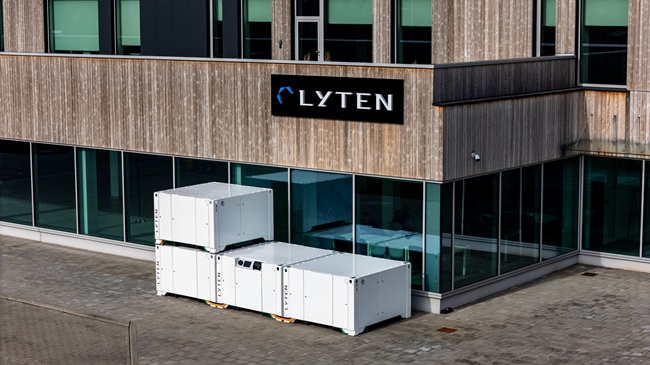
How did Lyten acquire the Gdansk facility and what does Lyten Dwa currently produce for European energy markets?
The Gdansk site, formally known as Lyten Dwa, is a 25,000-square-metre production facility and R&D centre that Lyten acquired in October 2025 as part of its broader absorption of Northvolt’s manufacturing estate. The full Northvolt acquisition, which includes assets in Sweden, Poland, and Germany, encompasses manufacturing facilities with a book value of $5 billion. Lyten funded these acquisitions through equity investments from existing and new North American and European investors, supplemented by capital linked to the EdgeConneX data center investment at the Skelleftea site.
Lyten Dwa is currently the largest battery energy storage system manufacturing facility in Europe by the company’s own account. The facility is equipped to support a 6 GWh annual production capacity and carries infrastructure that could support expansion to 12 GWh in the future. Its primary product is the Voltpack Mobile System, a modular BESS designed for industrial and infrastructure applications. The facility also hosts an R&D centre, which positions it as a potential industrialisation site for some of Lyten’s more advanced product lines currently in development, including lithium-sulfur battery variants intended for drone, robotics, and satellite applications.
Lyten’s acquisition of the Polish site in Q4 2025 was the first transaction to close in the broader Northvolt deal. The Sweden acquisition, covering Northvolt Ett and Northvolt Labs, completed in February 2026. Lyten has also announced a binding agreement to acquire Revolt, the Northvolt battery recycling facility in Skelleftea, with that transaction expected to close in the second quarter of 2026. A further acquisition of Northvolt’s assets in Heide, Germany remains in progress.
Why is Poland a strategically significant location for European battery manufacturing and digital infrastructure investment in 2026?
Poland has become one of the most active destinations for foreign industrial investment in Europe over the past decade, driven by a skilled engineering workforce, competitive operating costs relative to Western European markets, and an expanding physical and energy infrastructure base. Gdansk, in particular, occupies a strategically important position as a major Baltic Sea port city with strong logistics connectivity to both Western European supply chains and Baltic energy networks. For a company building a hub that depends on reliable power supply, proximity to Baltic energy infrastructure is a material consideration, not a geographic coincidence.
Poland is also increasing its defense spending at a pace that few European nations are matching. The government has committed to defense expenditure exceeding 4 percent of GDP, which makes it the highest in NATO on that metric. This matters for Lyten because several of the products it manufactures or intends to manufacture are defense-relevant. Lithium-sulfur batteries have materially better energy density per kilogram than conventional lithium-ion cells, which is a decisive attribute in drone and autonomous systems applications where payload weight is constrained. Ultra-high-strength additive manufacturing filaments and adhesives for aerospace and defense use are also part of the product set being evaluated for potential inclusion at the Gdansk hub.
The political signalling surrounding the March 20 launch event was deliberate. Lyten hosted Polish Minister of Finance and Economy Andrzej Domanski, Marshal of the Pomeranian Province Mieczyslaw Struk, and Gdansk Deputy Mayor Piotr Grzelak at the Lyten Dwa facility. Convening senior government officials from national, regional, and municipal levels at what was characterised as a welcome ceremony indicates that public-private partnership discussions are already underway in substance, even if formal agreements have not yet been announced.
What role does Lyten’s 3D graphene supermaterials platform play in differentiating its industrial hub model from conventional BESS manufacturers?
Lyten’s competitive positioning rests on its proprietary 3D graphene materials platform, from which it derives multiple product lines across what would conventionally be considered distinct industries. The ability to produce advanced batteries, construction materials, high-strength manufacturing filaments, and specialty adhesives from variants of the same core supermaterial platform is either a genuinely differentiated advantage or an extremely ambitious product diversification programme, depending on how each line matures commercially.
On the battery side, lithium-sulfur technology represents a potentially significant advance over lithium-ion because it uses sulfur as the cathode material rather than cobalt or nickel, both of which carry supply chain and geopolitical risk. Lyten currently manufactures lithium-sulfur batteries at its San Jose, California facility for drone, autonomous systems, and defense customers. Scaling this technology to European gigafactory volumes, which the Skelleftea R&D collaboration is partly intended to address, is the medium-term manufacturing challenge the company has not yet fully resolved.
Beyond batteries, the Lyten S Cure concrete admixture product, which uses graphene to produce higher-strength concrete with a reduced carbon footprint, is a commercially interesting adjacent application if the construction industry adoption curve accelerates. European infrastructure spending is significant and growing, driven by both defence-linked hardening programmes and the broader energy transition buildout. A supplier that can provide both the energy storage systems for new infrastructure projects and a construction-grade graphene product is positioned to participate at multiple points in large project supply chains.
What are the execution risks and capital requirements that could affect Lyten’s ability to deliver on its European industrial hub ambitions?
Lyten’s strategy is compelling in structure but carries material execution risk across several dimensions. The company has raised over $625 million in equity funding and signed letters of intent for $650 million in financing from the Export-Import Bank of the United States. However, it is simultaneously absorbing multiple large manufacturing sites across Sweden, Poland, and potentially Germany, while attempting to restart idled production lines, rehire workforces that dispersed when Northvolt entered bankruptcy, and develop new product lines from an advanced materials platform. The operational load is substantial even for a company with significant capital backing.
The feasibility study model that Lyten is using for the Poland hub is the right approach given these pressures. By defining the scope, investment requirements, and partnership structures through a formal study before committing to a build-out, the company preserves optionality and avoids the capital allocation errors that contributed to Northvolt’s difficulties. However, it also means that the Gdansk hub remains conceptual through at least the end of 2026, and announcements of feasibility studies are not the same as committed construction programmes.
European data center development also faces increasing scrutiny over power consumption, particularly in markets where grid capacity is constrained. Poland has made substantial investments in renewable energy and is actively upgrading its grid infrastructure, but the country remains more reliant on coal-generated power than Scandinavia. A data center campus at the Gdansk site would need to resolve its carbon intensity profile to attract the hyperscaler and enterprise customers that make large data center developments financially viable. This is a manageable challenge but it adds complexity to the partnership and offtake discussions that will define whether the Poland hub reaches the scale of the Sweden model.
How does Lyten’s Northvolt acquisition position it within the competitive European battery supply chain against rivals including CATL, Samsung SDI, and LG Energy Solution?
The Northvolt acquisition handed Lyten one of the most significant ready-made battery manufacturing footprints in Europe at a fraction of the greenfield development cost. The 16 GWh of capacity at Skelleftea alone took Northvolt years and billions of euros to build. European battery demand from automotive, BESS, and grid-scale storage markets is expected to grow substantially through the end of the decade, and the closure of Northvolt removed a major European-owned supplier from the competitive landscape. Lyten stepped into a supply gap that its Asian rivals, including China’s CATL and South Korea’s Samsung SDI and LG Energy Solution, are well-positioned to fill if European players do not.
The lithium-sulfur technology angle is where Lyten is attempting to carve out differentiation that Asian manufacturers cannot easily replicate on a short timeline. CATL and its peers have invested enormous resources in optimising lithium-ion and lithium iron phosphate chemistries, and their cost structures in conventional cell production are difficult to compete with on price. Lyten is not trying to win on price in the mass market. Its San Jose production of lithium-sulfur cells for defense and autonomous systems customers indicates a deliberate focus on high-value, performance-sensitive applications where weight, energy density, and supply chain provenance matter more than per-kilowatt-hour cost.
Expanding this commercial logic into Europe through the Gdansk hub, where defense sector demand is growing rapidly given Poland’s security posture and NATO commitments, is strategically coherent. If Lyten can demonstrate reliable lithium-sulfur cell production at the Skelleftea R&D centre and begin supplying defense and autonomous systems customers in Europe directly from a Polish facility, it builds a supply chain argument that is genuinely difficult for non-European producers to displace.
Key takeaways: What Lyten’s Poland industrial hub means for European energy storage, AI infrastructure, and defense supply chains
- Lyten is replicating its Sweden industrial hub model in Poland, combining BESS manufacturing at Lyten Dwa in Gdansk with planned AI data center infrastructure to attract both manufacturing-linked public support and data center-linked private capital.
- The Gdansk hub is anchored by Europe’s largest BESS manufacturing facility by Lyten’s account, with a current 6 GWh capacity and infrastructure capable of scaling to 12 GWh, giving it a credible production base to build from.
- A feasibility study running through end of 2026 will define investment scope and public-private partnership structures; the hub remains in a planning phase and does not yet represent a committed capital programme.
- Poland’s accelerating defense spending, which is on track to exceed 4 percent of GDP, creates a natural domestic demand driver for Lyten’s lithium-sulfur battery and advanced materials product lines, particularly for drone and autonomous systems applications.
- The attendance of Poland’s Minister of Finance and Economy alongside regional and municipal government officials at the March 20 launch event signals that state partnership discussions are substantive rather than ceremonial.
- Lyten’s broader Northvolt acquisition, which encompasses $5 billion in book-value manufacturing assets across Sweden, Poland, and pending Germany, gives it a European manufacturing footprint that no competitor has assembled in a comparable timeframe.
- The lithium-sulfur battery platform differentiates Lyten from Asian cell manufacturers on supply chain provenance and energy density grounds, but commercial-scale European production remains a medium-term goal, not a current reality.
- Co-location of BESS manufacturing with data center infrastructure creates an integrated power management logic that is strategically defensible for Lyten but depends on securing a credible data center partner in Poland, as EdgeConneX is serving in Sweden.
- Poland’s grid carbon intensity and ongoing energy transition will need to be addressed to attract hyperscaler-grade data center tenants who increasingly require renewable power commitments from site operators.
- Lyten’s industrial hub network, if executed across Sweden, Poland, and Germany, would establish the company as one of the few vertically integrated European battery and advanced materials players with both defense-relevant chemistry and grid-scale BESS manufacturing at meaningful scale.
Discover more from Business-News-Today.com
Subscribe to get the latest posts sent to your email.

