




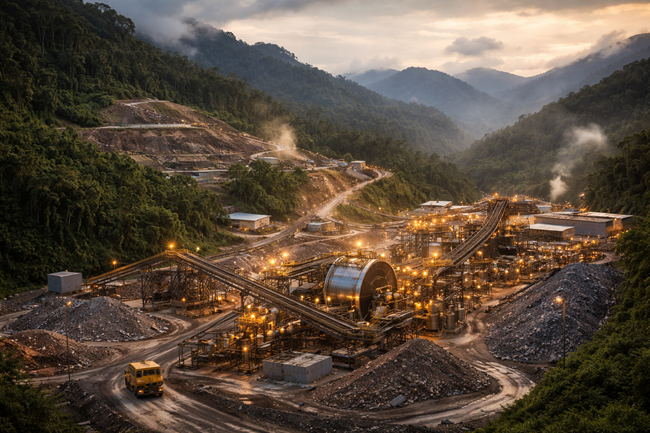
Lundin Gold Inc. (TSX: LUG) reported its fourth quarter and full year 2025 financial results, confirming a decisive shift in the company’s strategic profile from single-asset operator to a cash-rich gold producer with expanding district-scale growth options. The company generated record free cash flow of $926 million on revenues of $1.78 billion, supported by stable operations at the Fruta del Norte gold mine in Ecuador and the successful completion of its process plant expansion. With no debt and a year-end cash balance of $630 million, Lundin Gold Inc. enters 2026 with material balance sheet flexibility and a significantly expanded set of capital allocation choices.
The results reflect more than favourable gold prices. They highlight a structural improvement in throughput, operating efficiency, and capital discipline that is increasingly differentiating Lundin Gold Inc. within the global gold mining sector.
Why Lundin Gold Inc.’s 2025 financial performance reflects structural operating leverage rather than a cyclical gold price spike
Gold prices were clearly supportive in 2025, with Lundin Gold Inc. realizing an average gold price of $3,594 per ounce sold. However, the scale of cash generation suggests the company is capturing operating leverage rather than merely benefiting from price tailwinds. Cash operating costs averaged $838 per ounce and all in sustaining costs came in at $1,015 per ounce, levels that remain competitive even after accounting for higher royalties and statutory employee profit sharing linked directly to elevated gold prices.
These cost dynamics allowed Lundin Gold Inc. to convert higher revenues almost directly into free cash flow. Operating cash flow reached $1.02 billion for the year, while net income climbed to $792 million. For investors, this conversion efficiency matters because it demonstrates that margins are resilient even as external cost pressures rise across the mining industry. It also reduces reliance on external financing for growth initiatives, an increasingly valuable trait as capital markets remain selective toward mining equities.
How Fruta del Norte’s expanded throughput changes the long-term production and mine life equation
Operationally, 2025 marked a step change at the Fruta del Norte gold mine. The process plant expansion completed early in the year allowed average mill throughput to exceed 5,000 tonnes per day, compared with 4,620 tonnes per day in 2024. Gold production of 498,315 ounces was achieved despite lower average head grades, underscoring the operational flexibility introduced by higher throughput and improved recoveries.
Mill recoveries improved to 89 percent in 2025, and guidance for 2026 points to further improvement toward 91 percent. This recovery uplift is significant because it offsets expected grade variability as different sections of the ore body are mined. Rather than signalling depletion risk, the guidance implies a deliberate shift toward a more balanced mining sequence that prioritizes long-term output stability.
Production guidance for 2026 of 475,000 to 525,000 ounces reflects this transition. While unit costs are expected to rise modestly due to higher assumed gold prices driving royalties and employee profit sharing, the margin structure remains robust enough to support sustained free cash flow generation even under conservative price assumptions.
What the integration of Fruta del Norte South means for Lundin Gold Inc.’s next investment cycle
One of the most strategically important developments disclosed alongside the results is the planned integration of the Fruta del Norte South deposit into the broader mine plan. Following the inclusion of Fruta del Norte South into Mineral Reserves, Lundin Gold Inc. is advancing underground development and conducting a mine to mill expansion study that evaluates processing rates beyond 5,500 tonnes per day.
Management has indicated that a single integrated investment decision is expected in 2026, rather than a phased or piecemeal approach. This is an important signal for investors. A unified decision framework reduces execution complexity and improves capital efficiency, but it also concentrates risk. If the investment proceeds smoothly, Lundin Gold Inc. could materially extend mine life and sustain higher production levels for years. If delays or cost overruns emerge, the market response could be swift given the size of the implied capital commitment.
Non sustaining capital associated with initial Fruta del Norte South development in 2026 is estimated at $30 million to $35 million, a relatively modest figure when viewed against the company’s cash position. This reinforces the view that Lundin Gold Inc. has deliberately structured its growth pipeline to remain internally fundable even under less favourable market conditions.
How Lundin Gold Inc.’s exploration scale repositions the company from a single-mine story to a district operator
Exploration intensity in 2025 reached levels rarely seen for a company of Lundin Gold Inc.’s size. More than 121,000 metres of drilling were completed during the year, and plans for 2026 call for 133,000 metres, making it the largest exploration program in the company’s history.
Near-mine drilling continues to expand high-grade epithermal mineralization at Fruta del Norte South and Fruta del Norte East, while surface programs have confirmed copper gold porphyry systems at Sandia, Trancaloma, Castillo, and Chontas. The emergence of multiple porphyry targets alongside established epithermal systems materially alters the long-term optionality of the land package.
From a strategic standpoint, this combination is rare. High-grade epithermal deposits provide near-term production and cash flow, while porphyry systems offer scale and longevity. Markets often discount early porphyry discoveries until economic parameters are clearly defined, but sustained drilling success across multiple targets increases the probability that at least one evolves into a material asset over time.
Why Lundin Gold Inc.’s expanded dividend policy is reshaping investor perception of the stock
Capital allocation discipline has become a defining feature of Lundin Gold Inc.’s equity narrative. During 2025, the company returned $664 million to shareholders through a combination of fixed, variable, and special dividends. The dividend policy was revised to increase the fixed quarterly dividend to $0.30 per share while introducing a variable component based on at least 50 percent of normalized free cash flow.
The declared $1.15 per share dividend payable in the first quarter of 2026 reflects a payout of 100 percent of normalized fourth quarter free cash flow after the fixed component. This positions Lundin Gold Inc. as one of the more income-oriented names in the gold sector, without compromising reinvestment capacity.
For institutional investors, this balance matters. It reduces the risk that excess cash is deployed into marginal acquisitions while still allowing organic growth to be funded internally. It also introduces a yield component that can support valuation during periods of gold price volatility.
What cost inflation and execution risks investors are likely to focus on in 2026
Despite the strength of the financial position, 2026 introduces new variables that investors will monitor closely. Cash operating costs are expected to rise to between $900 and $960 per ounce, while all in sustaining costs are guided at $1,110 to $1,170 per ounce. These increases are largely mechanical, driven by higher assumed gold prices that flow through to royalties and employee profit sharing.
Sustaining capital expenditures are projected at $75 million to $90 million, primarily related to tailings storage facility expansions and infrastructure upgrades. While these investments are necessary to support higher throughput and extended mine life, they also increase quarterly variability in free cash flow.
The integrated expansion decision related to Fruta del Norte South remains the most important execution risk. Successful delivery could unlock a multi-year re-rating, while setbacks would test investor confidence even with a strong balance sheet as a buffer.
Why Lundin Gold Inc.’s 2025 results signal a broader shift in how profitable gold producers are being built and valued
Lundin Gold Inc.’s 2025 performance illustrates a broader trend within the gold mining industry. Companies that combine operational discipline, internal funding capacity, and exploration depth are increasingly separating themselves from peers that rely on acquisitions or external capital to sustain growth.
By demonstrating that a single asset can evolve into a district-scale platform without sacrificing shareholder returns, Lundin Gold Inc. is effectively redefining what mid tier success looks like in the current cycle. Whether that model proves replicable elsewhere remains uncertain, but the company’s execution to date has positioned it as a reference point for investors seeking quality exposure within the sector.
Key takeaways on what Lundin Gold Inc.’s 2025 results reveal about execution quality, capital discipline, and long-term sector positioning
- Lundin Gold Inc.’s record 2025 free cash flow confirms that the Fruta del Norte operation is now structurally cash generative rather than primarily price dependent, materially reducing single-asset risk.
- Completion of the process plant expansion and sustained throughput above 5,000 tonnes per day reposition Fruta del Norte from a mature mine narrative toward a platform capable of supporting extended mine life and higher long-term output.
- The integration of Fruta del Norte South into the mine plan introduces a clear 2026 investment catalyst that could meaningfully extend production visibility if executed within capital and schedule expectations.
- The scale and diversity of the exploration program signal a strategic pivot from incremental resource replacement toward district-scale optionality, including copper gold porphyry systems with longer life potential.
- Lundin Gold Inc.’s debt-free balance sheet and $630 million cash position provide insulation against cost inflation while preserving flexibility to fund growth internally without equity dilution.
- Rising unit costs in 2026 are largely mechanical and tied to higher gold price assumptions rather than operational deterioration, limiting downside risk to margins under current conditions.
- The revised dividend framework aligns shareholder returns with normalized free cash flow, strengthening capital discipline and improving valuation support during periods of gold price volatility.
- Collectively, the 2025 results position Lundin Gold Inc. as a reference case for how mid-tier gold producers can balance growth, cash returns, and execution discipline in the current mining cycle.
Discover more from Business-News-Today.com
Subscribe to get the latest posts sent to your email.


