


Shares of Lucid Group Inc. (NASDAQ: LCID) surged by nearly 14% on September 5, 2025, following the official closure of a $300 million strategic investment by Uber Technologies Inc. (NYSE: UBER). The funding, first announced in July, is earmarked to develop a premium autonomous electric robotaxi platform that combines Lucid’s next-generation EV technology, Nuro’s Level 4 autonomous driving system, and Uber’s ride-hailing infrastructure.
Lucid stock closed the day at $18.41, marking a sharp rise of $2.25 or 13.92% from its previous close of $16.16. The stock opened at $16.34 and climbed steadily throughout the trading session, peaking at $18.74 before slightly retreating in after-hours trading to $18.35. This intraday price movement represents one of the stock’s strongest single-day performances in 2025, triggering renewed interest among both institutional investors and retail traders on platforms like Reddit and StockTwits.
This spike wasn’t just a reaction to the funding figure—it reflected the broader implications of Lucid’s transition from a consumer-focused EV manufacturer to a platform enabler in the multi-trillion-dollar autonomous mobility market. It also highlighted how strategic alliances in autonomy and ride-hailing are now being treated by investors as critical validation events in a sector otherwise mired in capital discipline and delivery uncertainty.
How is the Lucid–Uber robotaxi alliance structured, and what is the deployment plan through 2030?
The robotaxi program will be built on Lucid’s Gravity SUV platform, integrating hardware-level autonomy support directly on the production line at its Arizona facility. The Lucid Gravity platform features a software-defined architecture, redundant zonal electronics, and an EPA-estimated range of up to 450 miles—making it particularly well suited for high-utilization, autonomous rideshare duty cycles.
Nuro, Inc. will provide the self-driving stack through its Nuro Driver system, a Level 4 autonomy solution that has already undergone live deployments in multiple U.S. cities. The system uses an end-to-end AI model designed for rapid scalability, environment adaptability, and seamless vehicle integration. Uber, in turn, will operate the robotaxi service exclusively on its global platform, leveraging its scale of over 34 million trips per day across 70 countries to ensure maximum deployment and utilization.
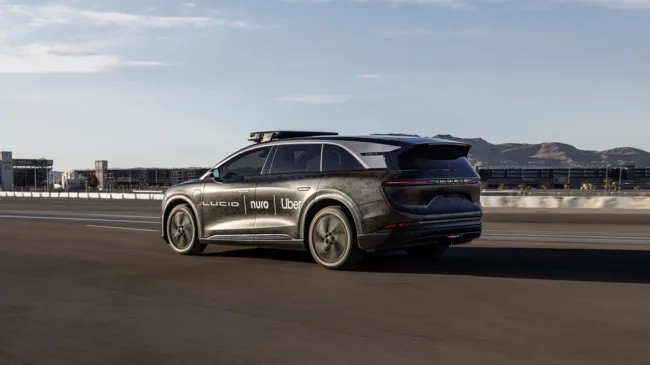
The first robotaxi prototype is already being tested at Nuro’s Las Vegas proving grounds, with a commercial rollout planned in 2026. The service is expected to launch in a major U.S. city—speculated to be either Phoenix, San Francisco, or Las Vegas—and will gradually scale to over 20,000 Lucid vehicles across multiple regions over a six-year period. These vehicles will be either owned by Uber directly or operated via its network of third-party fleet partners.
What does the stock rally signal about shifting investor sentiment toward Lucid’s business model?
For much of the last year, Lucid stock has struggled under the weight of production delays, margin compression, and a volatile EV demand landscape. The company’s shares are still trading significantly below their 52-week high of $40.80. However, the 13.92% rally on September 5 has flipped the tone of institutional conversations from caution to cautious optimism.
Analysts now see the Uber alliance as more than just a capital infusion—it’s a signal that Lucid may be evolving into a multi-revenue business model, leveraging its EV platform across ride-hailing, fleet partnerships, and autonomy licensing. Institutional investors appear to be responding positively to this strategic diversification. Notably, the stock closed with elevated volume, suggesting that the rally was driven not just by retail enthusiasm but also by new or renewed institutional positions.
With the capital from Uber, Lucid may also be in a better position to extend its cash runway beyond 2026, potentially improving its leverage when negotiating future capital raises or manufacturing scale-up. Uber’s validation of Lucid’s EV stack also adds external credibility to its long-standing pitch as a technology-first automaker, rather than a mere luxury EV brand.
How does the Uber–Nuro–Lucid partnership compare to other robotaxi efforts in the industry?
Unlike legacy OEMs or in-house AV programs run by Big Tech, this tri-party alliance is purpose-built to minimize integration friction. Lucid brings a production-ready, autonomy-capable EV architecture. Nuro contributes a validated AI-first autonomy system with multi-city deployment experience. Uber supplies the global network, fleet management expertise, and rider engagement layer.
This sharply contrasts with other high-profile robotaxi ventures like Cruise (General Motors), Waymo (Alphabet), and Zoox (Amazon), which have faced recurring hurdles—from urban operational limitations and regulatory bottlenecks to cost-prohibitive hardware. In contrast, the Lucid–Uber–Nuro configuration is engineered for scalability from day one and aims to solve for high asset utilization, low operating costs, and deep software–hardware co-design.
While Cruise and Waymo have run pilot programs with limited consumer traction, the Lucid robotaxi will launch with Uber’s existing user base and infrastructure. This dynamic gives the new partnership a significant market access advantage that could translate into faster time-to-revenue—an outcome that excites investors looking for realistic monetization pathways in autonomy.
What are the financial and operational risks that investors should still consider?
Despite the bullish response, several underlying risks remain. Lucid is still navigating the cost pressures of EV manufacturing and battery sourcing. Scaling a robotaxi production line—especially one integrated with autonomy-ready hardware—requires upfront capital, advanced QA systems, and compliance with both automotive and AV-specific regulations.
Moreover, Nuro’s autonomy software still needs to pass safety validation for passenger rides, a more stringent bar than its previous goods-delivery deployments. Regulatory frameworks for Level 4 autonomy vary widely across states and countries, and timelines are often unpredictable.
On the Uber side, managing a new category of premium autonomous rides will require careful orchestration with regulators, fleet partners, and urban infrastructure authorities. While Uber has stated that these robotaxis will operate only in areas with the right regulatory clarity, timelines could still slip, impacting fleet ramp-up targets.
Nonetheless, the shared-risk model between Uber, Lucid, and Nuro provides downside protection for each partner, which is a rare dynamic in capital-intensive AV collaborations. Analysts believe this structure helps de-risk the commercial launch and may enable faster capital efficiency at scale.
How did Uber stock respond, and what are analysts saying about its expanding AV ambitions?
Uber shares saw a modest uptick on the day but remained largely stable. That said, the strategic optics of the deal are being seen as highly favorable for Uber’s long-term positioning. By aligning with Lucid and Nuro, Uber gains tighter control over its future AV fleet without the burdens of full in-house development. This is in contrast to its previous AV efforts, including the now-divested ATG unit, which proved capital-intensive and slow-moving.
Uber CEO Dara Khosrowshahi’s recent comments reinforced this shift toward selective, purpose-built AV alliances that play to Uber’s strengths: rider engagement, logistics optimization, and global fleet deployment. Analysts suggest that Uber is attempting to create a new AV tier—one that merges autonomy with premium rider experience, rather than simply replacing human drivers with self-driving tech.
This strategic framing resonates with institutional investors, who have generally rewarded Uber’s asset-light autonomy strategy over competitors building verticalized AV stacks. The Lucid–Nuro play enhances Uber’s visibility as a platform aggregator rather than a vehicle OEM, reducing CapEx exposure while opening new margin expansion paths.
What is the outlook for Lucid stock and its role in the future of EV and mobility?
Looking ahead, the Uber deal marks a potential inflection point in how Lucid is perceived by the market. No longer confined to the EV luxury segment, the company now has a viable runway into mobility-as-a-service, licensing, and AV integrations. If the robotaxi program hits its targets, Lucid could begin generating recurring revenue from B2B and platform-as-a-service models—offering a far more sustainable path than pure vehicle sales.
Analysts expect Lucid shares to remain volatile in the near term but suggest upside potential in the $25–$30 range by late 2026, assuming production scaling, autonomy integration, and regulatory approvals proceed as planned. Institutional flows will be closely monitored in the coming quarters, particularly around Q3 earnings and deployment updates on the Gravity robotaxi.
Uber’s role as both investor and deployment partner further buffers Lucid from downside risk. With the ride-hailing giant committed to fielding over 20,000 Lucid–Nuro robotaxis globally, Lucid gains predictable demand visibility and long-term production volume certainty—something few EV startups can claim.
Can Lucid’s robotaxi pivot and Uber’s backing redefine its future in EV mobility and investor confidence?
Lucid Group’s nearly 14% surge following the closing of Uber’s $300 million investment marks more than just a stock rally—it signals a narrative shift. With production-ready EVs, autonomy-ready architecture, and a global ride-hailing partner onboard, Lucid is now positioned to compete in a much larger arena: the future of automated mobility.
The partnership has re-energized investor sentiment, opened new monetization channels, and aligned Lucid’s technology with one of the most scalable deployment platforms in the world. While execution risks remain, the roadmap ahead is clearer, and—for the first time in quarters—investors are starting to believe that Lucid’s vision might finally be within reach.
Discover more from Business-News-Today.com
Subscribe to get the latest posts sent to your email.