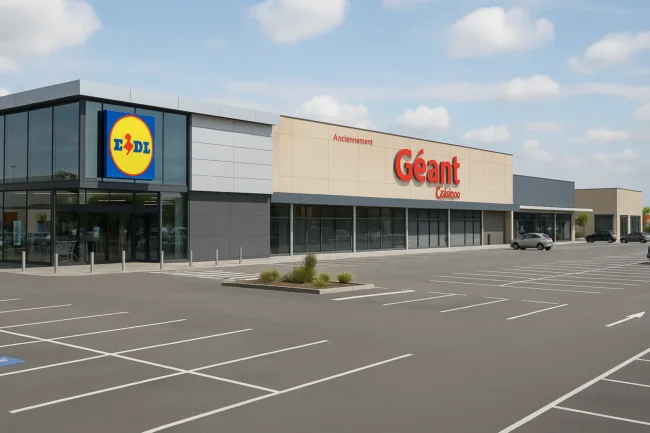
Discount grocery chain Lidl has signed a lease to take over part of the former Géant Casino premises at Mercialys SA’s retail property in Niort, France, marking the third such collaboration between the two entities at this site. The lease transaction secures long-term rental continuity for Mercialys (Euronext Paris: MERY), a leading French real estate investment trust (REIT) focused on transforming and managing retail spaces across France.
The newly restructured premises are scheduled to reopen under the Lidl banner in the second half of 2026. The agreement not only fills the void left by Casino’s withdrawal but also represents a broader institutional move by Mercialys to replace legacy hypermarket footprints with diversified, high-traffic tenants. According to statements released by the real estate investment trust, negotiations are underway with additional international retail brands to occupy remaining square footage, further enhancing the site’s tenant mix and regional pull.
Why is Lidl’s lease takeover at the Mercialys Niort site drawing institutional interest and market attention?
The Lidl lease in Niort highlights a deeper transformation unfolding across the French commercial property landscape, particularly in second-tier cities like Niort in the Deux-Sèvres department. For Mercialys, the agreement marks a continuation of its strategy to reconfigure large-format food retail properties once anchored by traditional hypermarket operators. The transition follows similar redevelopments by Mercialys in Brest and other retail zones where legacy anchors have exited due to commercial underperformance.
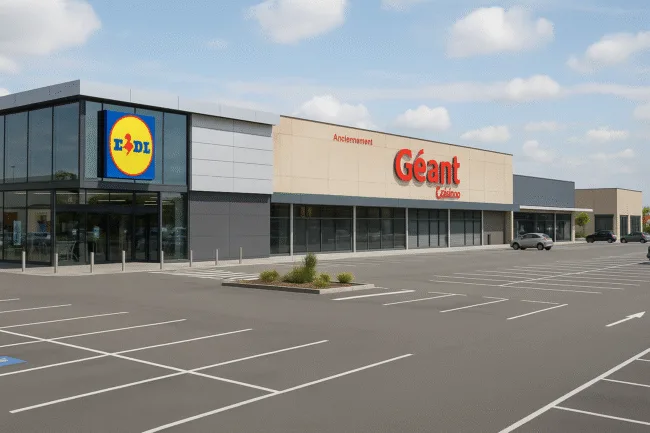
Historically, the Géant Casino brand, operated by the troubled Casino Group, was a dominant presence in large-format retailing across France. However, over the past five years, the Casino Group has undertaken massive restructuring and asset divestitures as part of its debt reduction program, leaving behind numerous vacant or underutilized properties. This systemic retreat has created market gaps that agile players like Lidl and Mercialys are now jointly exploiting.
Institutional observers view this as a signal that major retail landlords are adapting to a post-hypermarket era, where flexibility in asset reconfiguration becomes critical to maintaining income streams. Mercialys’ strategy appears focused on curating a tenant mix that includes resilient discount grocery operators and internationally known fashion and lifestyle brands, creating an experiential and high-frequency shopping destination.
How does Mercialys’ retail transformation strategy reflect broader shifts in France’s commercial real estate sector?
The partnership between Lidl and Mercialys illustrates a larger transformation in French commercial real estate. The traditional hypermarket model—which has long anchored suburban retail centers—is now being reevaluated due to changing consumer behavior, rising operational costs, and increased e-commerce penetration. Analysts suggest that the pivot toward discount-focused and mid-market tenants, like Lidl and unnamed fashion retailers, reflects institutional efforts to future-proof retail portfolios.
Mercialys’ public disclosures indicate that the retail REIT ended FY2024 with a portfolio worth €2.8 billion (including transfer taxes), comprising 1,927 leases generating €169.2 million in annualized rent. The landlord has increasingly invested in redevelopment projects designed to align with evolving footfall patterns and brand demand. These efforts are also in response to sluggish growth in traditional anchor formats and demand from new entrants looking to scale quickly across suburban markets.
By securing Lidl—a chain that continues to gain French market share—as a new tenant at Niort, Mercialys is leveraging a low-cost grocer’s footfall magnetism while simultaneously opening the property to new lease opportunities. Advanced negotiations are ongoing with two other national and international brands currently absent from the Deux-Sèvres retail footprint.
What are the expected financial and operational outcomes of the Lidl lease for Mercialys and its Niort asset?
From a financial perspective, the immediate benefit of the Lidl lease is rental income continuity. The agreement was structured to ensure there was no lapse in cash flow during the transition from the departing Géant Casino to the incoming Lidl. This aspect is especially important for REIT investors who seek stable and predictable dividends from property portfolios.
Operationally, the restructuring will involve retrofitting the vacated area for Lidl’s requirements. Given Lidl’s standardized store formats, the redevelopment will likely require moderate investment in interior configurations and energy-efficient upgrades—costs that Mercialys has typically managed through its annual capex allocation.
The Niort site is expected to see a significant uplift in daily footfall once Lidl and the incoming fashion tenant open in 2026. This could have a multiplier effect on adjacent retailers, boosting ancillary sales and increasing overall lease attractiveness. Analysts forecast that this reconfiguration could lead to an uplift in property valuation due to improved tenant quality and stronger consumer engagement metrics.
How are institutional investors reacting to Mercialys’ portfolio evolution and lease momentum with Lidl?
Investor sentiment around Mercialys has grown cautiously optimistic, driven by its active asset management and demonstrated ability to backfill large legacy spaces. Since listing on the Euronext Paris in 2005, Mercialys has been included in the SBF 120 index, which includes France’s most liquid and large-cap stocks. Its SIIC REIT tax status makes it particularly attractive to yield-seeking investors in a low-interest rate environment.
Institutional interest has centered on how effectively Mercialys can reconfigure underperforming assets and sustain a strong rental base without extensive vacancies. The Lidl lease and concurrent retailer discussions support the REIT’s ability to implement this playbook repeatedly, enhancing cash flow visibility. At the end of 2024, the REIT had 93.9 million shares outstanding, and investors have increasingly tracked lease announcements as leading indicators of forward yield security.
Although the company has not disclosed the specific lease duration or rental rate for Lidl, its language around “no disruption in rental income” suggests a financially neutral or accretive outcome, helping maintain its €169.2 million annualized rent base.
What is the broader future outlook for Mercialys’ retail redevelopment strategy beyond the Niort project?
Looking ahead, Mercialys appears well-positioned to continue its pivot toward mixed-tenancy redevelopment anchored by discount and lifestyle brands. The retail REIT has been signaling a proactive stance toward transforming obsolete or oversized hypermarket sites into multi-tenant destinations that meet contemporary consumer expectations.
As France’s regional cities continue to evolve demographically and economically, developers like Mercialys are expected to benefit from being first movers in repositioning legacy retail assets. The company’s operational history suggests a high degree of specialization in working with discounters, fashion chains, and new entrants in non-food verticals. Institutional investors will likely monitor execution quality, tenant diversity, and return on invested capital as Mercialys completes and announces more deals.
The Niort transaction is emblematic of what analysts expect will become a repeatable pattern for the real estate group—securing anchor tenants with proven foot traffic capabilities and leveraging that to elevate the surrounding tenant ecosystem. With several lease negotiations already at advanced stages, Mercialys is expected to unveil more tenant announcements in the coming quarters.
Discover more from Business-News-Today.com
Subscribe to get the latest posts sent to your email.