
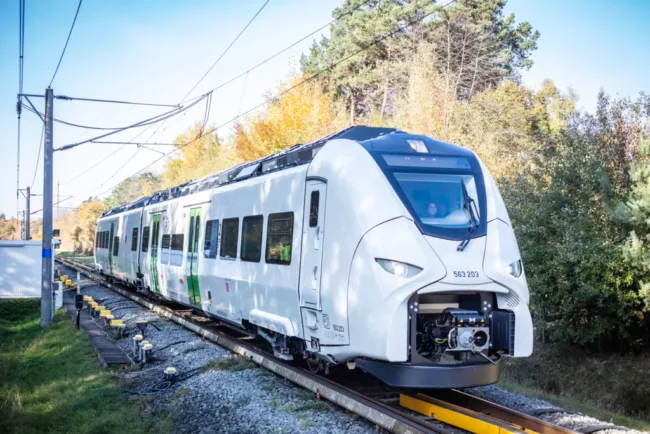
Siemens Mobility GmbH has unveiled its new fleet of Mireo electric and battery-electric trains for the S-Bahn Mitteldeutschland network, marking a key milestone in Central Germany’s shift toward low-emission regional rail. Presented at the Wegberg-Wildenrath Test Center on November 7, 2025, the rollout covers 75 trains under a contract valued at approximately €500 million, including 16 Mireo Plus B units designed for non-electrified routes. The full fleet is scheduled to enter service in December 2026 across Leipzig and surrounding areas.
The fleet stems from an order placed in December 2023 and represents the largest deployment to date for Siemens Mobility GmbH’s Mireo platform. With a focus on sustainability, capacity, and operational flexibility, the contract reflects growing institutional momentum behind clean public transport in Germany’s coal transition regions.
DB Regio AG, Die Länderbahn GmbH, and ZVNL Schienenfahrzeug GmbH will operate the new trains, which are expected to handle over 10.6 million train-kilometers annually. The procurement is backed by funding from the Federal Republic of Germany and the Free State of Saxony under the Coal Regions Investment Act.

What makes the Siemens Mireo Plus B rollout strategically important for regional transit in Germany?
The MDSB2025plus initiative, which stands for Mitteldeutschland S-Bahn 2025 plus, is not just a train order but a coordinated transformation of public transport across Saxony, Saxony-Anhalt, and Thuringia. The fleet includes 41 three-car Mireo electric trains for Die Länderbahn GmbH, 18 four-car electric models for DB Regio AG, and 16 two-car battery-electric Mireo Plus B units designated for ZVNL Schienenfahrzeug GmbH.
This combined fleet will serve as a unifying backbone for Central Germany’s growing commuter corridors. Rather than upgrading every kilometer of track to overhead electrification, the inclusion of battery-powered trains offers a cost-effective path to carbon-neutral operations. ZVNL and partner agencies have emphasized the long-term economic and environmental upside of deploying battery-electric trains on rural and mixed-use lines.
The effort is also a model of inter-agency coordination. Procurement and operations are being jointly managed by ZVNL, NASA GmbH on behalf of Saxony-Anhalt’s Ministry for Infrastructure and Digital Affairs, and public transport authorities from Saxony and Thuringia. This collaborative framework reduces fragmentation and accelerates execution.
What passenger-centric upgrades and operational benefits do the Mireo and Mireo Plus B trains offer?
Each variant of the new Mireo trains is tailored to different capacity needs. The two-car Mireo Plus B offers 100 seats, while the three-car and four-car electric versions provide 150 and 200 seats respectively. This modularity enables efficient fleet assignment based on route demand, avoiding the inefficiencies of one-size-fits-all models.
Interior upgrades focus on accessibility and convenience. All trains include barrier-free entry, spacious multi-purpose areas for bicycles and strollers, and designated family and first-class zones. Passengers can expect free Wi-Fi, multiple USB and power sockets, and wireless charging at four-person tables. Siemens Mobility GmbH has integrated its proprietary high-frequency window design to improve mobile network reception, which is a recurring issue on older rolling stock.
Real-time passenger information displays will provide route and connection updates. More doors and wider entrances will improve flow during boarding and disembarkation, helping maintain schedules during peak hours.
Operationally, Siemens estimates the Mireo trains to be up to 25 percent more energy efficient than comparable models. They are also up to 95 percent recyclable, aligning with both circular economy principles and EU green procurement standards.
Which routes will benefit from these new electric and battery-powered trains starting in 2026?
Once in service, the 75 new trains will be deployed across several key S-Bahn Mitteldeutschland lines. The four-car Mireo electric trains will run on the S4 line connecting Falkenberg to Oschatz via Leipzig, the S6 from Leipzig-Stötteritz to Naumburg, and the newly established S30 line between Schkeuditz and Leipzig main station.
Three-car Mireo electric trains will be operated by Die Länderbahn GmbH on the high-density S3, S5, and S5X routes, which span major urban and suburban nodes such as Geithain, Halle, Altenburg, Glauchau, and Zwickau.
The Mireo Plus B battery-electric trains will serve the S1 line connecting Leipzig-Miltitzer Allee to Döbeln. This route contains several segments that are not yet electrified, making it ideal for battery-electric operations. With charging performed through regenerative braking and partial electrified sections, these trains offer a fully integrated alternative to diesel.
How are regional operators and Siemens Mobility GmbH positioning this unveiling?
Executives from all parties have framed the event not just as a fleet reveal, but as a milestone in the German mobility transition. Thomas Graetz, Head of Regional Trains at Siemens Mobility GmbH, said the project affirms the scalability and flexibility of the Mireo platform, which has already been deployed in 23 fleets with more than 550 units globally.
ZVNL Association Chairman Kai Emanuel described the program as a dual-force initiative supporting both industrial continuity and climate objectives. The regional supply chain involved in train production ensures that the benefits of the investment are felt locally.
Christa Singer, Chairwoman of DB Regio Südost, emphasized that the S-Bahn network is the central artery of public transport in the region. She said that only modern, passenger-friendly vehicles can attract new users to public transit. Stephan Naue, Managing Director of Die Länderbahn GmbH, highlighted the need for increased onboard space and quick turnaround at stations to keep pace with growing ridership demand.
How does Siemens Mobility GmbH compare to competitors in the battery-electric rail segment?
In the European battery-electric train market, Siemens Mobility GmbH is competing directly with Alstom and Stadler Rail. Alstom’s Coradia iLint uses hydrogen fuel cells and is already operating in parts of Germany. Stadler Rail’s FLIRT Akku has won orders in Schleswig-Holstein and other states for its battery-powered variant.
What differentiates Siemens Mobility GmbH is the integration of multiple drive types – electric, battery-electric, and hydrogen, within a single platform architecture. This allows for mixed-fleet operation with reduced complexity in training, maintenance, and supply logistics.
The recently introduced Mireo Smart, offered via a leasing model, also makes Siemens attractive for regions looking to deploy modern fleets on faster timelines and tighter budgets.
The Mireo Plus B trains do not require purpose-built infrastructure for hydrogen fueling or full overhead wire upgrades, making them particularly cost-effective for semi-rural routes.
What are the implications of this fleet for Siemens AG’s broader strategy and investor sentiment?
While Siemens Mobility GmbH is not a separately listed entity, it contributes significantly to Siemens AG’s infrastructure earnings. In fiscal year 2024, Siemens Mobility GmbH generated €11.4 billion in revenue. Long-term public infrastructure contracts like this Leipzig rollout provide Siemens AG with predictable cash flows and a strong competitive moat.
Institutional investors have shown increasing interest in companies that support decarbonized public infrastructure. Battery-electric train fleets like Mireo Plus B align well with European Commission transport goals, and Siemens’ track record in rolling stock, automation, and maintenance software enhances its value proposition.
The Mireo fleet is also compatible with Siemens’ broader digital strategy, including predictive maintenance, energy management, and data analytics. As governments push toward smart mobility ecosystems, Siemens Mobility GmbH is well positioned to evolve from a rolling stock supplier into a full lifecycle infrastructure partner.
Key takeaways from Siemens Mobility GmbH’s unveiling of the Leipzig S-Bahn Mireo fleet
- Siemens Mobility GmbH has unveiled 75 new Mireo trains for the S-Bahn Mitteldeutschland network, including 16 battery-electric Mireo Plus B units.
- The contract, awarded in December 2023, is valued at approximately €500 million and represents the largest single order for the Mireo platform to date.
- The full fleet is scheduled to begin operations in December 2026 across Leipzig and surrounding areas in Saxony, Saxony-Anhalt, and Thuringia.
- DB Regio AG, Die Länderbahn GmbH, and ZVNL Schienenfahrzeug GmbH will operate the trains, which will collectively cover 10.6 million train-kilometers per year.
- Battery-electric Mireo Plus B trains will serve non-electrified lines, offering up to 25 percent energy savings compared to legacy rolling stock.
- New trains feature barrier-free access, real-time journey information, improved mobile reception, wireless charging, and expanded passenger capacity.
- The fleet is part of a coordinated procurement backed by the Federal Republic of Germany and the Free State of Saxony under the Coal Regions Investment Act.
- Siemens Mobility GmbH’s unveiling aligns with broader goals for decarbonized transport and infrastructure modernization in Germany.