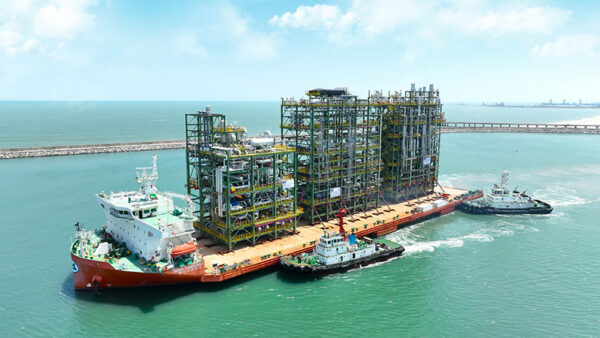
India’s diversified engineering and construction giant Larsen & Toubro Limited has successfully delivered 46 process and piperack modules to Linde Engineering Singapore for a major gasification facility that will produce hydrogen and synthesis gas. The modules, collectively weighing around 34,000 metric tons, were fabricated at Larsen & Toubro’s modular fabrication complex in Kattupalli, Chennai, and shipped to Singapore for installation.
The delivery marks a significant milestone for Larsen & Toubro’s modular fabrication business and reinforces its role as a global supplier of large-scale engineering modules for the energy sector. According to Larsen & Toubro Whole-Time Director and Senior Executive Vice President (Energy) Subramanian Sarma, the project was designed to be built entirely in modular form and then transported for assembly at the site in Singapore.
How did Linde Engineering choose Larsen & Toubro’s Kattupalli fabrication yard for this project?
Linde Engineering reportedly evaluated multiple fabrication yards worldwide before selecting Larsen & Toubro’s Kattupalli facility. Located on the east coast of India, near Chennai, the site is equipped with advanced machinery and infrastructure to handle the manufacturing of extremely large and complex modules.
Sarma noted that Linde’s decision was the result of a global search for a yard capable of executing the demanding requirements of the gasification project. The selection reflects both the technical capability and track record of Larsen & Toubro’s Energy–Hydrocarbon division, which serves clients across the oil, gas, and energy transition industries.
What makes the Kattupalli modular fabrication facility suitable for large-scale energy projects?
The Kattupalli yard is one of three dedicated modular fabrication facilities operated by Larsen & Toubro, alongside its Hazira yard in Gujarat, India, and the Sohar yard in Oman. Collectively, these facilities can produce up to 200,000 metric tons annually of large, complex modules.
The Kattupalli plant’s strategic location on India’s eastern seaboard allows direct sea access for transporting massive pre-fabricated structures to overseas clients. The yard is designed to handle modules with challenging dimensions, metallurgies, and safety requirements — a capability that proved essential for this Linde Engineering project.
What were the technical specifications and challenges of the Linde gasification modules?
Under the project, Larsen & Toubro fabricated modules in several metallurgies, including low-temperature carbon steel, low alloy materials, and inconel. Many of these modules were delivered with shop-applied fireproofing and both cold and hot insulation, meeting stringent safety and operational standards.
The scale of the work was considerable. The heaviest single module weighed around 2,800 metric tons, while the tallest reached 51 meters — equivalent to an 11-storey building — with a base footprint of 35 meters by 21 meters. These dimensions required specialized lifting, assembly, and logistics planning to ensure safe handling and shipping.
Larsen & Toubro highlighted that the manufacturing and shipment of such large modules underscored both the magnitude and complexity of the assignment. Coordinating fabrication, quality checks, and transport for modules of this scale involves meticulous project management and precise execution.
How does modular fabrication benefit large-scale gasification and hydrogen projects?
In the context of large energy infrastructure projects, modular fabrication offers several advantages over traditional stick-built construction. By assembling complete process units offsite, contractors can ensure higher quality control, optimize safety conditions, and reduce on-site construction time.
For Linde Engineering’s Singapore gasification plant, this meant that complex process and piperack systems could be manufactured in a controlled environment in India and then shipped ready for integration. This approach can help minimize weather-related delays, labor constraints, and logistical bottlenecks at the project site.
The gasification facility itself is designed to convert feedstock into hydrogen and synthesis gas (syngas), which are crucial intermediates for producing chemicals, fuels, and other industrial products. The modular construction method supports the efficiency and scalability of such advanced industrial plants.
What role does Larsen & Toubro’s Energy–Hydrocarbon division play in global modular supply?
Through its Energy–Hydrocarbon unit, Larsen & Toubro delivers modular solutions for both onshore and offshore oil and gas developments. This includes deep-water subsea production systems (SPS), subsea umbilicals, risers, and flowlines (SURF) projects, as well as offshore wind farm infrastructure.
The division’s modular fabrication expertise has been applied in projects across the Middle East, Southeast Asia, and other energy-producing regions. Its capabilities extend from heavy steel fabrication to specialized coatings, high-pressure vessel production, and integrated process system assembly.
In addition to the Indian and Omani yards, Larsen & Toubro recently inaugurated an integrated manufacturing complex in Jubail, Saudi Arabia, to serve regional demand for modules, piping, process skids, and thick-walled pressure vessels. This expansion underscores the company’s commitment to strengthening its fabrication footprint in key global energy markets.
How does this delivery reinforce India’s position in global engineering and fabrication?
India’s engineering and fabrication sector has increasingly become a preferred choice for global energy companies seeking high-quality, cost-effective modular solutions. The successful execution of this project positions Larsen & Toubro — and by extension India’s heavy engineering sector — as a competitive player capable of meeting the demands of large-scale, high-specification energy projects.
By meeting Linde Engineering’s rigorous standards and shipping modules of unprecedented size and complexity, Larsen & Toubro demonstrates the technical maturity and global competitiveness of Indian fabrication yards. This project also showcases India’s growing role in the global energy transition, particularly in hydrogen production and advanced chemical processing.
How could Larsen & Toubro’s delivery for Linde Engineering influence its future global modular fabrication contracts and market positioning?
The completion of the Linde Engineering shipment may serve as a reference point for Larsen & Toubro in securing additional global contracts. The company’s ability to handle diverse metallurgies, integrate safety features during fabrication, and deliver oversized modules on schedule is likely to be a strong selling point for future bids.
Given the projected expansion of hydrogen production, carbon capture, and advanced petrochemical facilities worldwide, demand for large modular fabrication is expected to remain robust. Industry sentiment in late 2022 indicated that global energy majors were increasingly looking to modular construction as a means of accelerating project timelines and reducing cost risks.
Discover more from Business-News-Today.com
Subscribe to get the latest posts sent to your email.