



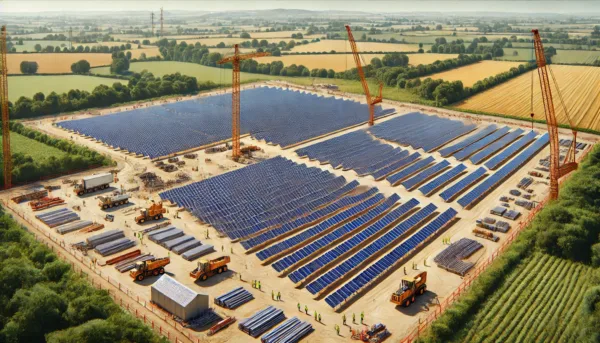
Adani Green Energy Limited (AGEL), a key player in India’s renewable energy sector, has announced the successful commissioning of its 100 megawatt (MW) solar power project in Khirsara, located in the Kutchh region of Gujarat. The project has been developed by Adani Solar Energy Kutchh Two Private Limited, a wholly owned subsidiary of AGEL, and has gone live well ahead of its scheduled commercial operation date under the terms of a 25-year power purchase agreement with Gujarat Urja Vikas Nigam Limited (GUVNL).
The Khirsara solar project adds significant momentum to Adani Green Energy’s ambitious expansion plans, with the company now achieving a cumulative operational renewable capacity of 2.95 gigawatts (GW) across India.
What Is the Significance of the Khirsara Solar Power Project?
The commissioning of the Khirsara solar project represents a critical milestone not only for AGEL but for India’s broader push toward sustainable and low-emission energy sources. With this 100 MW capacity addition, AGEL further consolidates its position as one of the fastest-growing renewable energy companies in the country.
According to AGEL, the power generated from the Khirsara facility will be sold to GUVNL at a fixed tariff of INR 2.44 per kilowatt-hour (kWh), under a 25-year PPA framework. This pricing aligns with recent trends in Indian solar auctions, where highly competitive tariffs have driven cost efficiencies and project scalability.
Adani’s Energy Monitoring Infrastructure Supporting Portfolio Efficiency
The newly commissioned plant is integrated into AGEL’s centralized Energy Network Operation Centre (ENOC), which acts as the nerve center for operational oversight across more than 80 renewable energy assets nationwide. The ENOC provides real-time data analysis, fault detection, and performance optimization, enhancing plant uptime and energy output. The inclusion of the Khirsara plant in this system is expected to support higher operational efficiency and ensure seamless integration with the company’s broader energy portfolio.
Why Is Gujarat Critical to India’s Renewable Energy Mission?
Gujarat continues to be a cornerstone state in India’s renewable energy transformation. Its geographical advantages — including high solar irradiance and availability of vast arid land — make it ideal for utility-scale solar deployment. The state government’s support for green energy policies, coupled with consistent infrastructure development, has attracted major developers such as AGEL to invest in solar and wind energy capacity across its districts.
The Khirsara site in Kutchh is strategically located and benefits from relatively low land acquisition costs and proximity to grid infrastructure, which has enabled rapid project execution and cost-effective transmission.
Adani Green Energy’s Long-Term Renewable Vision
In a statement accompanying the commissioning announcement, Vneet S. Jaain, Managing Director and CEO of Adani Green Energy Limited, reiterated the company’s long-term strategic commitment. He emphasized that the successful launch of the Khirsara plant demonstrates AGEL’s rapid project execution capabilities and reflects the Group’s scale and vision.
Jaain noted that AGEL’s broader target remains to build 25 GW of renewable energy capacity by 2025 — a goal that requires consistently scaling up capacity through a mix of solar and wind projects while maintaining adherence to global environmental and operational standards.
Investor and Sectoral Sentiment: Renewable Energy Stocks in Focus
The announcement comes at a time when investor interest in renewable energy stocks in India has seen a sharp uptick. Driven by a combination of favorable policy environments, lower capital costs, and improving grid parity, publicly traded companies like AGEL have outperformed broader market indices over the past year. As of December 2020, Adani Green Energy’s stock has delivered substantial returns to long-term investors, with its market capitalization soaring due to a steady stream of capacity additions and strong visibility on contracted revenue.
In the broader market context, the Indian government has reiterated its goal of achieving 175 GW of installed renewable energy capacity by 2022, later revised upward to 450 GW by 2030. Private sector involvement, especially from large conglomerates such as the Adani Group, is widely seen as a pivotal enabler in meeting these national targets.
What Does the INR 2.44/kWh Tariff Mean for the Solar Sector?
The INR 2.44/kWh tariff under the GUVNL PPA for the Khirsara project is reflective of the pricing competitiveness that has defined India’s solar power auctions since 2017. This pricing level is considered one of the lowest globally and has enabled states like Gujarat to procure clean energy at scale while lowering average power procurement costs. For developers, this also implies the necessity of efficient operations, low-cost financing, and superior asset management — areas where AGEL has consistently demonstrated capability.
The viability of these ultra-low tariffs is supported by AGEL’s vertically integrated capabilities, including access to Adani Solar’s panel manufacturing and Adani Transmission’s infrastructure. This integration has helped the company maintain competitive project execution timelines and long-term profitability, despite pricing pressures.
How Fast Is Adani Scaling Its Renewable Portfolio?
With the addition of the Khirsara project, Adani Green Energy edges closer to its medium-term capacity targets. Over the past two years leading up to 2020, AGEL has aggressively expanded its operational footprint with a mix of greenfield developments and acquisitions. The company continues to build its pipeline through state and central auctions, while also exploring strategic partnerships and global capital inflows to finance its clean energy projects.
In September 2020, AGEL secured a USD 6 billion contract from the Solar Energy Corporation of India (SECI) to develop 8 GW of solar projects — the largest such award globally at the time. This underscores AGEL’s strong execution credentials and signals its intent to dominate the renewable energy landscape not only in India but across emerging markets.
Future Outlook for Adani Green and India’s Renewable Goals
As of December 2020, AGEL’s near-term pipeline is expected to see accelerated commissioning over the next 12 to 18 months. Analysts tracking the sector believe that successful delivery of these projects — including those awarded under SECI and state auctions — will be critical to sustaining investor confidence and unlocking new financing opportunities.
Industry observers also highlight that India’s renewable transition is entering a phase where integration with storage, hybrid projects, and green hydrogen will become increasingly relevant. Companies like AGEL, with strong balance sheets, integrated operations, and institutional backing, are likely to emerge as central players in this next wave.
The commissioning of the 100 MW Khirsara solar power project by Adani Green Energy Limited marks another step in the company’s rapid ascent within India’s renewable energy sector. Achieved ahead of schedule, the project underscores AGEL’s operational rigor and strategic alignment with India’s national clean energy vision. As AGEL moves toward its 25 GW goal, its pace, scale, and integration-focused approach set a strong benchmark for the sector.
Discover more from Business-News-Today.com
Subscribe to get the latest posts sent to your email.