Why has Kerala issued a Nipah virus alert across six districts after a second suspected fatality in Palakkad?
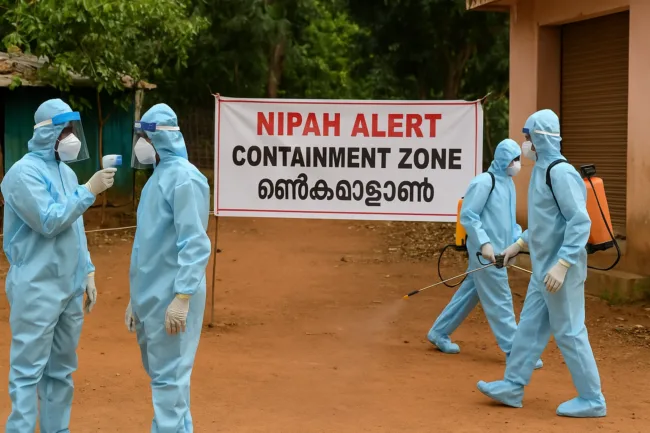
A second suspected Nipah virus-related death in Kerala has triggered a statewide health alert across six districts, with authorities intensifying contact tracing, surveillance, and isolation protocols. A 57-year-old man from Palakkad, who died on July 12 at a private hospital, tested positive for Nipah virus at Manjeri Medical College. Final confirmation is pending from the National Institute of Virology (NIV) in Pune.
This case follows the earlier death of an 18-year-old woman from Malappuram, who had also tested positive, sparking concerns about a localized viral resurgence in northern Kerala. With past outbreaks in 2018, 2021, 2023, and 2024, Kerala’s health infrastructure has activated its full-scale response mechanisms, modeled on previous containment blueprints.
How has Kerala’s past experience with Nipah outbreaks shaped its 2025 containment strategy?
Kerala’s aggressive outbreak control strategy stems from lessons learned during the 2018 Nipah virus outbreak in Kozhikode, where 17 deaths forced the state to develop institutional tools like the Institute of Advanced Virology. Subsequent outbreaks led to enhancements in real-time contact tracing, rural isolation protocols, and mobile health infrastructure.
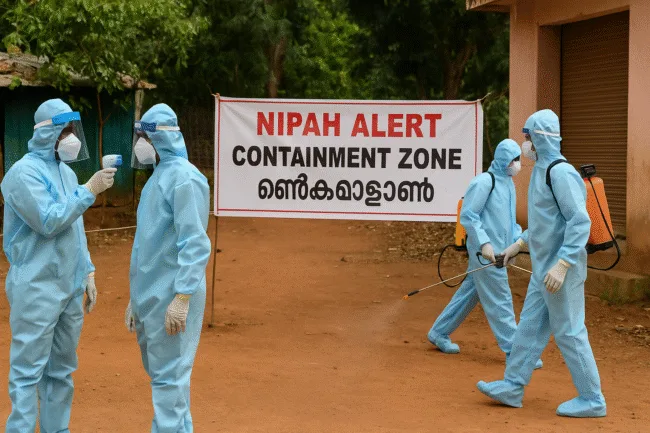
These cumulative experiences enabled a swift rollout of response actions this month, including digital contact tracing, deployment of mobile fever surveillance units, and region-specific containment zoning. The state’s confidence in handling the virus has helped maintain public calm while emphasizing vigilance.
What are the latest case numbers and district-level surveillance statistics in the new outbreak?
As of July 14, Kerala’s health department has placed a total of 543 individuals under surveillance across four districts. Palakkad accounts for 219 monitored contacts, followed by 208 in Malappuram, 114 in Kozhikode, and two in Ernakulam. Among the total, 36 individuals are categorized as high-risk contacts, and 128 are under close watch.
In Malappuram, 10 individuals remain under treatment, with two in ICU care. All 62 samples tested recently in that district returned negative. Palakkad authorities have isolated one patient with suspected symptoms, while five individuals tested negative there. These containment efforts have significantly reduced the threat of uncontrolled spread.
How are health officials digitally tracking the patient’s movement using tower data and CCTV?
Kerala’s containment operations have embraced digital technologies for real-time exposure mapping. Authorities used CCTV footage, mobile tower triangulation, and GIS tools to build a detailed timeline of the deceased Palakkad patient’s movements. A family tree has also been created to map close-contact vectors for follow-up tracing.
In total, 46 individuals have been identified as close contacts of the Palakkad patient. Their movements are being monitored for symptoms. These digital methods, introduced during COVID-19, now form an essential layer of Kerala’s infectious disease containment strategy, allowing faster decision-making and isolation.
What new public restrictions and healthcare protocols are in effect across the containment zones?
The government has imposed containment measures across 27 wards in Palakkad, covering Kumaramputhur, Mannarkkad, Karimpuzha, and Karakurissi panchayats. Health officials have directed the public to avoid unnecessary hospital visits, especially in Malappuram and Palakkad, and recommended that only one person accompany a patient.
Mask mandates have been enforced for patients, hospital staff, and attendants. The public has been urged to report symptoms including fever, disorientation, and severe headache immediately. Hygiene and movement restrictions are reinforced through district collector offices and local self-government bodies.
How are state, central, and virology agencies coordinating during Kerala’s 2025 Nipah response?
The Kerala Health Department is coordinating with national agencies including the National Institute of Virology (NIV), the Indian Council of Medical Research (ICMR), and the National Centre for Disease Control (NCDC). A central team led by Dr. Pranoy Varma of NCDC visited Malappuram and Kozhikode to review the containment infrastructure.
The Institute of Advanced Virology in Thiruvananthapuram has also been brought into active support for sample sequencing and surveillance data. Veena George, Kerala’s health minister, has provided daily updates, emphasizing state readiness and transparent communication with the public and the media.
Why is Nipah virus a global priority and how does the Kerala outbreak reflect zoonotic spillover risks?
The World Health Organization classifies Nipah virus as a priority pathogen due to its high fatality rate—up to 75%—and pandemic potential. A zoonotic disease, Nipah is transmitted via fruit bats, infected food, or direct human contact. Kerala’s forested regions and high humidity make it a periodic hotspot for spillover events, especially during monsoon.
Global outbreaks have occurred in Malaysia, Bangladesh, and Singapore. Kerala’s recurring experience is now seen as a case study in localized response to emerging zoonotic threats. Genomic studies and bat surveillance are underway to track viral evolution and spillover patterns.
What testing and hospital data reveal about the current risk level from Nipah in Palakkad and Malappuram?
So far, containment seems to be effective. All 62 samples tested in Malappuram returned negative, and five samples tested in Palakkad also came back negative. Only one patient in Palakkad remains isolated as a precaution. In Malappuram, two patients are in ICU but stable.
However, final lab confirmation from NIV Pune is still awaited for the second suspected death. Experts warn that incubation periods of up to 21 days mean continued vigilance is required, even with early negatives. Testing and follow-up are ongoing for all 543 contacts.
What institutional memory and virology infrastructure are being used from past outbreaks to fight Nipah?
The current response leans heavily on the state’s virology infrastructure built post-2018. The Institute of Advanced Virology is offering sequencing and diagnostics capacity, while government hospitals have pre-designated isolation wards with ready ICU units. District authorities have activated SOPs from prior Nipah and COVID emergencies, ensuring swift mobilization of medical teams.
Awareness campaigns are running across media channels in Malayalam and English to educate the public on symptoms and prevention. Past outbreak coordination with WHO and UNICEF has enabled Kerala to maintain a scalable playbook with built-in response triggers and resource allocation plans.
Kerala’s second suspected Nipah-related death in July 2025 has reignited pandemic protocol mode in six districts. With 543 individuals under monitoring and contact tracing underway, the state’s digital surveillance and containment strategy are being closely watched by both national agencies and global health networks.
Authorities remain on high alert as final lab confirmation from NIV Pune is awaited. However, the institutional experience and public health coordination already in motion suggest Kerala is once again prepared to control and contain a potentially deadly outbreak.
Discover more from Business-News-Today.com
Subscribe to get the latest posts sent to your email.