Can the long-delayed Prototype Fast Breeder Reactor cut through technological hurdles to signal India’s entry into breeder-based nuclear power?
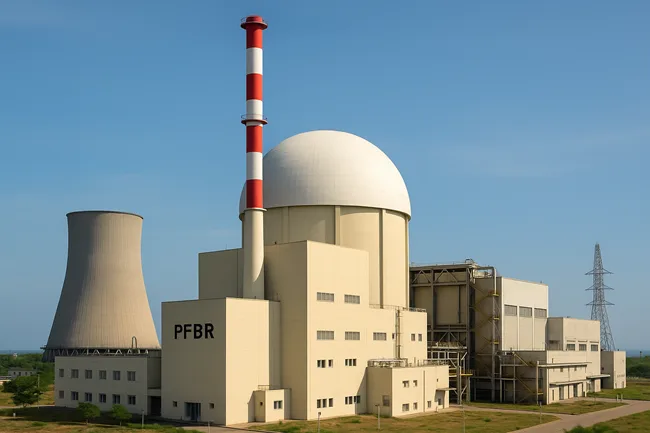
India is approaching a defining moment in its nuclear power journey. The 500 megawatt-electric (MWe) Prototype Fast Breeder Reactor (PFBR) at Kalpakkam, Tamil Nadu—central to the nation’s three-stage nuclear strategy—has entered the final stages of commissioning. Once operational, it will allow India to “close the fuel cycle” by breeding more fissile material than it consumes, paving the way for a thorium-based energy future.
The Department of Atomic Energy (DAE) and Bharatiya Nabhikiya Vidyut Nigam Limited (BHAVINI), the public sector enterprise executing the project, have stated that commissioning is expected between late 2025 and September 2026. The PFBR is designed to serve as the model for future fast breeder units, with the government targeting up to 5 gigawatts of breeder capacity by 2047.
From core loading to criticality: where does PFBR stand today?
The PFBR reached a key milestone in March 2024 when it entered the core loading phase, with Prime Minister Narendra Modi present to mark the occasion. This involved loading fuel assemblies into the reactor vessel for the first time. By July 2024, the Atomic Energy Regulatory Board (AERB) had granted approval for first-of-a-kind criticality testing—an essential step before the reactor begins sustained operations.
However, Union Minister Jitendra Singh told Parliament in early 2025 that commissioning had been delayed due to technical integration issues uncovered during testing. These include optimising the sodium coolant system’s thermal performance, calibrating neutron flux instrumentation, and ensuring redundancy in safety shutdown systems. BHAVINI has stated that all remedial actions are being implemented in phases, with safety as the overriding priority.
Industry observers note that such delays are common in first-of-a-kind nuclear builds. Given the complexity of sodium-cooled technology, some experts believe a September 2026 operational date is more realistic than the earlier late-2025 target.
How does a sodium-cooled fast breeder reactor work?
Unlike conventional pressurised heavy water reactors (PHWRs) or light-water reactors (LWRs), which use water as both coolant and moderator, the PFBR uses liquid sodium as the primary coolant. Sodium has a high boiling point and excellent thermal conductivity, allowing the reactor to operate at high temperatures without pressurisation.
The “breeder” aspect comes from the reactor’s ability to convert fertile material—such as uranium-238—into fissile plutonium-239 through neutron capture. In India’s case, the PFBR will run on a mixed oxide (MOX) fuel of plutonium and uranium, producing more plutonium during operation than it consumes. This surplus fissile material can then fuel additional breeder reactors or be used to start thorium-based reactors in stage three of India’s nuclear programme.
Why PFBR’s success matters for India’s three-stage nuclear programme
The PFBR is the linchpin of stage two of India’s three-stage nuclear vision, first laid out by Homi Bhabha in the 1950s. The first stage, built on PHWRs, uses natural uranium to produce plutonium as a by-product. Stage two—fast breeder reactors—uses that plutonium as fuel to produce more fissile material, including uranium-233, which will ultimately drive stage three: reactors fuelled by thorium and uranium-233.
India holds between 25% and 30% of the world’s known thorium reserves, embedded in monazite sands along its coasts. A fully operational breeder programme would unlock the potential of these reserves, enabling near-complete energy independence and providing a clean, dispatchable power source for centuries.
How repeated delays and rising costs have shaped the Prototype Fast Breeder Reactor’s long road to commissioning
The PFBR’s journey has been lengthy. Construction began in 2004 with an initial commissioning target of 2010. Multiple delays followed, driven by supply chain bottlenecks, changes in safety standards post-Fukushima, and the complexities of developing sodium-cooled technology domestically. The project cost, initially estimated at around ₹3,500 crore, has escalated to over ₹6,800 crore.
Despite these setbacks, each delay has been used to refine systems and integrate lessons from international breeder programmes. For BHAVINI, the PFBR is not just a single plant—it’s the prototype for a fleet of future breeders.
How India compares globally in fast breeder development
Globally, only Russia operates a commercial-scale fast breeder reactor, the BN-800, which began power generation in 2016. Japan’s Monju reactor was shut down in 2016 after decades of technical problems. China is currently constructing its CFR-600 fast reactors, with ambitions to scale further by the 2030s.
India’s PFBR stands out because it is part of a long-term national strategy to integrate breeders into a closed fuel cycle aimed at thorium utilisation. If successful, India would join an elite group of countries with operational breeder technology and could become the only nation to integrate it directly into a thorium fuel cycle.
From a policy standpoint, PFBR is more than a single reactor—it’s a test bed for India’s ambitions in advanced nuclear technology. The ability to commission and operate it safely will determine how quickly India can transition to a self-sustaining nuclear ecosystem. While delays have tested patience, the strategic significance of PFBR remains unchanged. A successful launch could mark the beginning of India’s most important chapter in nuclear energy.
Discover more from Business-News-Today.com
Subscribe to get the latest posts sent to your email.