

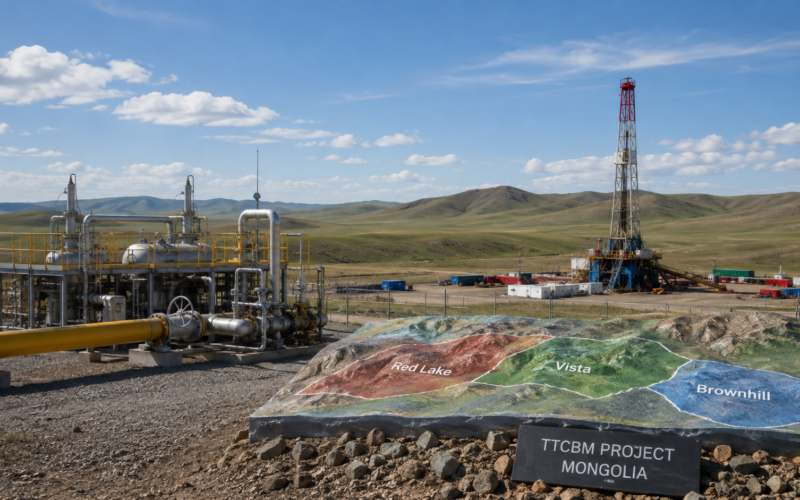
Jade Gas Holdings Limited (ASX: JGH) has submitted the initial Plan for Development of Operations for its TTCBM coal-bed methane project in Mongolia and agreed with the regulator on a proposed 502-square-kilometre Production Licence area, moving the project another step away from exploration and toward commercial development. The agreed footprint represents roughly 80% of Jade Gas Holdings Limited’s existing 629-square-kilometre exploration licence and incorporates the Red Lake development area together with the prospective Vista and Brownhill resource areas. The August 24 milestone follows Mongolia’s June approval of the country’s first natural-gas reserves at TTCBM and arrives after Jade raised additional equity and signed a non-binding arrangement that envisages external funding for its proposed first development phase. The investment question has consequently shifted from whether Jade can demonstrate gas resources toward whether regulatory approval, financing and construction can converge quickly enough to establish Mongolia’s first significant domestic gas operation.
This is a legitimate follow-on to Jade’s earlier appraisal milestone rather than another version of the same announcement. When the Mongolian regulator approved the TTCBM appraisal report in April, Jade still needed reserve registration, a formal development plan and an eventual production licence before commercial development could begin. The Mongolian Minerals Council subsequently approved the maiden reserve booking in June, allowing the PDO to be lodged, while the latest agreement now defines the geographical area Jade is seeking to carry into production.
How much of the TTCBM project would sit inside Jade Gas’s proposed production licence?
The proposed 502-square-kilometre production footprint covers approximately four-fifths of the existing exploration area, leaving Jade with a development tenure large enough to preserve more than the immediate Red Lake field. Including Vista and Brownhill is strategically useful because a production licence built only around the first reserve area could have constrained the company’s ability to expand if later drilling demonstrates commercial resources elsewhere within the broader TTCBM acreage.
The distinction between the initial reserve booking and the eventual licence area is particularly important. Jade’s first reserves were deliberately based on a relatively narrow development case, while previous company planning has contemplated a much larger multi-phase field build-out. The broader concept has included a Phase 1 programme of as many as 175 wells and, over the longer term, approximately 800 wells with a potential operating life exceeding 30 years. Those numbers remain development concepts rather than committed construction, but the 502-square-kilometre licence footprint preserves the physical room required for the project to expand if reservoir performance, demand and financing justify additional phases.

What does submitting the Plan for Development of Operations change?
The PDO is effectively the bridge between resource definition and field construction because it sets out how Jade proposes to develop, operate and manage the gas project. Previous regulatory disclosures indicated that the plan would address technical scope, infrastructure design, production forecasts and environmental-management commitments. Approval would then allow Jade to progress the formal exploitation or production licence process under Mongolia’s regulatory framework.
That makes the August 24 filing more consequential than another drilling result. Exploration companies can accumulate resources for years without establishing a financially executable development scheme, whereas the PDO forces the economics and engineering of the project into a more concrete regulatory structure. Jade still needs approval, and filing should not be confused with receiving the production licence itself, but a submitted plan means the company has now put a specific development architecture in front of the authorities.
The next disclosures should therefore become increasingly commercial. Investors will need clarity around approved well numbers, processing infrastructure, LNG or compressed-gas facilities, water management, construction sequencing and the timetable from licence approval to first commercial sales.
How does the proposed A$1.1 billion funding pathway fit the latest milestone?
Jade signed a non-binding collaboration agreement in July with a consortium led by PT Beijing Energy Linking, with PetroChina and Hunan Geology & Mining Technology named as subcontractors. The proposal contemplates funding 100% of Jade’s proposed Phase 1 capital expenditure, estimated at approximately US$762 million or A$1.1 billion. Because the arrangement remains non-binding, the headline amount cannot yet be treated as committed project finance.
The regulatory progress nevertheless makes the proposed financing more relevant than it was when first announced. External counterparties can evaluate a project more confidently once reserves have been formally recognised, a development plan has been lodged and the prospective production area has been defined. Conversely, Jade still needs to convert the non-binding financing structure into definitive agreements containing funding conditions, ownership arrangements, construction obligations and protections for existing shareholders.
That conversion may become the most important corporate milestone after licence approval. A fully funded development structure could allow a relatively small Australian-listed company to advance infrastructure far larger than its own balance sheet could support, but the economic value retained by Jade would depend heavily on the final contractual terms.
Has Jade Gas strengthened its own balance sheet while the larger financing is negotiated?
Jade completed an A$11 million placement in August following earlier capital raisings intended to support project commercialisation and development activities. The fresh equity provides near-term corporate funding while the much larger field-development financing pathway is negotiated.
That separation matters. Corporate equity can fund permitting, engineering, negotiations and working capital, but it would be unrealistic to expect a company of Jade’s current market capitalisation to self-fund a Phase 1 development carrying a potential A$1.1 billion capital requirement. Strategic or project-level capital therefore remains essential.
The structure also creates dilution sensitivity. Additional equity raises may still be required if binding project finance takes longer than expected, while any farm-down or development partnership could reduce Jade’s economic ownership in exchange for funding. The best outcome for shareholders would be a financing structure that brings sufficient external capital without transferring an excessive share of project economics.
What would Phase 1 actually sell if TTCBM reaches commercial production?
Jade has previously framed the initial development around producing gas for Mongolia’s domestic economy, with LNG supply to transport as a primary market and mining or industrial power users as additional opportunities. The South Gobi location provides a natural demand case because large mining operations and heavy transport consume substantial amounts of imported diesel and other fuels.
Domestic gas therefore does not require Jade to create an export LNG industry before earning revenue. A modular development could theoretically scale alongside customer conversion, reducing the risk of building an enormous processing system before demand is contracted. The commercial challenge is demonstrating that processed gas or LNG can compete with existing fuel alternatives after drilling, compression, liquefaction and transport costs.
Binding offtake will consequently matter almost as much as the production licence. Prospective customers need confidence that volumes will be dependable, while lenders and strategic investors will want evidence that customers are prepared to sign agreements capable of supporting project economics.
Why did Jade Gas shares fall despite the August 24 milestone?
Jade Gas Holdings Limited was trading around A$0.08 on August 24, with market data showing a decline of roughly 4.8% around the announcement and a market capitalisation near A$184 million. The shares remain well above the lower end of their 52-week range of approximately A$0.02 to A$0.12, illustrating how much project-development expectation has already been incorporated into the stock during 2026.
The negative reaction does not necessarily imply that investors considered the PDO filing disappointing. Jade has already rerated substantially from early-2026 levels, while the market is now waiting for harder milestones that directly affect project value, including PDO approval, the production licence, binding financing and commercial contracts. In that environment, procedural progress can be positive without generating another immediate share-price surge.
The project has now crossed several hurdles that were uncertain when BNT examined Jade’s appraisal approval in April. Mongolia has registered its first natural-gas reserves, Jade has submitted the development plan and a 502-square-kilometre production footprint has been agreed. The remaining steps are harder because they determine whether the geological and regulatory story becomes an operating business, but that is precisely why the August 24 milestone changes the investment case.
Discover more from Business-News-Today.com
Subscribe to get the latest posts sent to your email.