


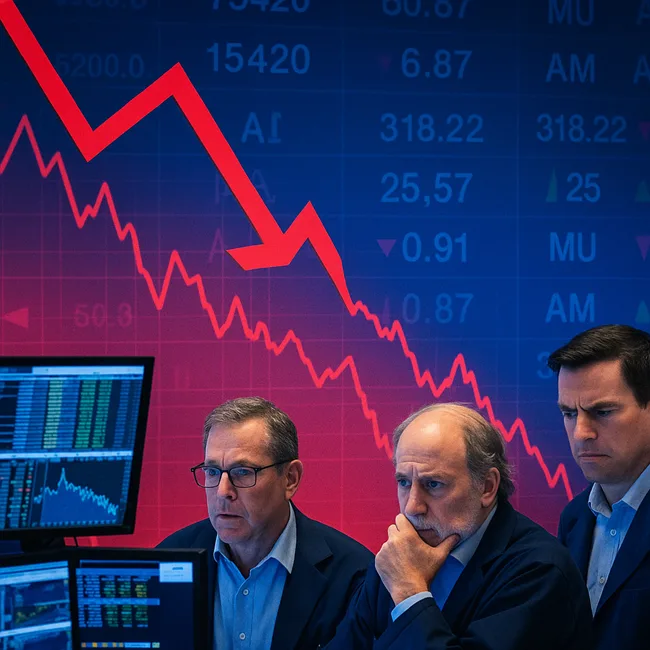
U.S. stock futures slipped on August 20, 2025, as Wall Street weighed a steep sell-off in major technology names and reassessed the future of the artificial intelligence trade. The Nasdaq Composite shed close to 1.6 percent while the S&P 500 dropped around 1.4 percent in the prior session, underscoring how fragile sentiment has become after months of relentless gains in artificial intelligence equities. The rotation came as concerns over an AI bubble gained traction, with OpenAI Chief Executive Officer Sam Altman warning that valuations appeared “frothy” and a new Massachusetts Institute of Technology study concluding that the vast majority of enterprise AI pilots had yet to produce meaningful returns.
Companies including Nvidia Corporation, Advanced Micro Devices Inc., Intel Corporation, and Micron Technology Inc. led the slide, erasing billions in market capitalization in a single trading day. The timing is especially sensitive as investors brace for Federal Reserve Chair Jerome Powell’s keynote speech at the Jackson Hole symposium, which could reset expectations around monetary policy.
What triggered the latest downturn in U.S. technology and AI-linked stocks?
The correction was sparked by a combination of valuation worries, profit-taking after an extended rally, and renewed skepticism about AI’s near-term payoff. Investors rotated into cheaper, more defensive corners of the market such as consumer staples and energy, leaving high-growth technology stocks exposed. The sell-off was particularly acute in the semiconductor sector, where valuations had stretched far above historical norms on the back of AI optimism.
Adding to the sense of caution, Sam Altman remarked that the fervor surrounding AI echoed the dot-com bubble era. While acknowledging the transformative potential of AI models, he suggested that exuberance around smaller startups and speculative projects had reached unsustainable levels. His comments landed just as an academic study from the Massachusetts Institute of Technology reinforced doubts about commercial adoption, noting that nearly 95 percent of surveyed enterprise generative AI pilots delivered only modest or negligible returns.
Together, these developments underscored the fragility of investor confidence, making even marginally disappointing signals a trigger for broad de-risking.
How are institutional investors and analysts interpreting the AI bubble narrative?
The institutional reaction has been mixed but notably cautious. Analysts broadly agree that valuations in the largest AI names may have run ahead of fundamentals, with investor positioning concentrated in a handful of mega-cap technology stocks. This concentration risk, often referred to as the “Magnificent Seven” effect, has left indexes vulnerable to sharp swings whenever sentiment shifts.
Institutional investors note that while companies such as Nvidia and Advanced Micro Devices continue to post strong demand for AI-related hardware, the pace of adoption by enterprise customers has lagged the hype cycle. Large-scale cloud providers remain committed to expanding AI infrastructure, but evidence from corporate surveys shows that many customers struggle to integrate generative AI tools into workflows in a way that produces immediate financial benefits.
Despite the warnings, some strategists emphasize that the infrastructure build-out behind AI adoption is far from over. Enterprise information technology budgets are increasingly allocating funds to AI integration, suggesting that firms specializing in data centers, networking, and cloud services could remain resilient even if speculative valuations in smaller AI-linked equities unwind. This bifurcated outlook is shaping a new phase in the AI trade: caution on overhyped applications but selective optimism for infrastructure enablers.
How are Federal Reserve policy signals shaping investor behavior alongside AI fears?
Beyond sector-specific concerns, the Federal Reserve’s policy outlook has become a decisive factor in the current market mood. Futures markets are pricing in the likelihood of a quarter-percentage-point rate cut as soon as September, reflecting both softening inflation data and concerns over slowing consumer demand. Powell’s keynote address at Jackson Hole will therefore be closely watched for confirmation of whether the central bank intends to pivot toward easing.
The juxtaposition of frothy AI valuations with the possibility of looser monetary conditions has created a tension in investor strategy. Some institutional players fear that premature rate cuts could fuel another leg of speculative excess in already expensive sectors. Others argue that easing would provide much-needed support for cyclical parts of the economy, justifying rotation into more defensive equities rather than renewed bets on high-growth technology.
Adding political complexity, President Donald Trump’s recent call for the resignation of Federal Reserve Governor Lisa Cook, citing allegations of mortgage-finance impropriety, has injected an additional element of uncertainty into monetary policy debates. For investors already grappling with AI volatility, the clash between the White House and the central bank adds to the reasons for a cautious approach.
What does historical context reveal about AI valuation dynamics and bubble risk?
The meteoric rise of AI-linked equities between early 2024 and mid-2025 is widely seen as one of the strongest rallies in modern market history. Companies enabling large-language model training, cloud infrastructure scaling, and semiconductor manufacturing delivered multi-fold gains, lifting the technology sector to an outsized share of the S&P 500 index.
Such concentrated rallies have historical parallels. The dot-com bubble of the late 1990s saw speculative capital pour into internet-linked equities long before business models matured. While many companies eventually failed, the underlying technology went on to reshape the global economy. Analysts caution that a similar pattern could play out with AI: an initial period of overvaluation, correction, and eventual normalization as sustainable use cases emerge.
Altman’s comparison of AI excitement to previous bubbles resonated with investors aware of these cycles. While AI’s long-term potential is unlikely to be dismissed, markets appear to be adjusting expectations to align more closely with near-term revenue realities.
What does recent trading data indicate about investor sentiment in listed AI companies?
Trading activity around major semiconductor and cloud stocks reflected heightened caution. Nvidia Corporation shares fell more than 3 percent on the day, trimming year-to-date gains that had previously exceeded 60 percent. Advanced Micro Devices Inc. also retreated by over 2 percent, while Intel Corporation and Micron Technology Inc. recorded similar declines.
Institutional flows indicated that foreign institutional investors (FIIs) reduced exposure to U.S. technology equities, reallocating toward energy and industrials. Domestic institutional investors (DIIs), meanwhile, were net buyers of defensive healthcare and consumer names, signaling a preference for balance sheet stability over growth exposure. Analysts described the rotation as evidence of a “risk-off” mindset that could persist if further cautionary data emerges.
The pullback also comes after mixed corporate earnings in adjacent sectors. Large retailers such as Target Corporation and Estee Lauder Companies Inc. delivered weaker results, reinforcing concerns about consumer resilience, while Lowe’s Companies Inc. posted stronger than expected performance. These mixed signals heightened volatility as investors searched for clarity on broader economic health.
What does the outlook suggest for markets and AI-driven equities going forward?
The outlook hinges on two parallel forces: monetary policy direction and the trajectory of AI adoption. If Powell signals a willingness to cut rates, investor appetite for riskier assets could rebound, potentially stabilizing technology shares. However, if the Fed remains cautious, markets may continue to punish high-valuation sectors.
For AI equities, analysts expect a period of differentiation. Infrastructure providers such as data center operators and semiconductor manufacturers may continue to see structural demand, even if speculative AI applications falter. Conversely, smaller firms without proven revenue streams could face funding challenges in a higher-scrutiny environment.
Long-term investors may find value in established names with durable balance sheets, while short-term traders could remain wary of volatility spikes. Ultimately, AI’s economic potential is unlikely to fade, but markets appear to be entering a new phase where fundamentals, execution, and realistic expectations matter more than narrative alone.
What key lessons can investors take from the latest AI stock sell-off and bubble debate?
The August 20 sell-off highlighted the market’s sensitivity to both valuation warnings and broader macroeconomic signals. With leading AI voices like Sam Altman urging caution and academic studies questioning the returns of early deployments, investors are recalibrating their expectations. While the promise of AI remains compelling, the current phase suggests that exuberance will need to give way to measurable performance.
For Wall Street, the days of AI hype carrying indexes on its own may be ending. The next chapter will likely depend on how companies demonstrate value creation from AI investments and how monetary policy aligns with risk-taking appetite. Until then, volatility is expected to remain elevated, and selectivity will be the order of the day.
Discover more from Business-News-Today.com
Subscribe to get the latest posts sent to your email.