




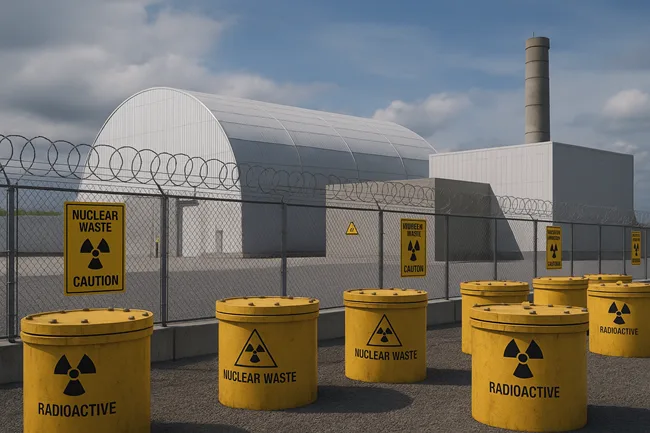
Nuclear waste management and decommissioning are no longer niche engineering activities—they are evolving into a massive industrial ecosystem projected to reach trillion-dollar scale by 2040. From Hanford’s US$589 billion cleanup estimate to the £136 billion Sellafield decommissioning effort and C$16 billion Canadian liabilities at Chalk River, governments are grappling with the financial and technical challenges of legacy nuclear sites.
In Canada, Canadian Nuclear Laboratories (CNL), under the Atomic Energy of Canada Limited (AECL) oversight, is expanding waste containment and decommissioning programs through a new C$1.2 billion annual Government-owned, Contractor-operated (GoCo) contract. In the United States, the Department of Energy (DOE) is forecasting multidecade remediation timelines at sites like Hanford and Savannah River. Analysts increasingly view this sector as a long-cycle, ESG-aligned investment theme driven by policy imperatives, technological innovation, and the restart of nuclear power programs globally.
What do massive cleanup liabilities at Hanford, Sellafield, and Chalk River reveal about the scale and urgency of decommissioning efforts?
The Hanford nuclear reservation in Washington State is emblematic of the sector’s scale and complexity. Once a core part of the Manhattan Project, Hanford holds 56 million gallons of radioactive waste stored in aging tanks, some at risk of leaking into the Columbia River. DOE’s 2025 Lifecycle Scope, Schedule, and Cost Report projects cleanup costs between US$364 billion and US$589 billion, with work extending to at least 2100.
In the UK, Sellafield—Europe’s most contaminated nuclear site—has surpassed £136 billion in projected decommissioning costs, prompting scrutiny from the National Audit Office over governance and funding transparency.
In Canada, AECL estimates a combined C$16 billion in long-term liabilities for environmental remediation at Chalk River and Whiteshell. CNL’s new Near Surface Disposal Facility (NSDF), designed to isolate low-level radioactive waste, represents a cornerstone of Canada’s cleanup strategy. Early phases have already processed 450,000 cubic metres of low-level waste along the Ottawa River shoreline, demonstrating gradual but measurable progress.
The sheer scale of these liabilities underscores why nuclear cleanup is emerging as a critical part of the global energy transition, demanding both public funding and private-sector expertise.
How large is the nuclear waste management market today, and what are its growth projections through 2040?
Despite cleanup liabilities running into hundreds of billions, the commercial nuclear waste management market is still nascent. Industry analysts estimate the global nuclear waste management market at US$5–7 billion in 2024, growing at a 2–5 percent CAGR to reach US$11–12 billion by 2032–33.
However, when factoring in full-lifecycle decommissioning, disposal, regulatory services, and infrastructure upgrades, the addressable market could approach US$1 trillion globally by 2040. North America and Europe currently dominate demand, but emerging nuclear economies in Asia are expected to drive additional decommissioning and disposal contracts as reactors reach end-of-life over the next two decades.
For contractors and technology firms, this creates opportunities in robotics, AI-powered waste tracking, advanced vitrification, and modular waste treatment systems. GoCo-managed labs like CNL and DOE’s national laboratories are serving as test beds for many of these innovations.
What policy and institutional mechanisms are being deployed to manage rising nuclear cleanup costs?
Governments are responding with detailed multi-year plans, public-private contracting frameworks, and stricter oversight. The DOE’s 2025 Hanford cost report introduced phased funding strategies and performance-based contracting to reduce cost escalation. In the UK, regulators are demanding greater transparency at Sellafield, with procurement reforms to reduce project delays.
Canada’s AECL has tightened oversight of CNL’s GoCo contract by integrating risk registers, Indigenous consultation requirements, and annual performance reviews. The new NLPC-led management team—comprising BWX Technologies, Amentum, and Kinectrics—is tasked with improving operational efficiency and stakeholder engagement.
Public accountability and community trust are increasingly critical. Indigenous engagement protocols at Chalk River, for example, are designed to ensure social license for long-term waste disposal infrastructure.
What are the key risks and opportunities as nuclear waste management becomes a mainstream industry?
Key risks include unpredictable geology, technological setbacks, political funding cycles, and public opposition. Hanford’s repeated timeline extensions and Sellafield’s escalating costs illustrate how technical challenges can compound over decades. In Canada, failure to maintain transparent consultation with Indigenous and local communities could slow or even halt projects.
Yet the opportunities are significant. Governments are increasingly outsourcing elements of cleanup, opening revenue streams for engineering firms, specialized waste processors, and environmental services providers. Infrastructure funds, ESG-focused investors, and green bond issuances are entering the sector, viewing it as a stable, government-backed industry with long-term cash flow.
As new nuclear power programs—particularly small modular reactors (SMRs)—gain momentum, proactive waste and decommissioning strategies will become a core credibility driver for nuclear energy’s social acceptance.
What does the long-term outlook for nuclear waste and decommissioning markets look like through 2040?
By 2040, nuclear decommissioning is expected to mature into a consolidated, technology-driven global industry. Analysts expect Canada to become a regional hub for waste technology and decommissioning services, leveraging CNL’s expertise and AECL’s public-private governance model.
The U.S., with DOE labs leading innovation, will remain the largest single market, while Europe’s Sellafield-scale liabilities ensure consistent demand for contractors. Emerging economies in Asia and the Middle East are forecast to adopt Western cleanup models as their reactors age, adding to the global addressable market.
If technological breakthroughs in vitrification, robotic waste handling, and modular deep geological repositories scale effectively, the sector could evolve beyond remediation into a circular economy opportunity—recovering usable isotopes and reducing long-term storage needs.
For institutional and long-horizon investors, the nuclear waste management and decommissioning industry represents a rare convergence of environmental, social, and governance (ESG) impact, sovereign-backed funding security, and multi-decade revenue visibility. Unlike traditional infrastructure sectors that face market cyclicality, nuclear remediation projects are almost entirely underwritten by government agencies or state-owned enterprises, ensuring consistent cash flow across decades.
The ESG alignment is particularly significant: decommissioning and waste containment are directly tied to climate resilience, groundwater protection, and environmental restoration goals, making them highly attractive for green bond issuances, ESG-themed exchange-traded funds, and sustainability-focused infrastructure funds. Leading financial institutions have begun classifying nuclear cleanup bonds and decommissioning equity stakes alongside renewable energy infrastructure as “high-impact green investments.”
From a revenue standpoint, most cleanup contracts operate on long-cycle, cost-plus or performance-incentive models, with guaranteed payouts over 10–30 years. This provides predictability rarely found in private infrastructure plays, where returns are often exposed to commodity price swings or regulatory volatility. Companies like BWX Technologies, Jacobs Engineering, and Veolia Nuclear Solutions have already established themselves as prime contractors, offering investors indirect exposure to a sector where backlogs can exceed US$10 billion per operator.
As global energy markets accelerate toward small modular reactor (SMR) deployments and nuclear power restarts, the waste management and decommissioning sector is expected to scale further, creating secondary markets for specialized robotics, AI-powered waste tracking, and isotope recovery technologies. This combination of ESG credibility, locked-in government funding, and long-term contract stability positions nuclear waste management as one of the most compelling infrastructure investment opportunities of the energy transition era—a strategic hedge for portfolios seeking stable, green-aligned returns in a decarbonizing global economy.
Discover more from Business-News-Today.com
Subscribe to get the latest posts sent to your email.