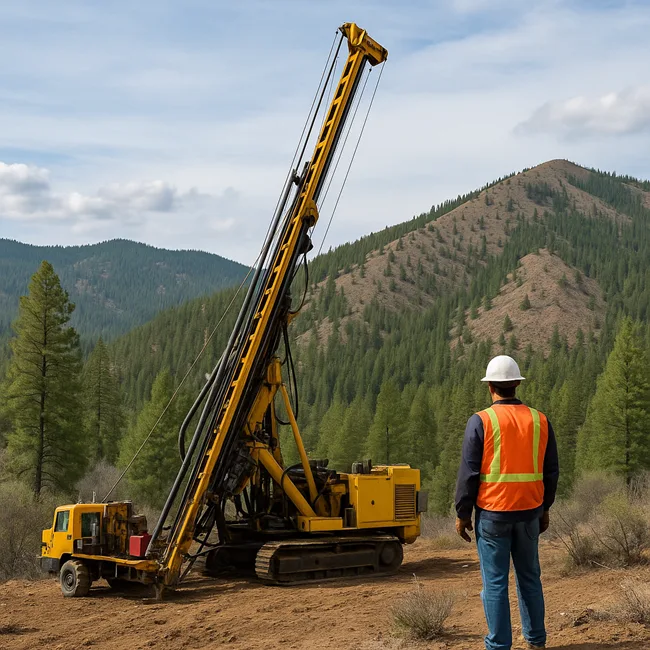
Metallis Resources Inc. (TSXV: MTS, OTCQB: MTLFF, Frankfurt: 0CVM) has officially commenced its first drill program at the Greyhound property in Idaho’s historic Stibnite Mining District. The Vancouver-based exploration company announced on August 22 that the inaugural campaign will test silver, gold, and antimony targets within a 3.5-kilometer mineralized shear zone.
Chief executive officer Fiore Aliperti described the launch as a turning point, noting that the Greyhound has intrigued prospectors for more than a century but has never been tested with modern exploration techniques. According to Aliperti, the combination of historic showings, recent groundwork, and systematic drilling could unlock new potential and form the basis for shareholder value creation.
What is included in the Greyhound inaugural drill campaign and what targets are being prioritized?
The 2025 campaign will cover approximately 2,000 meters of diamond drilling and has been contracted to Foraco Drilling Ltd., a global drilling services provider. The program is designed to systematically evaluate three priority zones.
The 1350’ Target will be one of the first areas tested, where past channel sampling returned values of 1.85 grams per tonne of gold and 785 grams per tonne of silver over 36.9 meters in the Lower Rufus Adit. The Bulldog Target, a broad shear zone accessible by road and characterized by quartz-sulfide veins, is another key site. The Birdie Target, which runs parallel to the Greyhound shear zone and has visible trenches and adits, is the third focus area.
Metallis stated that this marks the first organized drill testing ever carried out at Greyhound, distinguishing it from past prospecting and limited historical activity.
How does the Greyhound property connect to Idaho’s mining history and why is it considered significant?
The Greyhound property, located in Custer County, Idaho, about 42 kilometers northwest of Stanley and 35 kilometers south of Perpetua Resources’ Stibnite Mine, was once part of an active silver mining camp in the early 1900s. At its peak, the district hosted two mines and a smelter along the Greyhound shear.
Mineralization at Greyhound includes polymetallic quartz-sulfide veins rich in gold, silver, antimony, lead, and zinc. This geology has drawn comparisons to Idaho’s famed Silver Valley, one of the most prolific silver districts in the world, which historically produced over one billion ounces of silver, three million tons of zinc, and eight million tons of lead.
Why is antimony seen as a critical mineral and how does it add strategic value to the project?
Greyhound is notable not only for its gold and silver potential but also for its elevated antimony content. Antimony is listed as a critical mineral by the United States government due to its importance in flame retardants, military applications, semiconductors, and energy storage technologies.
In a period where geopolitical concerns and supply chain vulnerabilities are reshaping mineral exploration strategies, the presence of antimony within the Greyhound property adds another layer of potential value. Analysts view antimony discoveries in domestic U.S. districts as strategically important, particularly given rising federal focus on securing supplies of critical minerals.
How does Metallis Resources position Greyhound within its broader exploration portfolio?
Metallis Resources primarily focuses on its 100%-owned Kirkham property in British Columbia’s Golden Triangle, which is prospective for gold, copper, and silver. The Greyhound project, optioned in February 2024, provides a complementary U.S.-based exploration asset.
The company has outlined a dual strategy: advancing Kirkham in a proven mining region known for major discoveries, while simultaneously testing the underexplored Greyhound property in Idaho to add exposure to silver and antimony. Together, these assets are designed to diversify Metallis’ exploration portfolio and improve its leverage to multiple metals across jurisdictions.
What does institutional sentiment suggest about the launch of Greyhound drilling?
While small-cap exploration stocks such as Metallis Resources often trade on speculative momentum, institutional sentiment toward the Greyhound program is cautiously optimistic. Market observers have noted that the combination of high-grade historical samples, underexplored geology, and antimony’s critical mineral status provides a compelling narrative for early-stage investors.
However, analysts caution that the program is still in its infancy, with results yet to be produced. Until drill assays are released, sentiment is expected to fluctuate in line with broader junior mining trends. Exploration firms on the TSX Venture Exchange, where Metallis trades under the symbol MTS, often see share price movements linked to assay reporting timelines.
What has been the stock performance of Metallis Resources and how are investors positioning?
Metallis Resources trades under MTS on the TSX Venture Exchange, MTLFF on the OTCQB, and 0CVM on the Frankfurt Stock Exchange. The company has approximately 84.7 million common shares outstanding.
Shares of Metallis have historically been thinly traded, a common feature among early-stage exploration companies. Ahead of the drilling announcement, investors showed modest accumulation, with trading volumes reflecting growing anticipation of first assays. Institutional flows in the junior mining sector remain selective, with buy-side interest concentrated in assets tied to critical minerals or historically prolific districts such as Idaho’s Stibnite belt.
Analysts point out that junior miners with credible drill programs often see short-term share price volatility around initial drill results. For Metallis, positive results could support a rerating, while weak or inconclusive assays could dampen near-term sentiment.
What outlook do analysts see for Greyhound drilling and what comes next for Metallis?
Looking ahead, analysts expect assay results from the Greyhound program to be the next critical catalyst. If the drilling validates historical sampling and identifies economic grades, Metallis could proceed with follow-up drilling, expanded exploration, and potential resource delineation.
In addition to Greyhound, the company’s exploration activity at Kirkham remains important. The Golden Triangle region has historically attracted joint ventures and acquisitions by larger mining companies, and success there could draw strategic interest.
For Greyhound, the inclusion of antimony as part of the mineralization could also align Metallis Resources with evolving U.S. critical mineral strategies. Antimony has been recognized by the U.S. Department of the Interior as a critical mineral because of its strategic role in defense applications, renewable energy technologies, and flame-retardant materials. At present, the United States is heavily dependent on imports of antimony, primarily from China and Russia, which has raised concerns about supply chain security. By advancing a project with measurable antimony content in Idaho, Metallis could position itself not only as a gold and silver explorer but also as a potential contributor to domestic supply of this essential material.
The ability to demonstrate a reliable North American source of antimony could become a differentiator in attracting both public and private investment. Policymakers in Washington have been steadily increasing incentives and funding opportunities for projects that can reduce reliance on foreign critical minerals. Exploration companies that can validate economically viable deposits of antimony on U.S. soil may gain preferential access to grants, strategic partnerships, and institutional flows directed at securing domestic resource independence. For Metallis, this could mean that Greyhound is not merely an early-stage exploration play, but a strategically aligned project that speaks directly to national priorities.
From an investor perspective, the dual exposure to precious metals and a critical mineral enhances the project’s potential appeal. Gold and silver provide traditional value drivers, offering a hedge against inflation and a route to near-term market interest. Antimony, however, introduces a layer of structural demand tied to defense procurement and the energy transition. Analysts note that this blend of traditional precious metal upside with critical mineral significance could make Greyhound stand out in a crowded field of early-stage juniors, especially if drilling confirms grades that justify further investment.
Discover more from Business-News-Today.com
Subscribe to get the latest posts sent to your email.