Locksley Resources Limited (ASX: LKY; OTCQX: LKYRF) has significantly advanced its position as a key player in America’s critical minerals landscape after securing a Letter of Interest from the Export-Import Bank of the United States (EXIM) that outlines up to 191 million dollars in potential financing support for the company’s Mojave Project in California. In parallel, the Australian-listed but U.S.-focused firm provided a detailed operational update on the Desert Antimony Mine within the same project area, showcasing a multi-pronged strategy that combines upstream extraction, downstream processing, and strong federal alignment.
Locksley Resources is now among the most closely watched developers in the race to restore domestic antimony supply chains, an effort that directly supports U.S. national security, clean energy independence, and industrial resilience. The November 2025 updates illustrate a project moving rapidly through pre-development phases with both technical de-risking and institutional momentum building around it.

Why are U.S. policymakers accelerating domestic antimony projects and treating the mineral as essential for national security and clean energy supply chains?
Antimony is on the U.S. Department of the Interior’s critical minerals list, with applications spanning military-grade flame retardants, semiconductors, batteries, and specialty alloys used across the defense and clean energy industries. The element is almost entirely imported, with China, Russia, and Tajikistan controlling the vast majority of global production. That concentration of supply has created strategic vulnerabilities that are now front and center in U.S. industrial policy.
In response, the U.S. government has launched several programs including the Supply Chain Resiliency Initiative and the China and Transformational Exports Program to re-shore production of materials like antimony. These programs have expanded the mandate of EXIM Bank, which is now actively financing domestic mining, processing, and manufacturing projects that reduce dependence on foreign sources. The EXIM support extended to Locksley Resources reflects this new financing paradigm, where strategic alignment with federal priorities can unlock substantial capital access for critical minerals developers.
How the Mojave Project is pushing toward U.S. antimony independence
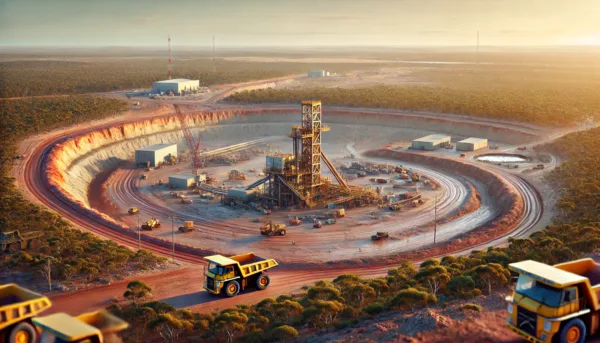
Locksley Resources is advancing the Mojave Project in San Bernardino County, California, and has positioned it as one of the fastest-moving U.S.-based antimony plays. The project centers around the Desert Antimony Mine, also known as DAM, which is undergoing accelerated development planning following several technical milestones in 2025.
Recent assessments of underground access have confirmed that historical workings at the mine are structurally sound and accessible, enabling safe re-entry and phased development. Mining engineers are scheduled to inspect the site later in November as part of design work for a pilot-scale processing facility. These efforts are backed by exploration data that includes approximately 236 meters of development across four levels spanning a 130-meter strike length. Based on this work, the company has established an exploration target containing between 19,400 to 67,000 tons of antimony metal, though this remains a conceptual estimate under the JORC Code and does not yet constitute a mineral resource.
Bulk sampling has returned promising grades. A recently completed 325-kilogram sample produced head grades of between 7.6 and 7.8 percent antimony. A smaller 23.1-kilogram sample returned an even higher grade of 9.6 percent, with subsequent flotation tests yielding concentrate at 68.1 percent purity, which aligns with both industrial and defense specifications. Additional underground mapping and sampling are currently underway and expected to deliver assay results by December 2025.
Surface sampling and drilling are also ramping up. A plan of operations has been approved, pending the posting of a required bond, which will allow Locksley Resources to commence drilling up to 16 holes at the Desert Antimony Mine. However, the company has indicated that drilling may first begin at the El Campo Prospect, also part of the Mojave Project, before returning to DAM in early 2026.
Parallel exploration activities include magnetic geophysical interpretation led by SGC, aimed at refining the structural geology of the broader Mojave Project area. This work is expected to conclude in the first quarter of 2026 and will help identify new structures that could expand the project’s exploration footprint. A third phase of surface geological mapping is scheduled to begin in late November, building on earlier campaigns. Regional stream sediment sampling is also in final planning and could further support new discovery once completed by the end of 2025.
How could EXIM Bank’s $191 million Letter of Interest accelerate Locksley’s path to U.S. antimony production and critical minerals self-reliance?
The 191 million dollar Letter of Interest issued by EXIM is a pivotal development in Locksley Resources’ financing roadmap. Although not a binding commitment, the LOI signals that the Mojave Project has passed an initial threshold of strategic relevance and technical credibility required to enter EXIM’s formal due diligence pipeline. The U.S. government’s interest in supporting the project strengthens the likelihood of downstream investment, offtake partnerships, and additional federal or state-level engagement.
Managing Director and Chief Executive Officer Kerrie Matthews stated that the LOI provides a strong foundation for formal negotiations around a comprehensive financing package. Matthews also pointed to the production of a 100 percent American-made antimony ingot as evidence of Locksley Resources’ operational capability and market readiness. The ingot, now manufactured and tested, is a tangible outcome that demonstrates downstream potential.
Strategic partners are also beginning to surface. The company is working with Rice University’s Deep Solve initiative to explore modular, scalable processing systems that can be quickly deployed to support domestic refining. This collaboration aims to accelerate the deployment of U.S.-based processing infrastructure and avoid the bottlenecks often seen in large-scale centralized refineries.
Drew Horn, a former White House advisor on critical minerals and now Chief Executive Officer of GreenMet, which advises Locksley Resources, emphasized that the EXIM LOI is part of a larger federal directive to reconstitute domestic supply chains. He stated that almost all U.S. government funding for critical minerals is now being steered by White House-led initiatives and that Locksley Resources stands to benefit as one of the few vertically aligned developers in this space.
How are analysts and investors interpreting Locksley’s fast‑track antimony strategy and what near‑term catalysts could influence the Mojave Project’s valuation outlook?
Investor attention is increasing as Locksley Resources demonstrates real movement across multiple workstreams that are often bottlenecks for junior mining companies. Analysts following critical mineral equities are monitoring three near-term triggers: first, the completion of underground and surface sampling results due in November and December; second, the potential commencement of pilot plant operations, which would validate processing viability; and third, progress in EXIM’s due diligence process which could lead to formal financing in the first half of 2026.
While the company remains pre-revenue, its presence on both the Australian Securities Exchange and the OTCQX in the U.S. provides dual exposure to institutional capital pools. As of mid-November 2025, the stock has been thinly traded, but sector analysts believe EXIM backing and positive assay results could act as catalysts for a market re-rating.
Locksley Resources is also viewed favorably due to its vertically integrated model. By handling both resource development and processing within the United States, the company offers a rare combination of technical execution and strategic policy fit. This approach may appeal to institutional investors and defense-focused offtakers looking for secure and traceable supply chains.
What comes next for the Mojave Project and U.S. antimony independence?
Locksley Resources is now positioned to become a cornerstone of U.S. efforts to secure its own critical mineral supply chains. With the Desert Antimony Mine already producing high-grade samples and permitting progressing for a larger-scale drilling program, the next phase of development will hinge on pilot plant validation and financing closure.
The broader roadmap includes integrating data from geological mapping, stream sediment sampling, and regional magnetic surveys to guide further exploration. Concurrently, refining technology pilots with academic partners such as Rice University are expected to shape how quickly downstream capacity can be scaled.
The convergence of federal financial backing, high-purity output, and domestic processing ambition makes the Mojave Project one of the more advanced antimony initiatives within North America. As U.S. policymakers continue to prioritize critical mineral independence, Locksley Resources is increasingly viewed not just as a junior explorer, but as a strategic actor capable of delivering industrial-grade antimony supply to U.S. markets.
What are the key takeaways from Locksley Resources’ Mojave Project and EXIM funding update?
- Locksley Resources Limited is rapidly advancing its Mojave Project in California, focused on restoring a domestic U.S. supply chain for antimony through its Desert Antimony Mine.
- The company received a Letter of Interest from the Export-Import Bank of the United States for up to 191 million dollars in potential project financing, signaling federal-level alignment with U.S. strategic minerals policy.
- Locksley confirmed exploration targets of up to 67,000 tons of antimony metal, supported by bulk sampling that delivered concentrate grades as high as 68.1 percent.
- A range of exploration activities including underground mapping, surface sampling, and regional geophysics are underway, with assay results expected by late 2025 and early 2026.
- Pilot plant planning is in motion, with site engineering studies scheduled for completion in Q4 2025 to support modular, U.S.-based refining.
- Rice University and GreenMet are supporting Locksley’s downstream processing and policy strategy, aimed at delivering 100 percent American-made antimony ingots for defense and energy transition use.
- The project benefits from bipartisan U.S. policy momentum around critical minerals, with EXIM financing viewed as a major de-risking milestone by analysts.
- Near-term investor attention is focused on drilling activity, EXIM due diligence, and potential offtake agreements that could validate market interest in U.S.-origin antimony.
- Locksley’s vertically integrated mine-to-metal model is rare among junior miners and is increasingly seen as a blueprint for U.S. critical minerals independence.
- As development accelerates, analysts believe the Mojave Project could emerge as one of the fastest-moving and most strategically significant antimony projects in North America.
Discover more from Business-News-Today.com
Subscribe to get the latest posts sent to your email.