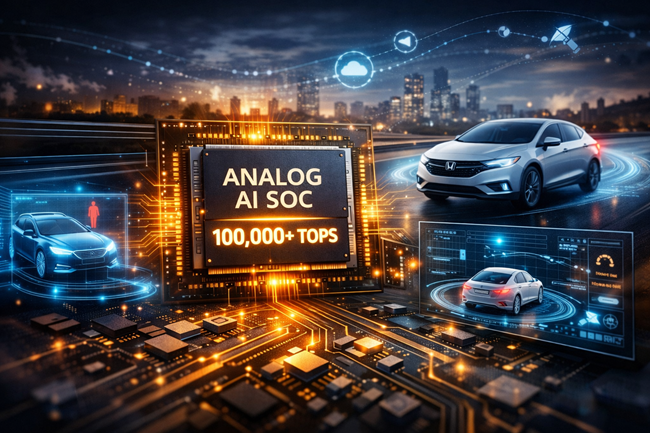
Honda Motor Co., Ltd. has entered a long-term joint development agreement with Silicon Valley-based Mythic to co-develop an automotive-grade analog artificial intelligence system-on-chip for deployment in Honda’s next generation of software-defined vehicles. The collaboration reflects a strategic shift in how Honda is thinking about onboard computing, energy efficiency, and the future scalability of advanced driver assistance and autonomous systems.
Under the agreement, Honda R&D Co., Ltd., the research and development subsidiary of Honda Motor Co., Ltd., will license Mythic’s Analog Processing Unit technology while working closely with Mythic engineers to design, validate, and integrate a production-ready analog AI system-on-chip. Initial prototype chips are expected to be tested in Honda vehicles toward the late 2020s, with commercial deployment targeted for the early 2030s following successful trials and automotive qualification.
At the center of the partnership is an ambitious performance target. The jointly developed chip aims to deliver more than 100,000 trillion operations per second of AI compute while achieving roughly 100 times greater energy efficiency compared with conventional digital AI accelerators. For Honda, this is not simply a performance upgrade. It is a foundational bet on a different computing paradigm that could redefine how intelligence is deployed inside vehicles at scale.
Why power efficiency has become the limiting factor for automotive AI roadmaps
Modern vehicles are increasingly constrained not by raw computing demand, but by energy availability and thermal limits. As vehicles evolve into software-defined platforms, the number of sensors, cameras, radar units, and AI models required to process real-time data continues to grow. At the same time, automakers must balance battery range, thermal management, cost, and long-term reliability.
Honda Motor Co., Ltd. views this tension as one of the defining challenges of next-generation mobility. Advanced driver assistance systems, higher levels of autonomy, and intelligent in-cabin features all depend on running complex neural networks continuously and locally. Cloud offloading is neither sufficient nor acceptable for safety-critical functions, particularly in scenarios where connectivity is unreliable or latency is unacceptable.
Traditional digital AI chips, many of which trace their architectural roots back to data center GPUs, struggle to meet these constraints when scaled aggressively inside vehicles. Memory access and data movement consume disproportionate amounts of energy, leading to diminishing returns as performance targets rise. Honda’s decision to explore analog compute-in-memory reflects a recognition that incremental efficiency gains may no longer be enough.
How Mythic’s analog compute-in-memory architecture changes the equation
Mythic’s technology departs fundamentally from digital architectures by collapsing memory and computation into a single analog plane. Instead of shuttling data back and forth between separate memory and processing units, computation occurs directly where the data resides. This approach drastically reduces energy consumption associated with data movement, which has become the dominant source of inefficiency in digital AI systems.
In practical terms, Mythic claims its Analog Processing Units can deliver up to 100 times better performance per watt for AI inference compared with conventional digital chips. For automotive applications, this translates into the ability to run significantly more complex models within the same power budget or to reduce overall system power consumption while maintaining high levels of intelligence.
Honda R&D leadership has positioned this capability as strategically aligned with the company’s long-term safety and sustainability objectives. Vehicles are inherently power-limited systems, and achieving meaningful gains in AI capability without compromising efficiency is essential if autonomous features are to be deployed broadly rather than confined to premium segments.
What 100,000+ TOPS enables inside software-defined vehicles
The headline figure of more than 100,000 TOPS represents a qualitative shift in what can be done onboard a vehicle. At this scale, multiple classes of AI models can operate simultaneously without competing for limited compute resources.
Vision transformers can be used for richer and more robust perception, enabling vehicles to interpret complex environments with greater accuracy. Physics-informed neural networks can support real-time vehicle dynamics modeling, improving stability, control, and predictive safety responses. Large language models can power in-car assistants that operate entirely offline, enhancing user experience while preserving privacy and reliability.
Crucially, this level of compute also allows for redundancy and diversity in AI systems. Rather than relying on a single monolithic model, vehicles can run parallel models trained differently or optimized for specific conditions. From a safety and regulatory standpoint, this redundancy is increasingly seen as essential for higher levels of autonomy.
Honda Motor Co., Ltd. appears to be positioning this analog AI system-on-chip as a core enabler of its future software-defined vehicle platforms, rather than as a bolt-on accelerator limited to specific features.
How analog AI underpins Honda Motor Co., Ltd.’s long-term safety roadmap and carbon neutrality targets
Honda has consistently framed its technology investments through the lens of its “Safety for Everyone” philosophy and its goal of achieving zero traffic collision fatalities involving Honda vehicles globally by 2050. The Mythic partnership fits squarely within this narrative.
Higher onboard intelligence enables faster perception, better prediction, and more nuanced decision-making in complex driving scenarios. At the same time, improved energy efficiency supports Honda’s broader carbon neutrality objectives by reducing the power demands of increasingly compute-heavy vehicles.
From a strategic perspective, analog AI offers Honda a potential path to scaling advanced safety and autonomy features across a wider range of vehicles, including mass-market models, without incurring prohibitive energy or cost penalties.
Why this partnership matters for Mythic’s commercial trajectory
For Mythic, the joint development agreement with Honda Motor Co., Ltd. represents a significant validation of its technology and roadmap. Analog AI has long been discussed as a promising alternative to digital computing, but large-scale commercial adoption has been limited by concerns around manufacturability, reliability, and ecosystem support.
Automotive deployment imposes some of the strictest requirements in the semiconductor industry, including extended operating lifetimes, wide temperature ranges, and rigorous safety standards. Honda’s willingness to co-develop an automotive-grade system-on-chip suggests confidence that Mythic’s architecture can meet these demands.
The partnership also builds on Mythic’s recent funding round of approximately $125 million, which included participation from strategic and deep-technology investors. Securing a development program with a global automotive original equipment manufacturer significantly strengthens Mythic’s position as it seeks to move from niche deployments to high-volume markets.
How Honda Motor Co., Ltd.’s analog AI bet could reshape competition in automotive AI silicon
The collaboration between Honda Motor Co., Ltd. and Mythic signals a broader industry reassessment of how AI compute should be delivered at the edge. While digital accelerators remain dominant today, their energy efficiency limitations are becoming more pronounced as workloads grow.
If Honda’s trials validate Mythic’s performance-per-watt claims under real automotive conditions, analog compute-in-memory architectures could emerge as a credible alternative or complement to existing digital solutions. This would have implications not only for automakers, but also for established semiconductor suppliers whose roadmaps are heavily invested in digital architectures.
From a competitive standpoint, Honda’s early engagement could provide it with a differentiated compute platform that is difficult for rivals to replicate quickly, particularly if the joint development results in tightly integrated hardware and software stacks.
How investors may interpret Honda Motor Co., Ltd.’s long-cycle analog AI investment
For investors, the announcement is unlikely to have immediate financial implications for Honda Motor Co., Ltd., given the long development timelines involved. However, it reinforces the company’s positioning as a technology-driven automaker willing to invest early in foundational capabilities.
The partnership also highlights a shift in how value is being created in the automotive sector. As vehicles become more software-defined, control over core computing architectures may become as strategically important as traditional strengths in manufacturing and supply chain management.
Analog AI remains an emerging field, and execution risks remain significant. Manufacturing scalability, consistency across process nodes, and integration with existing automotive software ecosystems will all be closely watched as the program progresses.
What to watch next as Honda and Mythic move toward vehicle trials
The next major milestone will be the delivery and testing of prototype chips in real vehicle environments. These trials will determine whether theoretical efficiency advantages translate into consistent, reliable performance under automotive conditions.
Success would position Honda Motor Co., Ltd. to accelerate its roadmap for advanced driver assistance and autonomous features while maintaining strict energy and cost discipline. Failure would underscore the challenges of bringing novel computing paradigms into safety-critical, high-volume markets.
From an industry analyst perspective, the collaboration represents one of the most concrete attempts yet to bring analog AI into mainstream automotive computing. Whether it becomes a blueprint for others will depend on execution, validation, and the ability to scale beyond pilot programs.
Key takeaways: What Honda Motor Co., Ltd.’s analog AI partnership really means
- Honda Motor Co., Ltd. has entered a long-cycle joint development agreement with Mythic to co-develop an automotive-grade analog AI system-on-chip for future software-defined vehicles, targeting deployment in the late 2020s to early 2030s.
- The partnership centers on Mythic’s analog compute-in-memory architecture, which aims to deliver roughly 100 times greater energy efficiency than conventional digital AI chips while scaling onboard compute beyond 100,000 trillion operations per second.
- Power efficiency, rather than raw compute demand, is emerging as the primary constraint for advanced driver assistance systems and autonomous driving, making analog AI strategically attractive for mass-market vehicle deployment.
- Achieving data-center-scale AI performance within automotive power and thermal limits could enable richer perception, redundancy-driven safety architectures, and fully offline in-vehicle intelligence.
- The collaboration aligns closely with Honda Motor Co., Ltd.’s long-term goals of zero traffic collision fatalities and carbon neutrality, positioning onboard AI as a core safety and sustainability enabler.
- For Mythic, the agreement represents a major commercial validation of analog AI technology and a potential pathway into high-volume automotive markets.
- From a competitive standpoint, successful validation could challenge the dominance of digital automotive AI accelerators and give Honda Motor Co., Ltd. a differentiated compute platform over the next decade.
- Investor sentiment is likely to frame the deal as a strategic option with long-term upside rather than a near-term earnings catalyst, with execution and scalability remaining key risks to monitor.
Discover more from Business-News-Today.com
Subscribe to get the latest posts sent to your email.