



Inovar Packaging Group, LLC, a Dallas-based national label and packaging platform, has acquired Kiliper Corporation, a Midwest-based producer of stretch sleeves, roll-fed labels, and printed film solutions. The transaction expands Inovar Packaging Group’s technical footprint in wide-web flexible packaging while reinforcing its strategy of building a diversified, acquisition-led national manufacturing platform.
The deal matters less for headline scale and more for capability density. Stretch sleeves, roll-fed labels, and printed films represent faster-growing, higher-complexity segments of the labeling and packaging value chain, where speed, customization, and run-length flexibility increasingly matter to brand owners navigating SKU proliferation and supply chain volatility.
What strategic gap is Inovar Packaging Group addressing by acquiring Kiliper Corporation now
Inovar Packaging Group has spent the past several years assembling a national platform across prime labels, shrink sleeves, and extended content solutions, primarily through targeted acquisitions rather than greenfield expansion. The acquisition of Kiliper Corporation fits squarely into that playbook but also signals a more deliberate move into flexible packaging adjacencies that sit closer to customers’ full packaging system requirements.
Stretch sleeves and roll-fed labels occupy a distinct position between traditional pressure-sensitive labels and shrink sleeves. They are often chosen for cost efficiency, recyclability considerations, and compatibility with high-speed filling lines, particularly in food and beverage, household chemicals, and industrial consumables. By adding Kiliper Corporation’s wide-web flexographic printing and converting capabilities, Inovar Packaging Group gains access to applications that can be cross-sold alongside its existing label formats rather than competing with them.
Timing also matters. Brand owners are under pressure to simplify supplier bases while still demanding shorter lead times and greater design flexibility. Acquiring a company that specializes in short-to-medium-run production allows Inovar Packaging Group to position itself as a more responsive, multi-format partner rather than a single-technology vendor. In that sense, the transaction is less about volume and more about relevance in procurement conversations.
How Kiliper Corporation’s wide-web and flexographic capabilities reshape Inovar’s manufacturing mix
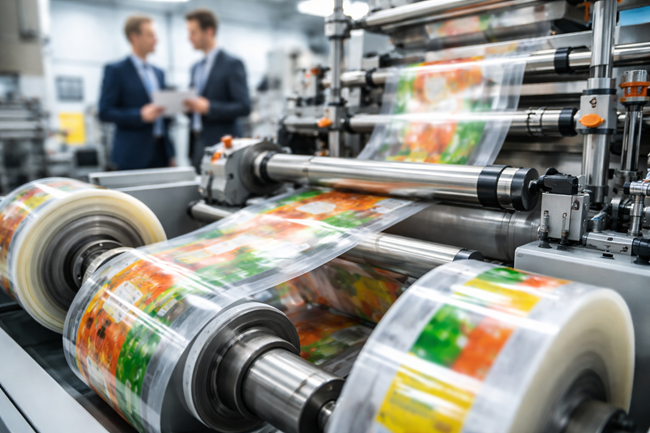
Kiliper Corporation brings a production profile that complements rather than duplicates Inovar Packaging Group’s existing assets. As a wide-web printing and converting business, Kiliper Corporation is optimized for flexible materials such as films and polybags, using flexographic technology suited for longer webs and higher throughput.
This matters operationally because wide-web flexo enables cost-effective production of roll-fed labels and printed films at scales that are difficult to replicate on narrow-web label presses. For Inovar Packaging Group, this expands its manufacturing mix without forcing a reconfiguration of existing plants. Instead, it adds a parallel capability that can absorb different types of customer demand.
Equally important is Kiliper Corporation’s reputation for fast turnaround times and value-add services. In packaging, service levels increasingly act as a competitive moat, particularly for regional and mid-sized brands that lack the volumes to command priority from global suppliers. Integrating Kiliper Corporation’s operational discipline into a larger national network could allow Inovar Packaging Group to offer both scale and speed, a combination that is not trivial to execute.
Why the Midwest footprint expansion matters for regional and national brand customers
Geography remains a non-trivial factor in packaging economics. Freight costs, lead times, and responsiveness to production changes all benefit from regional proximity. Kiliper Corporation’s Midwest presence strengthens Inovar Packaging Group’s ability to serve customers in central and northern U.S. markets without relying solely on long-haul logistics from coastal or southern facilities.
For national brand customers, this creates optionality in production planning and risk mitigation. For regional customers, it preserves the local service model that often differentiates family-owned converters from larger conglomerates. The challenge for Inovar Packaging Group will be to scale operational integration without eroding the local responsiveness that made Kiliper Corporation attractive in the first place.
From a strategic standpoint, Midwest expansion also positions Inovar Packaging Group closer to industrial, janitorial, and sanitation customers, segments that often value functional performance and supply reliability over branding complexity. These end markets tend to generate stable demand even during economic slowdowns, offering a degree of revenue defensiveness.
How leadership continuity at Kiliper Corporation reduces integration and execution risk
One of the quieter but more consequential elements of the transaction is the decision for Kiliper Corporation’s owners, Tom Kiliper and Lindsay Maysent, to remain as Co-Presidents post-acquisition. In packaging, where customer relationships and operational know-how are deeply embedded in leadership teams, retention often matters more than formal integration timelines.
Keeping second-generation family leadership in place reduces the risk of customer churn during the transition and preserves institutional knowledge around equipment, workflows, and client preferences. For Inovar Packaging Group, this also signals a partnership-oriented acquisition approach rather than a cost-cutting or consolidation-heavy model.
However, leadership continuity also implies limits on how quickly Inovar Packaging Group can standardize processes or centralize decision-making. The balance between autonomy and platform discipline will be a key determinant of whether the acquisition delivers its intended strategic value without operational friction.
What this deal signals about consolidation trends in labeling and flexible packaging
The labeling and flexible packaging sector continues to consolidate, driven by private equity interest, customer demand for scale, and the rising capital intensity of printing and converting technologies. Inovar Packaging Group’s acquisition of Kiliper Corporation reflects a broader shift toward building multi-technology platforms rather than single-format specialists.
Unlike mega-mergers aimed at cost synergies, this transaction appears focused on capability layering and market access. That approach aligns with a growing recognition that packaging customers increasingly want integrated solutions spanning labels, sleeves, and films, even if production occurs across different plants.
For smaller independent converters, this trend raises the bar. Competing solely on price or local relationships becomes harder as platforms like Inovar Packaging Group expand their technological breadth while maintaining regional footprints. At the same time, the continued use of partnership language and leadership retention suggests that well-run family businesses may still find attractive exit options without being fully absorbed into corporate structures.
How sustainability and material choices influence the strategic logic of the acquisition
While the announcement emphasizes capability expansion, sustainability considerations sit just below the surface. Stretch sleeves and certain roll-fed label formats can offer material efficiency advantages compared to traditional pressure-sensitive labels, particularly when designed for recyclability or downgauging.
Brand owners facing regulatory and consumer pressure around packaging waste are increasingly open to alternative labeling formats that reduce material usage or improve compatibility with recycling streams. By expanding into these formats, Inovar Packaging Group positions itself to participate in sustainability-driven redesigns rather than reacting defensively to them.
That said, sustainability in flexible packaging remains complex, with trade-offs between material types, recyclability, and performance. Execution will depend on Inovar Packaging Group’s ability to invest in material science expertise and collaborate with customers on application-specific solutions rather than treating sustainability as a marketing overlay.
What operational and competitive risks could limit upside from the Kiliper acquisition
Despite the strategic logic, execution risk should not be understated. Integrating wide-web flexographic operations into a platform that may be more accustomed to narrow-web label environments requires careful coordination across procurement, scheduling, and quality systems.
There is also the risk of internal competition for capital and management attention. As Inovar Packaging Group continues to pursue acquisitions, prioritizing investments across plants and technologies could become more complex. Without disciplined capital allocation, the platform risks becoming a collection of capabilities rather than a coherent operating system.
Competitively, larger global packaging groups with deep flexible packaging portfolios may still outgun Inovar Packaging Group on scale and pricing for certain applications. The company’s differentiation will likely hinge on responsiveness, customization, and service rather than pure cost leadership.
What happens next if Inovar Packaging Group continues its acquisition-led growth strategy
If the integration proceeds smoothly, the acquisition of Kiliper Corporation could serve as a template for future deals in adjacent flexible packaging niches. Expect Inovar Packaging Group to continue targeting businesses that add technical depth or geographic reach rather than sheer volume.
Over time, this could reposition the company from a label-centric platform to a broader packaging solutions provider, capable of serving complex, multi-format needs across consumer and industrial end markets. The success of that evolution will depend on whether the company can maintain cultural cohesion and operational discipline as complexity increases.
Failure, by contrast, would likely manifest not as a dramatic breakdown but as gradual dilution of focus, slower response times, and missed cross-selling opportunities. In a sector where margins are earned through execution rather than innovation alone, those risks are material.
Key takeaways: What Inovar Packaging Group’s acquisition of Kiliper Corporation means for the packaging industry
- The acquisition strengthens Inovar Packaging Group’s position in stretch sleeves, roll-fed labels, and printed films, expanding its relevance in flexible packaging applications.
- Kiliper Corporation’s wide-web flexographic capabilities add manufacturing depth without duplicating existing assets, improving portfolio balance.
- Midwest footprint expansion enhances regional responsiveness and logistics efficiency for both regional and national customers.
- Leadership continuity at Kiliper Corporation reduces near-term integration risk and preserves customer relationships.
- The deal reflects a broader consolidation trend focused on capability layering rather than pure scale.
- Sustainability considerations indirectly support the strategic rationale by enabling alternative, material-efficient labeling formats.
- Execution risk lies in operational integration and capital allocation discipline across a growing platform.
- Competitive differentiation will depend on service, customization, and speed rather than price leadership.
- The transaction positions Inovar Packaging Group for continued acquisition-led growth into adjacent packaging niches.
Discover more from Business-News-Today.com
Subscribe to get the latest posts sent to your email.

