




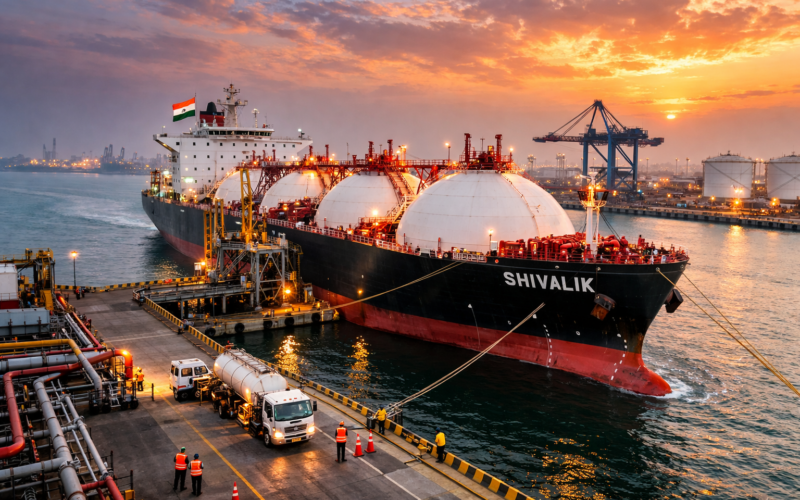
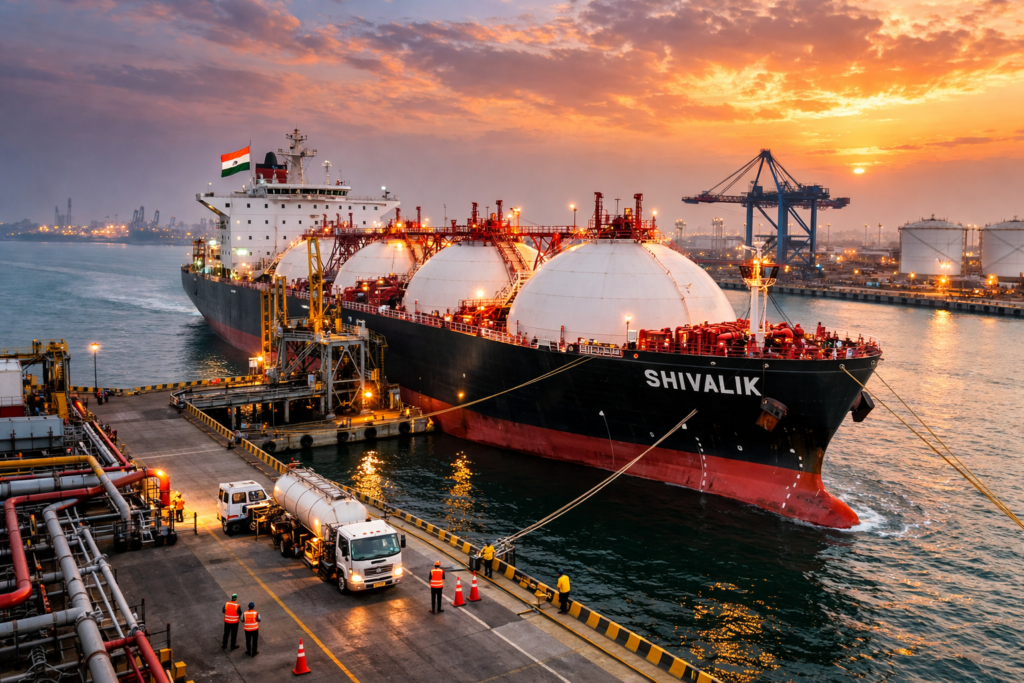
The Indian-flagged liquefied petroleum gas carrier Shivalik docked at Mundra Port in Gujarat on the afternoon of 16 March 2026, delivering approximately 46,000 metric tonnes of liquefied petroleum gas after successfully transiting the Strait of Hormuz. The vessel, a Very Large Gas Carrier operated by the Shipping Corporation of India, had crossed the strategic maritime corridor connecting the Persian Gulf to the Arabian Sea, with unloading operations expected to begin shortly after berthing to feed the domestic distribution system.
The arrival came against the backdrop of a significant disruption to global energy supply chains triggered by the ongoing conflict in West Asia, which intensified following military strikes by the United States and Israel on Iran in late February 2026 and subsequent retaliation by Tehran. Iran’s effective restriction of tanker traffic through the Strait of Hormuz placed India in a particularly vulnerable position. India imports approximately 62 to 65 per cent of its total liquefied petroleum gas demand, and more than 90 per cent of those imports, equivalent to roughly 20.5 million metric tonnes in 2024, came from West Asian suppliers with most shipments routed through the Strait of Hormuz.
How did two Indian-flagged LPG carriers successfully transit the Strait of Hormuz amid the West Asia conflict?
Iranian authorities recently permitted the passage of two Indian-flagged liquefied petroleum gas vessels, Shivalik and Nanda Devi, carrying a combined approximately 92,700 metric tonnes of liquefied petroleum gas destined for Indian ports. External Affairs Minister S. Jaishankar noted that India is engaging with Iran to facilitate the reopening of the vital waterway, which handles nearly 20 per cent of global oil trade. He indicated that diplomatic discussions are already showing progress and emphasised the importance of cooperation with Tehran, stating that India finds it more effective to reason and coordinate with Tehran rather than disengage. Jaishankar clarified that a formal blanket arrangement covering all Indian-flagged vessels has not yet been established and that transit is currently being managed on a case-by-case basis.
Rajesh Kumar Sinha, Special Secretary in the Ministry of Ports, Shipping and Waterways, confirmed at a media briefing that Shivalik docked at Mundra on 16 March and that Nanda Devi is expected to dock at Kandla Port on 17 March 2026. The two ships were among the 24 Indian-flagged vessels stranded on the western side of the strait since the conflict broke out. Their safe passage represented the first significant movement of Indian energy vessels through the contested corridor since the crisis began.
Sinha also confirmed that the Indian-flagged crude oil tanker Jag Laadki, which sailed from the United Arab Emirates on 14 March 2026 carrying approximately 81,000 metric tonnes of Murban crude oil, is safely en route and is expected at Mundra Port on 17 March 2026, with all seafarers on board confirmed safe.
What is the scale of India’s domestic LPG supply disruption following the Strait of Hormuz crisis?
The cargo carried by Shivalik and Nanda Devi can fill around 68 lakh domestic cylinders, while India’s average daily demand is roughly 55 lakh cylinders, making the combined shipment equivalent to approximately 1.25 days of total national liquefied petroleum gas demand. While the volumes address an immediate shortfall, they represent a fraction of the sustained import quantities India requires on an ongoing basis.
The supply crunch has been amplified by panic buying. Reports of disruption triggered rushes at distribution centres across multiple states, with customers seeking early refills. The spike in demand has also led to black-market activity in some areas, with commercial cylinders sold at significantly elevated prices. Commercial cylinders that normally cost approximately 1,600 rupees are reportedly being sold for nearly 3,000 rupees in Mumbai, according to representatives of the Association of Hotels and Restaurants, while reports indicate that nearly 15,000 small and medium eateries could face closure within days if supplies do not improve.
In Bhopal, district authorities found domestic cylinders being sold at prices of up to 1,500 rupees. The Commissioner of Food Civil Supplies, Karamveer Sharma, directed oil company officials and the district administration to hold regular meetings to ensure no hoarding occurs at the distributor level.
A survey conducted during the period found that approximately 57 per cent of households experienced delays in receiving cylinders during the previous week, while nearly one in five respondents reported purchasing liquefied petroleum gas in the black market. Separately, around 23 per cent of households acquired induction cooktops as a contingency measure, with approximately 75 per cent of those purchasers citing concerns about potential liquefied petroleum gas supply disruption in their area.
How is the Government of India responding to the LPG supply disruption and black market activity across states?
The Government of India held its fourth inter-ministerial media briefing at the National Media Centre on 16 March 2026, with senior officials from the Ministries of Petroleum and Natural Gas, External Affairs, Ports, Shipping and Waterways, and Information and Broadcasting participating. The government emphasised that its highest priority is ensuring uninterrupted domestic liquefied petroleum gas supply and maintaining stability in fuel availability across the country. All refineries in the country are operating at high levels and maintaining adequate crude oil inventories. India is currently self-sufficient in petrol and diesel production, and no imports are required to meet domestic demand. Oil Marketing Companies have reported no fuel dry-outs at retail outlets.
Domestic liquefied petroleum gas production from refineries has been increased by approximately 31 per cent. Authorities are promoting digital booking systems including interactive voice response calls, SMS, WhatsApp, and mobile applications to prevent crowding at distribution agencies. Consumers have been advised to opt for alternative fuels like piped natural gas where available, while hotels and restaurants are being encouraged to expand commercial piped natural gas connections to reduce pressure on liquefied petroleum gas demand.
A nationwide enforcement drive against black marketing and hoarding has resulted in approximately 20 first information reports being registered, with prosecution proceedings initiated against around 19 individuals. Raids have been conducted in Uttar Pradesh across approximately 1,400 locations, and similar operations are ongoing in Andhra Pradesh, Bihar, Odisha, and Karnataka.
In the National Capital Region, the Commission for Air Quality Management issued an order permitting the temporary use of biomass-derived pellets, specifically Refuse Derived Fuel pellets, as a substitute for natural gas by industries, hotels, restaurants, and other enterprises for a period of one month.
What is the broader energy security and geopolitical context for India’s LPG dependence on the Strait of Hormuz?
The International Energy Agency described the disruption caused by the United States and Israel strikes on Iran and the subsequent effective closure of the Strait of Hormuz as the largest supply disruption in history. India, as the world’s second-largest importer of liquefied petroleum gas after China, invoked emergency powers directing refineries to maximise liquefied petroleum gas production, with oil companies focused on ensuring the stability of domestic supplies including to essential services such as hospitals.
Unlike crude oil, liquefied petroleum gas is harder and more expensive to store because it must be kept in liquid form under pressure. India’s total liquefied petroleum gas storage capacity is estimated at around 1.9 million tonnes, equivalent to roughly 22 days of supply. The constrained buffer underscores the urgency with which the Government of India is pursuing simultaneous diplomatic engagement with Tehran and domestic production increases.
On fertiliser supply, officials said India has adequate stocks for the upcoming Kharif 2026 season, with urea stocks higher than at the same point last year and diammonium phosphate stocks double those of the previous year. The Department of Fertilisers has issued global tenders and expects to receive the bulk of quantities ordered from various sources by the end of March 2026.
The Ministry of Ports, Shipping and Waterways reported that 22 Indian-flagged vessels with 611 seafarers remain in the Persian Gulf region west of the Strait of Hormuz, under close monitoring by the Directorate General of Shipping. The Ministry of External Affairs reiterated India’s call for de-escalation and dialogue while maintaining engagements with Gulf Cooperation Council countries, Iran, the United States, and Israel to prioritise energy security and safe maritime transit.
India is also receiving additional pressure from its South Asian neighbours, with Bangladesh, Sri Lanka, and the Maldives having requested liquefied petroleum gas supplies from New Delhi. The requests reflect the broader regional dimension of the supply crisis and India’s position as a key energy hub for neighbouring economies.
Key takeaways on what the arrival of Shivalik at Mundra Port means for India’s energy security, domestic supply, and the West Asia crisis
- The Indian-flagged Very Large Gas Carrier Shivalik docked at Mundra Port on 16 March 2026 carrying approximately 46,000 metric tonnes of liquefied petroleum gas, the first significant Indian energy shipment to complete the Strait of Hormuz transit since the West Asia conflict began.
- A second vessel, Nanda Devi, carrying the remainder of a combined 92,700 metric tonne cargo, is expected to dock at Kandla Port on 17 March 2026, with transit clearance having been granted by Iranian authorities on a case-by-case basis following diplomatic engagement with Tehran.
- The Government of India confirmed that all refineries are operating at high capacity, Oil Marketing Companies have reported no fuel dry-outs at retail outlets, and domestic liquefied petroleum gas production has been increased by approximately 31 per cent to offset import shortfalls.
- A nationwide enforcement drive against hoarding and black marketing has resulted in raids at over 1,400 locations in Uttar Pradesh and multiple other states, with around 20 first information reports filed and prosecution proceedings initiated against approximately 19 individuals.
- The Ministry of External Affairs confirmed that 22 Indian-flagged vessels with 611 seafarers remain in the western Persian Gulf under monitoring by the Directorate General of Shipping, with India maintaining active diplomatic engagement with Gulf Cooperation Council countries, Iran, the United States, and Israel on energy security and maritime transit.
Discover more from Business-News-Today.com
Subscribe to get the latest posts sent to your email.

