



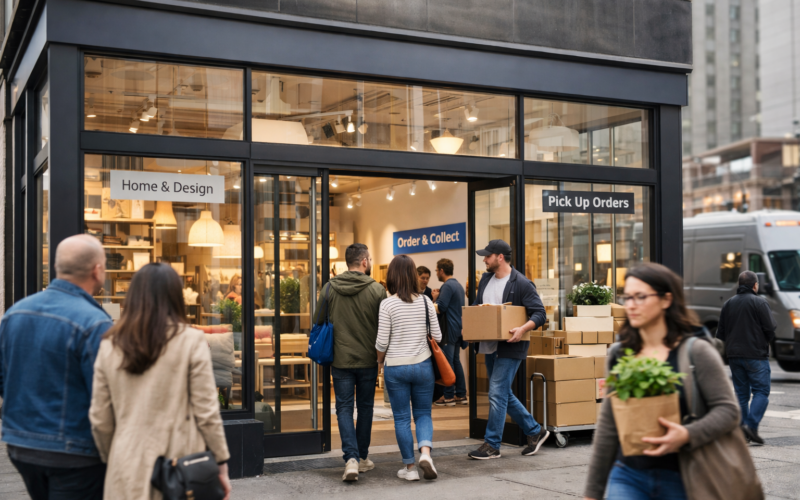
IKEA, the Swedish home furnishings giant operated in the United States by Ingka Group, is executing a systematic small-format retail expansion that represents the most significant strategic pivot in its 40-year U.S. history. After opening 14 new locations in fiscal year 2025 (ended August 31, 2025), including two purpose-built small-format city stores in Arcadia, California and San Marcos, Texas, alongside nine Plan and Order Points with integrated pickup services, the company has announced a further 10 store openings planned for 2026. The expansion strategy encompasses three distinct store formats, each engineered to penetrate a different tier of the market: full small-format city stores running approximately 35,000 to 63,000 square feet, Plan and Order consultation points of around 8,000 to 9,000 square feet, and dedicated pickup locations. IKEA U.S. generated $5.3 billion in total sales in its most recent fiscal year, including $1.9 billion in e-commerce, and is pressing ahead with expansion despite a challenging tariff environment and waning consumer confidence.
Why is IKEA abandoning its warehouse-only model to open smaller stores across the United States?
The logic is straightforward even if the execution is complex. IKEA’s iconic big-box format, typically 300,000 square feet or more, requires land parcels and traffic volumes that are simply unavailable in dense urban cores or mid-sized regional markets. As urban household formation has outpaced suburban growth in several key demographics, IKEA found itself structurally excluded from the customers most likely to purchase home furnishings. Smaller formats address this by concentrating IKEA’s highest-velocity product range, typically 2,000 to 3,200 items for immediate purchase, in locations where those customers already live and shop.
Ingka Group, IKEA’s largest franchisee operating 375 stores across 30 countries, had signaled this direction as far back as 2022 when it announced a 3 billion euro investment in new and existing locations across the U.S., France, Finland, Canada, Germany, and Spain. The U.S. arm formalized the domestic version of that commitment in 2023 with a separate $2.2 billion omnichannel investment. What has crystallized since then is not just the intent but the format hierarchy. Plan and Order Points function as consultative retail outposts, allowing customers to sit with IKEA co-workers to design kitchens, bedrooms, and living rooms before placing orders for delivery or in-store pickup. City stores, by contrast, are scaled-down but functional showrooms offering a curated selection of the full range alongside food, room-setting inspiration, and digital access to the entire catalog.
IKEA interim U.S. CEO Rob Olson has framed the rationale around convenience and accessibility, particularly for markets that could not sustain a large-format location. The Huntsville, Alabama opening in early 2026 is illustrative: a market IKEA had long wanted to enter but could never justify with a 300,000-square-foot footprint. The smaller format changes the unit economics of market entry.
How does IKEA’s three-tier store format strategy change its fulfillment model and last-mile cost structure?
The store format diversification is inseparable from a deeper operational shift toward last-mile ownership. IKEA’s traditional model relied on customers driving to large stores, loading flat-pack furniture into personal vehicles, and self-delivering to their homes. That model is increasingly incompatible with urban consumers who do not own cars and with a customer base conditioned by e-commerce to expect delivery as a standard service, not a premium add-on.
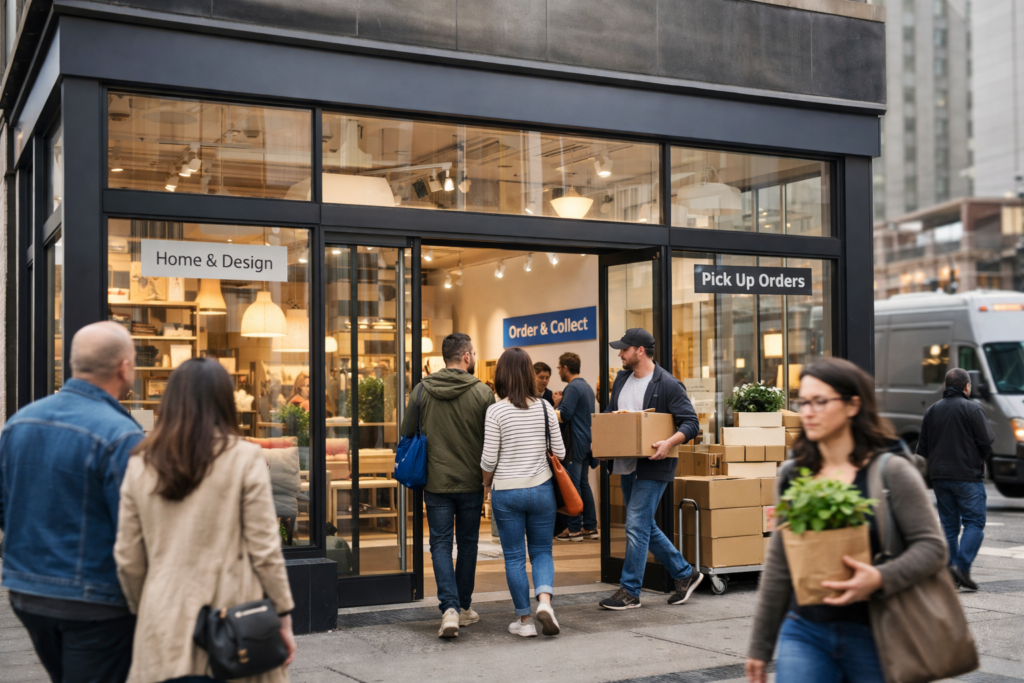
The Plan and Order Points serve a dual function: they are consultation environments and pickup hubs simultaneously. Customers who order online can collect at a Plan and Order Point rather than waiting for a home delivery slot, which compresses the last leg of the supply chain. IKEA has also embedded electric delivery vehicles across 48 U.S. locations and installed 374 EV chargers at its stores, boosting zero-emission deliveries by more than 90 percent compared to fiscal 2023. This matters because last-mile delivery is IKEA’s largest variable cost outside of product sourcing, and reducing its dependence on third-party carriers is a structural margin lever.
The acquisition of Locus, a U.S. logistics technology company, by Ingka Group underscores this direction. Locus’s AI-driven route planning and real-time tracking tools are expected to optimize IKEA’s delivery operations, with projected savings of around 100 million euros annually. Taken together, the smaller store footprint and improved logistics infrastructure are not simply retail moves; they are the buildout of a vertically integrated, urban-capable distribution network that Wayfair and Amazon cannot easily replicate with comparable physical touchpoints.
What markets is IKEA targeting in 2026 and how does the location selection signal its competitive intent?
The 10 stores announced for 2026 reveal a deliberate geographic diversification strategy rather than a simple concentration in already-served markets. The list includes IKEA Culver City in Los Angeles, which will be the city’s first city-center IKEA location; IKEA Tulsa, Oklahoma, which marks the brand’s first entry into that state; IKEA Gurnee Mills in the Chicagoland area near the Wisconsin border; and IKEA Fort Collins in Colorado. Earlier announced locations include Huntsville, Alabama; University Park in Dallas, Texas; Phoenix, Arizona; Rockwall in the Dallas-Fort Worth area; a Chantilly and Dulles location in the Washington D.C. region; and Houston-Webster, Texas.
The pattern is clear. IKEA is moving into secondary and tertiary markets where disposable income growth has been outpacing gateway cities, and into urban cores within large metros where it has historically had a presence only at the suburban perimeter. Texas is receiving particular attention: there are now five full-sized IKEA stores in the state, three Plan and Order Points with pickup, and two additional locations under development in San Marcos and Rockwall, with the University Park city store in Dallas slated for late 2025. The concentration reflects Texas’s sustained population growth and its economic profile, a young, cost-conscious consumer base that fits IKEA’s value positioning precisely.
The competitive implication is that IKEA is not conceding tertiary markets to online-only retailers. It is instead using smaller physical formats to establish brand presence in markets where Wayfair, Amazon, and Ashley Furniture currently face no in-store IKEA competition. A physical IKEA location, even a small one, changes consumer behavior: basket sizes, frequency, and brand recall all shift when customers can experience products rather than order from a photograph.
How are Trump administration furniture tariffs threatening IKEA’s affordability promise in the U.S. market?
The expansion is proceeding against a materially adverse trade policy backdrop. Tariffs on imported furniture introduced under the Trump administration took effect in October 2025 and carry significant cost implications for a retailer that sources approximately 90 percent of its U.S. product volume from overseas, primarily China, Vietnam, and Poland. The tariff schedule includes a 25 percent duty on kitchen cabinets and upholstered furniture, a 10 percent duty on softwood timber, with rates escalating potentially to 50 percent on certain categories from non-cooperative trade partners.
IKEA has acknowledged the pressure. The company has warned U.S. customers that some prices will increase and has confirmed it is shifting procurement toward domestic sources where feasible. Kitchen cabinets sold in the U.S. are now fully sourced domestically, and the company is actively exploring domestic sourcing for mattresses and other high-tariff-exposure categories. Ingka Group’s consolidated net profit fell by nearly a third in fiscal 2025 as the company absorbed tariff costs and continued its own price-reduction program to protect consumer affordability.
The financial tension is real. Inter IKEA Group, the franchise and product development parent, reported total revenues essentially flat in fiscal 2025 at 26.3 billion euros, down marginally from 26.5 billion euros the prior year, partly due to intentional wholesale price reductions. Total franchise retail sales declined 1 percent to 44.6 billion euros. The company has committed to maintaining wholesale price stability through fiscal 2026 to protect franchisee margins, absorbing the squeeze at the group level. Whether that commitment holds if tariffs escalate to the 50 percent tier is an open question.
For smaller-format stores specifically, the tariff risk cuts in a particular way. These locations stock a curated selection of high-turnover products, many of which fall into the tariff-affected categories: kitchen planning solutions, bedroom furniture, upholstered seating. If price integrity cannot be maintained on these product lines, the value proposition of the small-format store weakens precisely where it needs to be strongest.
Can the IKEA small-format model outflank Wayfair, Ashley Furniture, and big-box rivals for the urban consumer?
The competitive set IKEA is navigating is unusually broad. In the online channel, Wayfair offers a catalog of millions of SKUs with aggressive delivery pricing. In the value channel, Walmart and Target have expanded their home furnishings assortments with Scandinavian-inspired products at prices designed to undercut IKEA’s entry points. In the specialty channel, Williams-Sonoma brands including West Elm and Pottery Barn compete on design quality and brand aspiration. In the kitchen and bath category specifically, Home Depot and Lowe’s are formidable incumbents with deep contractor relationships.
IKEA’s defensible advantage in the small-format context is experiential. A Plan and Order Point staffed with trained co-workers who can model an entire kitchen renovation in three dimensions, identify the most efficient storage solution for a particular room configuration, and walk a customer through ordering, delivery, and assembly coordination is a service that no online retailer currently replicates at scale and at IKEA’s price point. Wayfair sells furniture; it does not offer a sitting consultation with a specialist who can draw up a floor plan.
The risk, however, is brand dilution and operational consistency. IKEA’s large-format stores are environments unto themselves: the one-way labyrinthine showroom, the Swedish food court, the warehouse self-service floor. These elements create a distinctive brand ritual that drives repeat visitation and emotional attachment. A small-format city store offering 2,500 products and a limited food selection is a materially different experience. Whether it generates the same loyalty, or whether it trains customers to think of IKEA as just another furniture retailer, is not yet clear from the data. The IKEA Family Rewards program reached 25 million members in fiscal 2025, a 17 percent increase year over year, and 56 percent of sales now flow through Family program members, which suggests loyalty is holding. But measuring whether small-format stores sustain or dilute that loyalty over time will require several years of comparable performance data.
What does IKEA’s 40-year U.S. expansion history reveal about the risks of departing from the big-box formula?
IKEA entered the U.S. market in 1985 with a store in Plymouth Meeting, Pennsylvania, and spent four decades refining a retail model built around scale, spectacle, and destination shopping. The blue box was never a convenience store; it was an all-day event. That format generated enormous customer lifetime value but required significant infrastructure investment and large suburban catchments to be viable. The deliberate departure from that model is a calculated bet, not an evolutionary refinement.
The historical precedent from other global retailers moving into small formats is mixed. Best Buy has experimented with small-format concepts with inconsistent results. Target’s small-format urban stores performed well in college-adjacent markets but faced margin pressure from higher urban real estate costs. For IKEA, the real estate equation is different because its small-format stores are being sited largely in existing shopping centers and mixed-use developments rather than requiring greenfield construction, which compresses the capital commitment per door.
The company’s own executives have been explicit that the large-format store remains the preferred destination format where it is viable. The small-format stores are additive, not substitutional. The question is whether the economics of smaller stores, lower per-transaction basket sizes, higher real estate costs per square foot, and greater operational complexity in managing pickup logistics across dispersed locations, can be made to work at a margin that justifies the capital allocation. IKEA has not disclosed small-format store-level profitability metrics. Until it does, the investment case rests on strategic logic and brand extension rather than demonstrated unit economics.
Key takeaways: What IKEA’s small-format U.S. expansion means for retail, competitors, and the home furnishings market
- IKEA is executing the most structurally significant shift in its 40-year U.S. history, moving from a destination big-box model to a tiered network of city stores, consultation points, and pickup hubs designed to serve markets its large format could never reach.
- The three-format architecture (city stores of 35,000 to 63,000 square feet, Plan and Order Points of 8,000 to 9,000 square feet, and pickup locations) reflects a deliberate segmentation of consumer need rather than a one-size-fits-all contraction.
- IKEA U.S. opened 14 new locations in fiscal 2025 and has announced 10 more for 2026, with expansion into first-entry markets such as Oklahoma and secondary markets such as Huntsville, Alabama, and Fort Collins, Colorado.
- Fiscal 2025 total U.S. sales of $5.3 billion, including $1.9 billion in e-commerce, provide the financial base for continued investment, though Ingka Group’s global net profit fell by nearly a third as tariff absorption and price reductions weighed on margins.
- Trump administration furniture tariffs affecting kitchen cabinets, upholstered furniture, and softwood timber at rates of 10 to 25 percent, with potential escalation to 50 percent, represent the single largest near-term risk to IKEA’s affordability positioning, which is the foundation of its small-format value proposition.
- IKEA is responding to tariff pressure by onshoring product sourcing where possible, starting with kitchen cabinets, and is investing in domestic supply chain relationships for categories including mattresses.
- The Locus logistics technology acquisition and the electric vehicle delivery network buildout signal that IKEA is constructing a proprietary last-mile capability that will reduce its dependence on third-party carriers and lower long-run delivery costs.
- Competitors including Wayfair, Ashley Furniture, Home Depot, and Target face a more distributed and geographically pervasive IKEA presence than at any prior point. Each new small-format location is a physical touchpoint in a market where IKEA previously had no in-store footprint.
- The IKEA Family Rewards program at 25 million members and growing at 17 percent year over year, with 56 percent of sales flowing through members, suggests the loyalty infrastructure exists to make smaller-format stores commercially productive if they convert new catchment customers into program members.
- The unresolved question is unit economics: IKEA has not disclosed per-store profitability for small-format locations, and investors and analysts will need several years of comparable data before the financial case for format diversification can be assessed with confidence.
Discover more from Business-News-Today.com
Subscribe to get the latest posts sent to your email.