



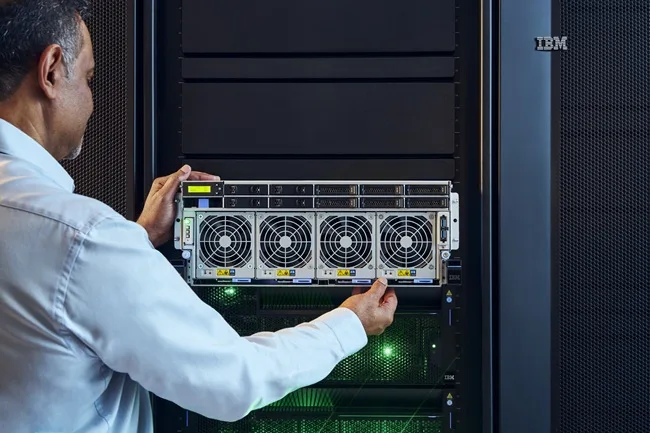
International Business Machines Corporation (NYSE: IBM) has officially launched IBM Power11, the next-generation enterprise server platform engineered to deliver AI acceleration, hybrid cloud performance, and near-perfect availability. Marking the most comprehensive release in the history of IBM Power systems, Power11 promises 99.9999% uptime, integrated ransomware protection, quantum-safe cryptography, and scalable deployment across high-end, mid-range, and entry-level servers.
IBM Power11 arrives at a time when global enterprises are rearchitecting their technology stacks to support AI-driven workloads while maintaining operational continuity. With expectations of over one billion new logical applications by 2028, according to IDC, IBM Power11 aims to serve as a resilient foundation for next-generation enterprise computing.
Institutional investors view the launch as a reaffirmation of IBM’s strength in mission-critical infrastructure. With a 33% year-to-date gain in IBM shares and momentum building in AI and hybrid cloud revenues, market observers are now watching whether Power11 can capture infrastructure wallet share from hyperscalers and x86-based OEMs.
What uptime guarantees and operational continuity does IBM Power11 offer for mission-critical workloads?
IBM Power11 is built around what IBM describes as the most resilient server design in its Power platform history. It offers 99.9999% uptime—a six-nines availability benchmark rarely matched in enterprise hardware—and introduces zero planned downtime for system maintenance through intelligent workload migration and autonomous patching.
This always-on design enables businesses to maintain application availability during system updates, firmware upgrades, and security patch deployments without taking mission-critical services offline. According to IBM executives, this transforms how enterprise IT teams approach lifecycle management, freeing up resources traditionally devoted to maintenance scheduling.
IBM Power11’s automation is tightly integrated with IBM Concert, an AI-powered operations tool designed to detect operational risks and automate remediation. The server stack is further supported by IBM Technology Lifecycle Services, which offers AI-enabled global infrastructure support aimed at maximizing uptime and performance.
How does IBM Power11 protect enterprise systems from ransomware and quantum-era cybersecurity threats?
A standout feature of Power11 is its built-in IBM Power Cyber Vault, designed for sub-minute ransomware threat detection. Built to comply with the NIST Cybersecurity Framework, Cyber Vault safeguards workloads through immutable, regularly tested data snapshots that allow for rapid recovery in the event of a breach.
Importantly, IBM Power11 also integrates quantum-safe cryptography at the firmware level. By adopting NIST-approved algorithms for data-at-rest and firmware integrity protection, Power11 aims to protect against “harvest-now, decrypt-later” attacks—an emerging threat where adversaries store encrypted data today in anticipation of decrypting it with future quantum systems.
Security has become a top consideration for organizations handling sensitive data in healthcare, banking, and government. Analysts suggest that Power11’s robust cyber resilience capabilities could drive adoption in these regulated sectors where system integrity and availability are paramount.
What are the core performance and energy efficiency improvements in IBM Power11 versus Power10 and x86 systems?
IBM reports that Power11 offers up to 55% higher core performance compared to IBM Power9 and up to 45% more capacity in entry and mid-range configurations compared to Power10. This performance leap is attributed to architectural changes in the Power11 processor and higher core counts per socket.
From an energy efficiency standpoint, Power11 delivers twice the performance per watt relative to comparable x86-based servers. It introduces a new Energy Efficient Mode, which IBM claims reduces energy usage by up to 28% compared to maximum performance mode. These enhancements are expected to be particularly attractive to enterprises optimizing for both high throughput and lower total cost of ownership (TCO).
How is AI integration being implemented across the IBM Power11 server stack?
IBM Power11 is the first system in the Power family to be natively AI-ready, featuring on-chip AI acceleration for inferencing and integration with the forthcoming IBM Spyre Accelerator—a purpose-built AI system-on-a-chip expected in Q4 2025. Spyre will also be deployed across IBM z17 and LinuxONE 5 servers, creating a unified AI hardware architecture.
To support the software layer, Power11 aligns with IBM’s watsonx strategy. Enterprises can deploy Red Hat OpenShift AI for AI workload orchestration and use watsonx Code Assistant for i to modernize legacy RPG applications. IBM also plans to make watsonx.data, its open, hybrid data lakehouse, available on Power11 by the end of 2025.
The integration of AI workloads directly into the enterprise compute fabric is expected to significantly cut inference latency and allow businesses to operationalize models without externalizing compute to the cloud.
What deployment flexibility and configuration options does Power11 provide for hybrid cloud strategies?
For the first time in IBM Power’s history, Power11 will be launched across the full server stack simultaneously, covering high-end, mid-range, entry-level, and Power Virtual Server in IBM Cloud. This means clients can modernize workloads on-premises or move them to the cloud with minimal disruption.
Power Virtual Server is certified as a hyperscaler platform for RISE with SAP, further validating IBM’s hybrid credentials. This flexibility enables organizations to keep sensitive data on-prem while scaling AI inference, analytics, or containerized workloads in the cloud.
The high-end E1180 server supports up to 16 sockets, 2048 threads, and hundreds of terabytes of memory, while entry-level models like the S1122 are tailored for departmental workloads or edge use cases. Mid-tier variants such as the E1150 support up to 120 cores and 16TB of DDR5 RAM—suitable for growing data estates or high-performance SAP HANA environments.
What is the investor sentiment around IBM’s Power11 launch and how is IBM stock performing?
Institutional investors have responded positively to IBM’s broader strategy in enterprise AI and hybrid cloud, with IBM’s stock (NYSE: IBM) gaining roughly 33% year-to-date and 64% over the past twelve months. IBM is currently trading near a 52-week high (~$296 as of July 8), with gross margins hovering near 57%, supporting long-term reinvestment in innovation and infrastructure.
While retail sentiment on trading forums remains mixed, institutional confidence stems from IBM’s steady dividend, improving free cash flows, and transition away from legacy businesses toward AI-driven offerings. Power11 is seen as central to this transformation.
Analysts suggest that with further Power11 adoption in regulated and security-sensitive industries, IBM could outmaneuver competitors focused primarily on scale-out infrastructure. Investors are also watching how the integration of IBM Spyre and deeper watsonx deployment will play out across large Power estates.
What is the broader outlook for IBM Power11 in the enterprise infrastructure and AI hardware market?
IBM Power11 arrives in a highly competitive environment where cloud-native platforms, GPU accelerators, and x86 incumbents dominate the infrastructure narrative. Yet Power11 distinguishes itself by offering unmatched resilience, security, and AI-native architecture, tailored for businesses unwilling or unable to move fully to public cloud.
For industries like financial services, public health, and national security—where data sovereignty, availability, and automation are non-negotiable—Power11 could serve as the high-assurance backbone of their AI modernization efforts.
IBM is expected to push deeper AI and automation features through 2025, with the IBM Spyre Accelerator rollout, watsonx integration, and additional energy-optimized configurations. This positions Power11 not only as a successor to Power10 but as a long-term infrastructure pillar in IBM’s AI-first enterprise strategy.
Discover more from Business-News-Today.com
Subscribe to get the latest posts sent to your email.