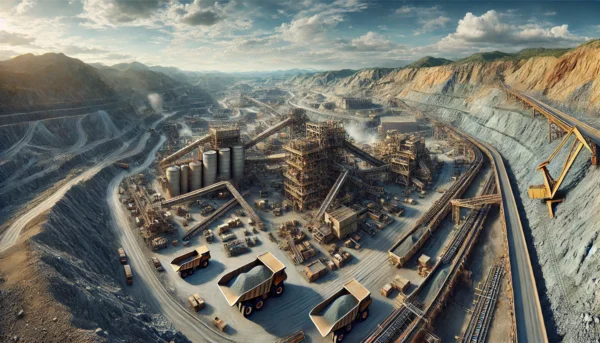
i-80 Gold Corp. (TSX: IAU, NYSE American: IAUX) has released the results of a detailed engineering study for the refurbishment of its Lone Tree Plant in Northern Nevada, positioning the facility as the core processing hub for three high-grade underground gold mines. The move shifts the company from a toll-milling model to an owner-operator structure, with the potential to increase operating margins by $1,000 to $1,500 per ounce and drastically improve cash flow.
With a total estimated capital cost of $430 million and a projected commissioning target by the end of 2027, the Lone Tree restart could serve as a pivotal transformation in i-80 Gold Corp.’s push to become a mid-tier U.S. gold producer.

How does Lone Tree’s modernization reshape i-80 Gold Corp.’s competitive position in Nevada?
At the heart of i-80 Gold Corp.’s growth strategy is the refurbishment of the Lone Tree Plant into a modern, fully integrated processing center capable of handling both refractory and oxide ores. Located alongside Interstate 80 and acquired from Nevada Gold Mines in 2021, Lone Tree features an existing autoclave circuit—making i-80 one of only two gold producers in Nevada with this infrastructure. The other is Nevada Gold Mines, the Barrick–Newmont joint venture.
The study, conducted by engineering firm Hatch Ltd., outlines a phased upgrade that preserves the legacy infrastructure while integrating modern pressure oxidation (POX) and carbon-in-leach (CIL) technologies. The design supports nameplate throughput of 2,268 tonnes per day or 827,806 tonnes annually, allowing material from the Granite Creek, Archimedes, and Cove mines to be processed in-house once the facility is operational.
Strategically, this positions i-80 Gold to break its dependence on toll-milling and centralize its production workflow, reducing variability, cutting processing costs to one-third of current levels, and increasing control over margins and scheduling.
What are the economics behind the Lone Tree investment, and how fast can it pay off?
With a projected capital cost of $430 million, including $18 million in capital spares, the Lone Tree restart ranks among the most substantial investments for a company of i-80 Gold’s size. However, management emphasizes a swift 12 to 24-month payback period depending on processed grade and gold prices.
Cost increases from the initial $400 million estimate were driven by inflation, engineering refinements, and additional redundancy in the filtered tailings system. Still, management views the investment as a value-accretive pivot. The anticipated boost in operating margins per ounce, coupled with flexibility to process oxide ore during POX maintenance outages, provides potential upside to throughput and recovery.
Detailed engineering is already 30 percent complete, providing increased confidence in cost estimates and execution feasibility. With Hatch leading the EPCM scope and an internal team experienced in Nevada autoclave operations, i-80 Gold has built a low-risk profile around the restart timeline and project scope.
What infrastructure upgrades are being implemented, and how do they align with ESG mandates?
Lone Tree’s overhaul incorporates environmental and regulatory enhancements alongside process modernization. Legacy equipment such as the original CIL tanks, refinery, and oxygen plant will be demolished. In their place, i-80 Gold will install updated mercury abatement systems, a new oxygen plant run by a third-party vendor, and filtration circuits to enable dry-stack tailings.
This filtered tailings system, which is considered more sustainable than traditional tailings ponds, improves water recovery, lowers closure costs, and reduces the plant’s environmental footprint. These changes, particularly the POX circuit upgrades and tailings redesign, also align with evolving U.S. regulatory expectations around water pollution, air quality, and mercury handling.
The POX circuit itself will transition fully to an acid-based system, which management expects will improve gold recovery rates, even if it results in higher operating costs.
What’s the status of permitting, and when will Lone Tree restart construction?
Permitting remains the gating item before full-scale construction begins. While the plant is already permitted for legacy operations, revised applications covering air, water, mercury, and reclamation compliance must be filed for the new design.
Engineering designs required for these updated permits are expected to be completed by the end of 2025. Permit applications will follow in the first quarter of 2026, aligning with the company’s internal review timeline.
Demolition and site preparation could begin as early as Q2 2026, with construction ramping up in the second half of the year. Commissioning is forecast for Q4 2027. In the interim, refractory ore from Granite Creek and Archimedes will continue to be processed via third-party toll-milling contracts.
How is i-80 Gold funding the Lone Tree restart, and what are the recapitalization levers?
To fund the refurbishment, i-80 Gold Corp. is working through a multi-part recapitalization strategy that includes a mix of senior debt, royalty financing, and the potential sale of non-core assets. Management expects to conclude this recapitalization effort by the end of Q2 2026 or earlier.
The structure of the financing package will be closely watched by institutional investors, particularly as it relates to future dilution, cost of capital, and any revenue-linked instruments such as royalties or streaming deals. Any asset sales, if executed efficiently, could provide upside without undermining core production growth.
Given the high upfront cost, i-80 Gold’s capital discipline and sequencing will be key to maintaining balance sheet flexibility during the refurbishment phase. The ability to lock in low-cost financing without equity dilution will likely be a sentiment driver heading into 2026.
What does this signal about the future of mid-tier gold production in the U.S.?
The Lone Tree upgrade reflects a broader trend among junior and mid-tier producers aiming to vertically integrate to improve margins, reduce external dependencies, and insulate from tolling cost volatility. In a tightening U.S. permitting and regulatory environment, access to permitted processing infrastructure, especially for refractory ore—is increasingly viewed as a strategic advantage.
For i-80 Gold, the Lone Tree asset is not just a processing hub but a differentiator. The presence of existing infrastructure, favorable logistics, and ownership of three high-grade underground mines allows the company to control both the mining and downstream value chain. If execution proceeds as planned, i-80 Gold could transition from a developer to a vertically integrated mid-tier producer over the next 24 to 36 months.
With only one other Nevada-based company, Nevada Gold Mines, operating similar POX capabilities, i-80 Gold stands to gain competitive leverage in a high-barrier processing environment, particularly as new gold discoveries increasingly involve refractory deposits.
Key takeaways: What the Lone Tree restart means for i-80 Gold Corp. and the gold industry
- i-80 Gold Corp.’s $430 million Lone Tree Plant refurbishment could transform it into a mid-tier U.S. gold producer with integrated processing.
- Refurbishment enables a shift from toll-milling to owner-operator processing, boosting margins by $1,000 to $1,500 per ounce.
- The study outlines a 12–24 month project payback window, driven by increased throughput and internal processing flexibility.
- Environmental upgrades such as filtered tailings and mercury abatement align with U.S. ESG and permitting standards.
- Engineering is 30 percent complete, with construction expected to begin in 2H 2026 and commissioning by Q4 2027.
- The acid-based POX design improves gold recovery rates compared to alkaline alternatives, albeit with higher operational costs.
- i-80 Gold is actively pursuing recapitalization through a combination of debt, royalty sales, and asset divestitures to fund the restart.
- As one of only two Nevada gold companies with an autoclave facility, i-80 Gold is positioned for competitive advantage in refractory ore processing.
Discover more from Business-News-Today.com
Subscribe to get the latest posts sent to your email.