

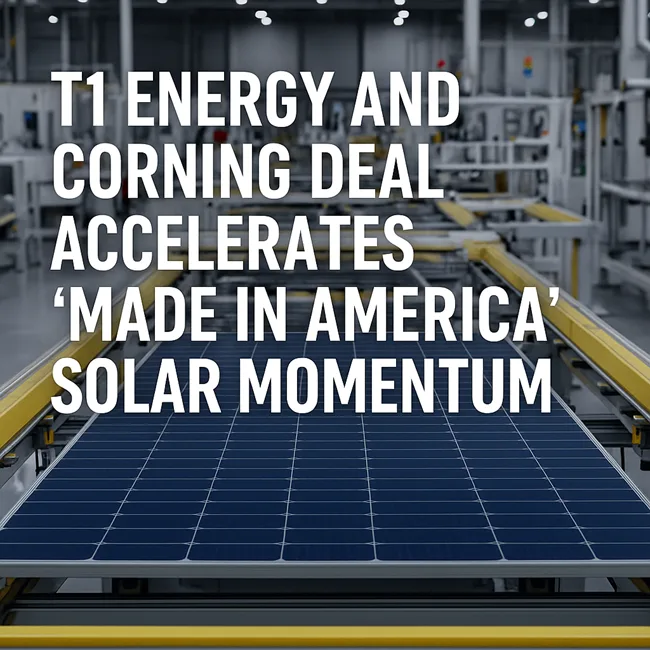
How does the T1 Energy and Corning solar partnership reshape America’s clean energy manufacturing base?
T1 Energy Inc. (NYSE: TE) has signed a landmark commercial agreement with Corning Incorporated (NYSE: GLW) that executives describe as a breakthrough for American solar manufacturing. The deal builds a fully integrated U.S. solar supply chain at a time when demand for energy security and affordable renewable power has never been higher.
Under the arrangement, T1 Energy will source hyper-pure polysilicon and solar wafers produced at Corning’s Michigan campus starting in the second half of 2026. Those wafers will be shipped to T1’s G2_Austin solar cell plant, currently under development, before being processed into finished modules at the company’s G1_Dallas facility. The structure ensures that every step — from raw material to module assembly — is contained within U.S. borders.
T1 Energy’s Chairman and Chief Executive Officer Daniel Barcelo emphasized that the initiative would support nearly 6,000 domestic jobs while enhancing national energy resilience. Corning’s Solar division leader AB Ghosh underscored that the move confirms strong demand for American-made solar components, positioning Michigan as a hub for advanced solar manufacturing.
Why is U.S. solar production becoming critical as AI-driven electricity demand grows and energy independence becomes a national goal?
The urgency of this deal reflects two converging pressures: the rising power consumption linked to artificial intelligence infrastructure and the strategic need to reduce reliance on foreign energy supply chains.
AI development is accelerating at a pace that requires unprecedented levels of electricity, particularly for data centers across the United States. At the same time, federal policymakers have prioritized domestic manufacturing of renewable components to ensure compliance with sourcing incentives and to mitigate the risks of tariff exposure and geopolitical tensions.
The T1–Corning agreement directly addresses these issues by creating a resilient supply chain anchored in Michigan and Texas. By eliminating dependence on imported wafers and cells, the two companies are offering utilities and solar developers a pathway to predictable, scalable supply and regulatory compliance.
What regulatory and supply chain benefits come from linking Michigan polysilicon to Texas solar plants?
Utilities and developers have long struggled with delays, cost inflation, and uncertainty due to reliance on imports from Asia. By combining Corning’s polysilicon production in Michigan with T1 Energy’s cell and module manufacturing in Texas, the partnership delivers certainty across the value chain.
Regulatory benefits are equally significant. Under the Inflation Reduction Act, projects that meet domestic content requirements qualify for bonus tax credits. With an end-to-end American supply chain, developers can more easily access these incentives, strengthening project economics for multi-gigawatt installations.
In addition, the model creates thousands of U.S. jobs, with Michigan gaining high-value manufacturing roles and Texas benefiting from long-term operational capacity. Analysts note that the political resonance of this geographic distribution is strong, aligning with calls for energy independence in both industrial Midwest and Sun Belt regions.
How does this deal expand Corning’s role in renewable energy alongside its traditional glass and materials markets?
Corning has a 170-year history of pioneering in glass science, ceramics, and optical technologies. Its markets traditionally span consumer electronics, telecommunications, automotive, and life sciences. With this agreement, the company is sharpening its focus on renewable energy as a growth driver.
According to Corning’s solar division leadership, scaling up wafer capacity in Michigan positions the company to capture new opportunities in the booming U.S. solar sector. Industry observers say Corning’s expertise in precision manufacturing and process innovation gives it a competitive edge in a market where quality and reliability determine profitability.
For investors, this diversification reduces exposure to cyclical downturns in sectors such as consumer electronics while providing a foothold in the long-term megatrend of decarbonization. Analysts suggest that institutional interest in materials companies with renewable energy exposure will continue to grow as energy transition policies advance.
What does this agreement mean for T1 Energy’s ambitions to lead U.S. solar and battery storage manufacturing?
T1 Energy’s December 2024 restructuring positioned the firm as a vertically integrated solar and battery storage manufacturer with a distinct focus on U.S. capacity. Since then, it has sought to prove its execution capability while balancing growth and portfolio optimization.
Market sentiment has been cautiously optimistic. Institutional investors view the Corning deal as validation of T1 Energy’s integrated approach, strengthening its credibility as a serious contender in the domestic renewable energy sector. With operational progress at G1_Dallas and construction of G2_Austin underway, the Corning partnership secures a reliable upstream input for the company’s ambitions.
That said, execution risk remains on the radar. Timelines for 2026 wafer delivery and plant ramp-up will be closely scrutinized. Analysts are also watching competitive dynamics, particularly as other U.S. firms attempt to replicate or differentiate from T1’s vertically integrated model. Still, the partnership provides a tangible roadmap for scaling in a fragmented market.
How does the future of U.S. solar depend on federal incentives, AI energy demand, and reshoring supply chains?
Looking ahead, the U.S. solar industry is expected to be shaped by three major forces: federal tax incentives, AI-driven electricity demand, and global supply chain realignment. The T1–Corning agreement sits at the intersection of all three.
Federal policy continues to incentivize domestic content and large-scale deployment. AI infrastructure, particularly hyperscale data centers, is fueling unprecedented demand for reliable renewable power. And global trade disputes are pushing U.S. policymakers to prioritize national supply chains over international dependency.
The T1–Corning deal demonstrates that rebuilding American industrial capacity in solar is possible. If execution stays on track, it could become a template for how other manufacturers align with national goals while maintaining investor confidence.
What does the T1 Energy and Corning agreement reveal about the future of American solar independence and job growth?
The partnership between T1 Energy and Corning represents more than a supply agreement. It is a signal of intent: that “Made in America” is no longer a slogan but a strategy for securing energy independence, stabilizing supply chains, and supporting American jobs.
For T1 Energy, the collaboration underscores its ambition to lead integrated solar and storage manufacturing in the U.S. For Corning, it marks a significant diversification into renewable energy, leveraging its legacy of materials innovation to serve the future of clean power. Together, the companies are betting that the next chapter of the energy transition will be written in Michigan and Texas.
Discover more from Business-News-Today.com
Subscribe to get the latest posts sent to your email.