


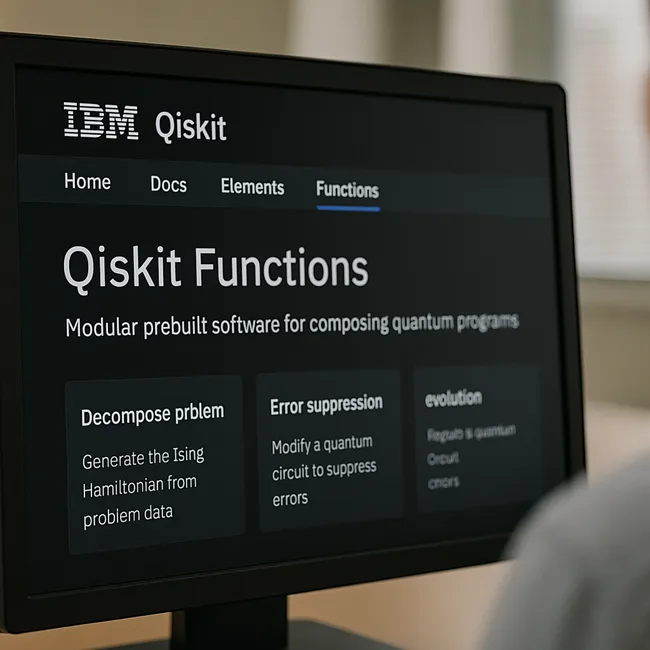
In a move that signals the next phase of quantum computing software commercialization, IBM has expanded its Qiskit Functions ecosystem to integrate third-party solutions—including Tel Aviv–based QEDMA, a quantum middleware startup focused on error mitigation. Qiskit Functions allows quantum developers to build, publish, and scale reusable quantum application modules, bringing standardization and interoperability to a historically fragmented field.
QEDMA, which recently raised $26 million in a Series A round with participation from IBM, has become one of the first external middleware vendors to integrate directly with the Qiskit platform. This milestone represents more than just technical compatibility—it reflects a broader shift in how quantum software is being delivered, modularized, and scaled for enterprise use. With global corporations beginning to test quantum workloads in pharmaceuticals, logistics, and finance, IBM’s modular function architecture provides a blueprint for how the quantum software stack might look in practice.
The move has drawn attention from investors and researchers alike, with institutional sentiment pointing to increased maturity in the quantum developer ecosystem. Analysts believe such modular frameworks are necessary for mass adoption, particularly as hardware development outpaces the availability of practical software tools.
Why are Qiskit Functions becoming critical for scaling quantum software to enterprise users in 2025?
As the quantum computing landscape matures, there is a growing need to shift from bespoke, lab-based experimentation to production-grade, repeatable workflows. Qiskit Functions aims to address this need by allowing developers to package their quantum applications into callable modules—effectively turning discrete capabilities into enterprise-ready services.
These functions are designed to run on IBM’s quantum cloud infrastructure, enabling seamless integration with classical computing systems. For enterprises experimenting with hybrid models or simulation-intensive workloads, Qiskit Functions offer a way to avoid rebuilding algorithms from scratch. Instead, users can deploy pre-tested functions directly into their workflows.
Qiskit Functions also provides an API-like interface for developers, where different modules—from optimization routines to noise profiling—can be composed to run on IBM’s backend. This level of modularity mirrors the evolution of classical software through containerization and microservices, which unlocked a surge in enterprise cloud adoption over the past decade.
How does IBM’s Qiskit Functions ecosystem support third-party tools like QEDMA and drive industry adoption?
IBM’s embrace of third-party middleware, starting with QEDMA, marks a turning point in the evolution of Qiskit from an open-source SDK to a full-stack quantum platform. QEDMA’s software specializes in profiling quantum device noise, suppressing known error vectors, and applying post-processing mitigation—all critical for improving quantum fidelity on noisy intermediate-scale quantum (NISQ) machines.
By hosting QEDMA’s error mitigation protocols as callable Qiskit Functions, IBM allows enterprise users to access cutting-edge error handling tools without deep domain expertise. This bridges the gap between quantum hardware and enterprise developers who may not be quantum specialists but need reliable building blocks for complex workloads.
Qiskit’s support for such integrations also paves the way for a quantum “App Store” dynamic, where vetted tools can be published, versioned, and deployed at scale. Startups like QEDMA benefit from access to IBM’s enterprise customer base, while IBM enhances its ecosystem with solutions that improve the usability and performance of its own quantum systems.
What makes modular middleware like QEDMA attractive to enterprises using IBM Quantum services today?
Enterprises exploring quantum computing often face challenges in both performance and reproducibility. Middleware platforms like QEDMA address these issues by enabling applications to run at scale with greater reliability. In particular, QEDMA’s approach—integrating real-time noise profiling with algorithmic suppression and statistical error mitigation—offers immediate improvements without requiring hardware changes.
For example, a pharmaceutical firm running quantum chemistry simulations on IBM’s quantum backend can invoke QEDMA’s error suppression module via Qiskit Functions, enhancing result fidelity without modifying its core workflow. This value proposition—“better outcomes without deeper integration burden”—has made modular middleware especially attractive in pilot deployments.
QEDMA’s platform-agnostic design also allows it to serve as a future-proof investment for enterprises. Even as hardware vendors innovate and compete, middleware solutions that can operate across architectures ensure that software investments remain relevant. QEDMA’s compatibility with Qiskit accelerates its adoption, particularly among enterprise users already embedded in IBM’s ecosystem.
How are startups leveraging Qiskit Functions to demonstrate practical quantum advantage across use cases?
Beyond QEDMA, several startups are beginning to leverage Qiskit Functions to showcase specific quantum capabilities in fields like optimization, financial modeling, and machine learning. These modular integrations allow them to target specific verticals with minimal deployment friction.
For instance, firms working on portfolio optimization algorithms can package quantum annealing routines as Qiskit Functions, making them immediately available to financial services institutions. Similarly, in supply chain optimization, quantum startups can deploy ready-to-use modules that integrate seamlessly into enterprise resource planning (ERP) systems.
QEDMA’s specific contribution—quantum error mitigation—acts as a performance booster to all such applications. By reducing computational noise, its functions enhance the validity of simulation outputs, statistical sampling, and other operations that are otherwise fragile in NISQ environments.
Startups are also using Qiskit Functions to validate performance metrics under real-world conditions. This feedback loop—from function invocation to performance benchmarking—enables iterative refinement and helps demonstrate progress toward quantum advantage, especially in pre-commercial environments.
What is the long-term strategic outlook for Qiskit Functions as a commercialization channel for quantum startups?
The long-term vision for Qiskit Functions aligns closely with how software marketplaces evolved in classical cloud ecosystems. Just as AWS Lambda and Azure Functions became foundational to serverless computing, Qiskit Functions could become the default interface for deploying and monetizing quantum capabilities.
For startups, this represents a major go-to-market advantage. Rather than building proprietary distribution channels or maintaining their own infrastructure, quantum developers can publish within IBM’s platform and gain exposure to enterprise users already engaged with IBM Quantum services. This marketplace model also creates opportunities for licensing, subscription billing, and bundled services.
IBM, in turn, benefits from ecosystem depth. With more developers and startups contributing useful modules, IBM can offer a broader range of capabilities without building everything in-house. This strengthens customer retention, improves system utilization, and positions IBM as the de facto platform for quantum application development.
QEDMA’s early integration is just the start. As more third-party developers join Qiskit Functions, we may see the emergence of category leaders across core areas like quantum simulation, optimization, and machine learning. Institutional investors are watching closely, with some suggesting that Qiskit Functions could become the most commercially important interface layer in the quantum stack.
Discover more from Business-News-Today.com
Subscribe to get the latest posts sent to your email.