Public-private partnerships are emerging as the critical scaffolding behind North America’s modular nuclear rollout, blending public-sector support with private-sector execution. From Ontario Power Generation’s small modular reactor (SMR) construction at Darlington to the United States Department of Energy’s funding calls for microreactor demonstration, government backing is providing the financial and regulatory leverage private developers need to scale.
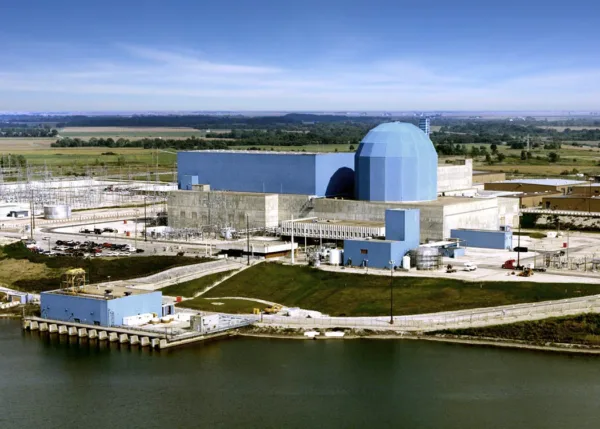
Ontario Power Generation has secured approvals from the Canadian Nuclear Safety Commission to construct North America’s first grid-scale small modular reactor—GE Vernova’s BWRX‑300—at the Darlington site in Ontario. The project, part of a public-private consortium with GE Vernova and Hitachi Nuclear Energy, will represent a C$20.9 billion capital investment for four reactors and is expected to support nearly 3,700 full-time equivalent jobs annually over 65 years.
In parallel, the United States Department of Energy is driving microreactor adoption through a $900 million commercial deployment program launched in March 2025. Targeted at Generation III+ reactor designs and HALEU-fueled systems, the solicitation encourages demonstration-scale deployments that could fast-track licensing under the NRC’s proposed Part 53 rule.
What project-level partnerships are shaping modular nuclear rollout in the U.S. and Canada?
Modular nuclear partnerships in North America are defined by tight coordination across licensing, funding, siting, and operations. Ontario Power Generation’s Darlington SMR development is structured around a formalized public-private model, with provincial government financing aligned to federal climate commitments and clean energy targets. The project has also triggered vendor localization agreements, including turbine supply and fuel fabrication contracts with Canadian-based vendors.
In the United States, private-sector players such as BWX Technologies and Holtec International are executing similar playbooks. BWX Technologies is advancing a Defense Department-backed microreactor design through Project Pele, a Tactical Mobile Nuclear Energy program aimed at forward-deployed U.S. military bases. Holtec, meanwhile, has revived the Palisades site in Michigan with a $1.5 billion plan to co-locate a new SMR-300 reactor beside the previously decommissioned nuclear facility, with support from the DOE’s Loan Programs Office and state government incentives.
These projects highlight a model where government-backed capital and permitting support serve as the foundation for private-sector construction, reactor deployment, and off-take.
How are hybrid capital structures evolving across microreactor and SMR projects?
Capital formation in modular nuclear projects is shifting toward layered hybrid models combining federal grants, provincial subsidies, ratepayer financing, and institutional equity. In Canada, the Darlington SMR build benefits from green bond issuance and access to Ontario’s clean energy procurement framework. Construction risk is being reduced through early-stage site licensing and pre-negotiated component procurement.
The United States DOE, meanwhile, is backing multiple ventures through milestone-based grants and early demonstration support. The Idaho National Laboratory’s Microreactor Applications Research Validation and Evaluation (MARVEL) site is now open to select private reactor developers through a competitive demonstration access program.
Institutional capital is beginning to follow. Infrastructure-focused investors are increasingly attracted to modular nuclear projects with clear offtake pathways, repeatable factory-based licensing, and risk-mitigated financing structures. Sovereign wealth funds and private equity players—particularly those aligned with national security, industrial decarbonization, or critical mineral supply chains—are exploring equity stakes in HALEU supply and modular deployment firms.
How are regulators enabling public-private modular deployment frameworks?
Canada and the United States are actively reforming regulatory pathways to support modular reactor scale-up via public-private routes. The Canadian Nuclear Safety Commission’s vendor design review (VDR) framework has enabled Ontario Power Generation’s BWRX-300 to proceed through predictable, staged approvals—reducing timeline risk for public and private capital alike.
In the U.S., the Nuclear Regulatory Commission’s proposed Part 53 rule is designed to replace the one-size-fits-all licensing model with a risk-informed, performance-based framework tailored to modular reactors. The Biden and Trump administrations have both endorsed this strategy, with President Trump’s June 2025 executive order calling for licensing timelines under 18 months to support clean industrial competitiveness.
For mobile microreactors, such as those being piloted by BWX Technologies and Ultra Safe Nuclear Corporation, the Department of Defense’s Defense Innovation Unit (DIU) has introduced contracting mechanisms that allow for commercial co-deployment. These flexible regulatory arrangements are critical for modular nuclear to meet demand in mining, defense, and remote industrial use cases.
What lessons are emerging from early-stage SMR and microreactor P3 models?
Several structural lessons are emerging from the first wave of public-private modular nuclear projects across North America. One is that federal or provincial co-financing must be locked in well before licensing and construction to meet infrastructure investor requirements. Second, regulatory milestones—such as CNSC’s VDR or NRC’s Part 53 docketing—are essential de-risking indicators that determine access to institutional funding.
Third, multi-use case alignment—such as combining electric power generation with district heating, hydrogen production, or data center cooling—is emerging as a key revenue optimization pathway. Finally, localization strategies around fuel supply (especially HALEU and TRISO) and component manufacturing are now being built into government partnership frameworks, ensuring strategic industrial policy alignment.
Analysts expect future modular nuclear P3s to embed vertically integrated value chains across financing, fuel supply, siting, construction, operations, and digital control systems. Those capable of delivering this end-to-end visibility—such as Ontario Power Generation and select U.S. DOE-supported projects—are likely to attract larger pools of private capital.
What is the future outlook for public-private modular nuclear development in North America?
The next phase of North America’s modular nuclear journey will be defined by replication, scale, and integration into diversified energy use cases. Ontario Power Generation is already positioning itself as a global first mover, with plans to scale beyond the initial BWRX-300 unit at Darlington to a full fleet of reactors across the province. The multi-unit buildout is not just a clean electricity play—it is increasingly being aligned with hydrogen production, data center co-location, and industrial steam applications for hard-to-abate sectors. This holistic use-case design is expected to become a model for replication across Canada and beyond.
In the United States, several state governments and tribal authorities are now working with federal partners and private reactor developers to identify viable microreactor and SMR deployment zones. Alaska, with its remote grids and high fuel transportation costs, has emerged as a natural proving ground. Similarly, Wyoming, already a hub of energy infrastructure, is evaluating modular nuclear to offset coal phase-outs and support large-scale data center expansion. On tribal lands, energy sovereignty initiatives are catalyzing modular deployments that align with self-sufficiency and resilience goals, particularly where diesel generators currently dominate.
In the microreactor segment, the U.S. Department of Defense is expected to play a leading role in near-term commercialization. Pending the successful validation of Project Pele’s HALEU-fueled prototype—designed by BWX Technologies—at Idaho National Laboratory, permanent installations at forward-operating bases, Arctic outposts, and joint force logistics hubs are anticipated to begin by 2026. These defense deployments are not merely isolated experiments; they are designed to establish microreactors as durable infrastructure assets capable of replacing diesel and extending mission endurance in off-grid environments.
In tandem, the Department of Energy’s Microreactor Applications Research Validation and Evaluation (MARVEL) platform is advancing toward becoming a national testbed for integrated system performance. By 2026, MARVEL is expected to host demonstrations of modular reactors interfacing with hydrogen electrolysis systems, thermal desalination modules, and energy storage platforms. This integrated approach is intended to validate how next-gen reactors can serve as the thermal and electrical backbone of multi-vector clean energy hubs.
Importantly, institutional investors are watching this second wave of public-private deployments with growing interest. If licensing consistency—via frameworks like the NRC’s Part 53—and financing innovation continue to converge, analysts expect modular nuclear could deliver 5 to 10 gigawatts of clean, dispatchable power across North America by the early 2030s. This level of output would no longer be niche but instead mark a structural turning point in clean infrastructure: modular nuclear would shift from a high-potential technology to a repeatable, bankable asset class.
The long-standing barriers of cost overruns, regulatory inertia, and supply chain gaps are being challenged by a new wave of coordination between public entities, private developers, and capital providers. If sustained, this alignment may transform what was once a slow-moving regulatory frontier into one of the most dynamic investment categories in the clean energy landscape.
Discover more from Business-News-Today.com
Subscribe to get the latest posts sent to your email.