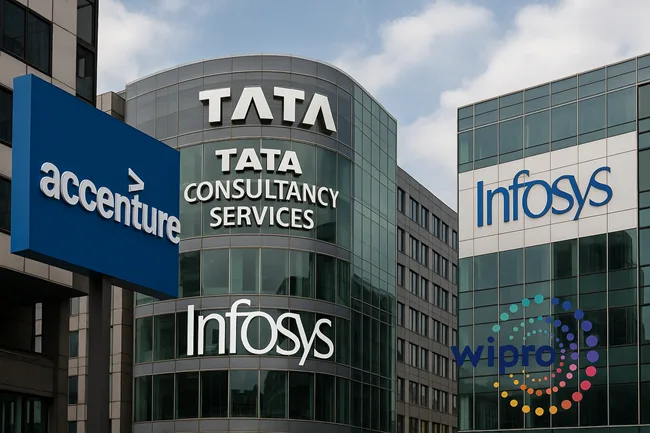
Enterprise IT services in 2025 are undergoing their most significant strategic pivot since the rise of cloud computing. Generative artificial intelligence, or GenAI, is now at the core of this transition. From deal origination and contract fulfillment to software development and support operations, global consulting and IT services firms are embedding GenAI into every layer of delivery. Indian IT services providers such as Wipro Limited (NSE: WIPRO), Infosys Limited (NSE: INFY), and Tata Consultancy Services Limited (NSE: TCS) are competing directly with global consulting giants like Accenture plc (NYSE: ACN), attempting to match their speed, execution, and monetization of GenAI-powered services.
How is Accenture consolidating its generative AI services into a unified enterprise reinvention model in 2025?
Accenture plc has emerged as the clearest first mover in converting GenAI into revenue. The American consulting and technology services provider reported $1.4 billion in GenAI bookings for its most recent quarter, bringing its cumulative GenAI revenue since 2023 to over $5.6 billion. This performance has been enabled by Accenture’s strategic bundling of GenAI into what it now calls “reinvention services,” a comprehensive transformation program that merges cloud, data, security, and AI under a single delivery umbrella. Reinvention services are being positioned not as discrete consulting projects, but as long-term operational overhauls that deliver recurring impact.
Institutional investors have responded favorably to Accenture’s transparent revenue tracking and vertical depth, particularly in sectors such as industrials, pharmaceuticals, and public sector modernization. Analysts credit Accenture’s early success to both its M&A activity and its decision to unify AI service lines into client-facing value frameworks tied to measurable KPIs.
How are Wipro, Infosys, and Tata Consultancy Services positioning their GenAI platforms for enterprise transformation in India and abroad?
Among the Indian IT services providers, Wipro Limited has been the most aggressive in realigning internal resources and delivery architecture around GenAI. In 2024 and early 2025, Wipro integrated Google Cloud’s Vertex AI and Gemini models into its proprietary HOLMES platform, which is now being deployed across multiple geographies and industries. The Indian IT services developer has upskilled 44,000 employees in GenAI and plans to scale internal use cases as a lever for improved productivity and client engagement.
Infosys Limited has developed a suite of large language models branded under Topaz, supporting domain-specific applications in marketing, legal, and enterprise workflow automation. The Indian IT consulting firm has also partnered with Adobe and Meta to bring GenAI capabilities to customer experience and enterprise social platforms. Tata Consultancy Services, meanwhile, has launched the AI.Cloud unit to consolidate AI and cloud-native services, and recently reported a GenAI deal pipeline of $900 million with over 250 client engagements across banking, manufacturing, and healthcare.
Despite these moves, none of the Indian firms have yet disclosed discrete GenAI revenue numbers. Analysts have noted that this lack of transparency limits valuation upside compared to peers like Accenture, which now consistently breaks out AI bookings and client impact statistics.
What are the most important differences in revenue tracking and deal reporting for GenAI between Indian and global IT services leaders?
A key differentiator in the GenAI services landscape is how vendors report deal wins, revenue realization, and service categorization. Accenture has explicitly defined GenAI contracts and published both quarterly and annual growth rates. This transparency has been crucial in establishing credibility with enterprise clients, institutional investors, and partners.
By contrast, Wipro, Infosys, and Tata Consultancy Services currently report GenAI-related progress in terms of deal pipeline, engagement count, and client references—but do not quantify realized revenues from GenAI-specific workstreams. This has led to speculation among institutional analysts that GenAI activity may be concentrated in proofs of concept, labs, and pilot deployments, rather than full-scale production engagements. Investors are therefore awaiting clearer monetization updates in the second half of FY26, particularly for large BFSI and CPG accounts.
How are delivery models, reskilling strategies, and workforce architecture evolving to meet GenAI demand in 2025?
GenAI is not just a technological transformation—it is fundamentally altering the delivery model of IT services. Accenture has committed to training over 80,000 professionals in data and AI by FY26 and has embedded GenAI into its consulting and operations workflow for large enterprise clients. Its hiring strategy is focused on AI engineers, industry-specific solution architects, and prompt engineers capable of building and fine-tuning foundation models.
Indian firms are following suit. Wipro’s GenAI reskilling initiative has been concentrated at its Innovation Lab in Bengaluru, where early-career engineers work on embedded AI projects alongside partners like Microsoft and Google. Infosys has redesigned its Lex platform to offer Topaz-based GenAI certifications. Tata Consultancy Services has moved toward more agile squad-based delivery models for its AI.Cloud unit and is hiring specialized consultants in natural language processing and AI ethics.
Industry observers say that Indian IT services exporters will need to further flatten their pyramid-style staffing models, increase onshore specialist presence, and localize GenAI solutioning for regional markets—particularly in North America and Europe—to compete at the Accenture level.
What execution challenges are Indian IT services firms facing in commercializing GenAI-led deals in FY25?
While Indian providers are demonstrating strong early interest, several challenges remain in moving from opportunity to revenue. Analysts point to a lag between client experimentation and enterprise-wide deployment, particularly in regulated sectors like financial services and healthcare. For example, while Wipro reported 17 GenAI-related deal wins in Q4 FY25, its overall IT services revenue remained flat to slightly negative, signaling that GenAI deal flow has not yet translated into material top-line impact.
Attrition of specialized GenAI talent also continues to weigh on Indian providers. While firms like Infosys and TCS are investing in internal certification, several startups and global hyperscalers are poaching mid-career engineers, pushing compensation costs higher. Additionally, clients in Europe are demanding explainable AI, auditability, and data localization—areas where Indian vendors must strengthen compliance and delivery assurance models.
What does the institutional investment community expect from GenAI adoption across Indian IT services by FY26?
Institutional investors are closely tracking three metrics: GenAI revenue contribution, margin impact from automation, and conversion of pipeline to production-scale programs. Most expect GenAI to improve utilization rates and reduce delivery costs over the long term, but express concern that Indian vendors may be underreporting costs associated with platform development and workforce reskilling.
Despite these concerns, there is growing recognition that GenAI is becoming central to large deal conversations. Analysts expect that by FY26, Indian firms will break out GenAI as a separate service line, either within digital transformation or under newly structured consulting units. If these changes materialize, investors believe Indian IT services stocks could re-rate based on higher productivity per employee and higher-margin platform revenue, rather than pure headcount growth.
Discover more from Business-News-Today.com
Subscribe to get the latest posts sent to your email.