Could India’s AP1000 agreement unlock stalled U.S. reactor commerce and reshape the future of nuclear partnerships?
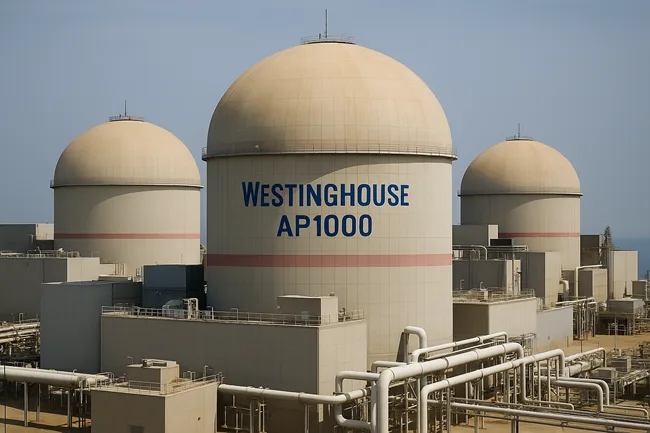
India’s civil nuclear ambitions are once again in focus as progress resumes on a long-discussed agreement with Westinghouse Electric Company to deploy AP1000 nuclear reactors in Andhra Pradesh. The project, centred around the coastal site of Kovvada, has been on the table for over a decade. If finalised, it could mark a turning point for both Indian nuclear expansion and the revival of U.S. nuclear exports, which have struggled in recent decades.
The agreement is part of India’s broader goal to expand nuclear capacity from 7.5 gigawatts today to 22.5 gigawatts by 2031, and eventually to 100 gigawatts by 2047. For the United States, it would be one of the most significant overseas nuclear deals in recent history, showcasing that American reactor technology can still compete internationally.
What has changed to revive the stalled AP1000 project?
One of the main roadblocks for the deal over the past decade was India’s Civil Liability for Nuclear Damage Act, which placed supplier liability provisions far stricter than those accepted internationally. U.S. vendors like Westinghouse were reluctant to enter the Indian market under those terms.
In 2025, India announced plans to amend the Atomic Energy Act and the Civil Liability for Nuclear Damage Act to create a more predictable liability environment and support a larger nuclear build-out. While these amendments are not yet fully enacted, the policy direction has given suppliers more confidence to engage in detailed project discussions.
Diplomatic engagement on the AP1000 deal picked up during Prime Minister Narendra Modi’s June 2023 state visit to Washington. Modi and then–U.S. President Joe Biden agreed at that meeting to intensify consultations on a Westinghouse techno-commercial offer for six units at Kovvada in Andhra Pradesh. As of December 2024, the Government of India confirmed that discussions with Westinghouse Electric Company were still in progress, with pre-project activities such as land acquisition, seismic studies, and site surveys underway.
In 2025, renewed trade tensions — driven by U.S. President Donald Trump’s imposition of tariffs of up to 50% on Indian goods — have added geopolitical strain to nuclear and commercial cooperation.
How AP1000 technology could fit into India’s energy strategy
The Westinghouse AP1000 is a Generation III+ pressurised water reactor with passive safety systems designed to cool the reactor core for up to 72 hours without operator intervention or external power. These features aim to address lessons from past nuclear accidents, reducing the risk of large-scale radioactive release even under extreme conditions.
For India, the AP1000’s modular construction approach offers the potential for faster build times compared to older large-reactor designs. With the government committed to diversifying beyond its indigenous pressurised heavy water reactors (PHWRs) and developing fast breeder reactors, the AP1000 provides an internationally proven option that complements domestic programmes.
The Kovvada project is also structured to align with India’s localisation drive. A significant share of components would be manufactured domestically, building industrial capability, creating jobs, and positioning Indian firms to supply components for AP1000 units in other markets.
What financial, supply chain, and public acceptance hurdles could impact India’s AP1000 reactor rollout
Despite renewed momentum, the project faces substantial challenges. Financing six large reactors will require a complex mix of public-sector funding, potential U.S. export credit, and private capital. Nuclear projects worldwide have faced cost overruns when schedules slip, and the AP1000 has a mixed delivery record internationally.
Localisation, while strategically valuable, adds complexity to the first units as supply chains adapt to AP1000 specifications. Meeting Westinghouse’s quality standards will be critical to ensuring safety and avoiding delays.
Public acceptance is another factor. While nuclear enjoys strong policy support in India, coastal projects like Kovvada often face scrutiny from local communities and environmental groups. Transparent safety communication, robust regulatory oversight, and community engagement will be key to avoiding social or legal roadblocks.
How the AP1000 nuclear deal could reshape India–U.S. energy cooperation and global reactor market dynamics
If completed, the AP1000 project would be a milestone in U.S.–India civil nuclear cooperation, building on the 2008 civil nuclear agreement but under very different geopolitical circumstances. For India, it would diversify its reactor fleet, accelerate capacity growth, and deepen industrial capabilities. For the U.S., it would restore a major foothold in the global nuclear export market, where competition from Russia and China has been intense.
A successful Kovvada programme could serve as a model for other developing nations considering U.S. nuclear technology, showing that projects can balance commercial viability, safety, and localisation. It would also demonstrate that cross-border nuclear partnerships can advance energy security and decarbonisation goals, even in a challenging geopolitical climate.
Discover more from Business-News-Today.com
Subscribe to get the latest posts sent to your email.