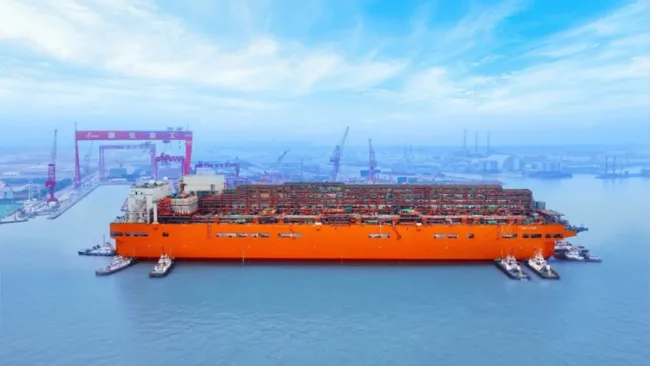
Eni S.p.A. (BIT: ENI) has reached a critical milestone in its liquefied natural gas (LNG) ambitions with the sail away of the Nguya floating liquefied natural gas (FLNG) unit from Shanghai, marking the start of Phase 2 of the Congo LNG project in the Marine XII concession offshore the Republic of Congo. The sail away ceremony on August 26, 2025, attended by Congo’s Hydrocarbons Minister Bruno Jean Richard Itoua and senior Eni executives, underlined the strategic importance of this project for both the Italian energy group and the African nation.
At 376 meters long and 60 meters wide, the Nguya FLNG is designed to produce 2.4 million tonnes per annum (MTPA) of LNG, bringing Congo LNG’s total capacity to 3 MTPA when combined with the Tango FLNG, which began operations in December 2023. This development positions the Republic of Congo as a fast-rising LNG exporter at a time when Europe, its primary destination market, is seeking to diversify away from Russian pipeline gas.
Why is the Nguya FLNG unit seen as a benchmark for speed, efficiency, and sustainability in LNG development?
One of the standout features of the Nguya FLNG project is its record-setting execution timeline. From contract award to sail away, the unit was conceived, designed, and built in just 33 months—one of the fastest in LNG history. Industry observers note that this rapid deployment underscores both Eni’s project management capabilities and the urgency with which Europe and other markets are pursuing alternative LNG supplies.
Beyond speed, the unit incorporates advanced technologies aimed at reducing the carbon footprint of LNG production. It can process gas from multiple fields, enhancing flexibility and future-proofing the project for yet-to-be-developed reserves. The reuse of existing infrastructure is also central to this sustainability narrative: the Scarabeo 5 drilling rig has been refurbished into a floating production and compression unit that will channel processed gas to Nguya, demonstrating industrial circularity and cost efficiency.
How does Phase 2 of Congo LNG align with Eni’s broader decarbonization and zero-flaring strategy?
Phase 2 of Congo LNG is not only about increasing export capacity; it is also about embedding lower-carbon practices in gas monetization. The project has been designed with a zero-flaring technological approach, reducing fugitive methane emissions and aligning with Eni’s long-term decarbonization commitments.
The subsea infrastructure to support the Nguya unit is advancing on schedule, with mooring and start-up expected by the end of 2025. When operational, the unit will play a dual role: supplying LNG cargoes to export markets and reinforcing local energy supply through gas-to-power integration. Eni already supplies the Congo Power Plant, which provides 70% of the country’s electricity generation, illustrating how upstream gas development is tied directly to socio-economic benefits on the ground.
What has been the historical trajectory of Congo LNG, and how did the project reach this stage?
Congo LNG is the Republic of Congo’s first liquefaction project and represents a significant leap forward in monetizing the country’s abundant gas resources. Development began in 2022 with an aggressive strategy that combined exploration and production ramp-up to shorten the time between discovery and export.
Phase 1 of the project centered on the Tango FLNG, a 0.6 MTPA unit positioned nearshore that exported its first cargo in February 2024. With 12 cargoes shipped since December 2023, Tango established Congo as a new entrant in the global LNG producers’ club. Phase 2 now builds on that momentum by scaling capacity with the offshore Nguya unit.
The first LNG cargoes from the project were allocated to Piombino’s regasification terminal in Italy, cementing the link between Congo’s upstream resources and Europe’s demand security.
How do analysts view the economic and geopolitical significance of Congo LNG for the Republic of Congo and Europe?
Institutional investors and energy analysts highlight that the Congo LNG project provides the Republic of Congo with both an economic lifeline and a stronger geopolitical standing. LNG exports are expected to become one of the country’s key foreign-exchange earners, diversifying revenues away from crude oil and supporting broader economic stability.
For Europe, Congo LNG represents part of a mosaic of new LNG sources—from the U.S. Gulf Coast to Qatar and Mozambique—that are collectively reshaping the global gas trade. Analysts believe that the project could enhance Europe’s ability to secure spot and long-term cargoes, especially as LNG remains the fossil fuel with the lowest carbon footprint.
Institutional sentiment around Eni remains constructive, with investors pointing to the company’s ability to execute complex projects quickly, its portfolio diversification across LNG, renewables, and carbon capture, and its resilience in volatile commodity markets.
What is the outlook for LNG exports from the Republic of Congo, and how does it fit into Africa’s role in the global energy transition?
With the addition of Nguya, the Republic of Congo’s LNG export capacity of 3 MTPA may appear modest compared to giants like Qatar or the United States, but its strategic value lies in speed-to-market and flexible supply. This positions Congo as a reliable incremental supplier at a time when LNG demand in Europe and Asia remains robust.
Africa’s LNG pipeline is also expanding rapidly, with projects in Mozambique, Mauritania-Senegal, and Nigeria adding to the continent’s export profile. Analysts note that Congo’s progress could inspire similar smaller-scale but high-efficiency projects elsewhere in Africa, where abundant gas remains underdeveloped.
For Eni, the project dovetails with its strategy of pairing gas development with decarbonization, enabling the firm to capture short-term LNG revenue while aligning with the energy transition by supplying gas-to-power projects, renewables, and low-carbon fuels.
How has Eni’s stock performed amid the LNG expansion, and what does investor sentiment suggest?
Shares of Eni S.p.A. (BIT: ENI) have reflected cautious optimism in recent months, with the LNG expansion providing a counterbalance to weaker refining margins and oil price volatility. While exact market movements on the day of the Nguya sail away were muted, analysts note that institutional investors continue to treat LNG growth as a medium-term bullish driver.
The project also enhances Eni’s free cash flow visibility, which is critical for sustaining dividends and share buybacks. Foreign institutional investor flows into European energy equities have been selective, but projects like Congo LNG strengthen Eni’s positioning as one of the few majors with both near-term LNG growth and a credible decarbonization pathway.
Sentiment analysis suggests a “hold to accumulate” posture among investors, reflecting confidence in execution while acknowledging broader energy market uncertainties.
What are the broader implications of LNG for energy security, emissions, and future investment cycles?
LNG continues to occupy a paradoxical position in the global energy transition. On the one hand, it is still a fossil fuel; on the other, it is the cleanest-burning among them and provides immediate benefits in replacing coal and oil in power generation. Projects like Congo LNG therefore straddle the dual objectives of emissions reduction and energy security.
For resource-rich nations such as the Republic of Congo, LNG projects open the door to new foreign investment, infrastructure development, and improved local energy access. For international investors, they represent opportunities in a commodity with a resilient demand outlook into the 2030s.
Eni’s dual strategy—building LNG capacity while investing in renewables, carbon capture, and industrial reuse—illustrates how energy majors are positioning themselves to stay relevant in a decarbonizing world. Analysts expect LNG to remain a cornerstone of Eni’s earnings mix, with Africa playing an increasingly important role in the portfolio.
Discover more from Business-News-Today.com
Subscribe to get the latest posts sent to your email.