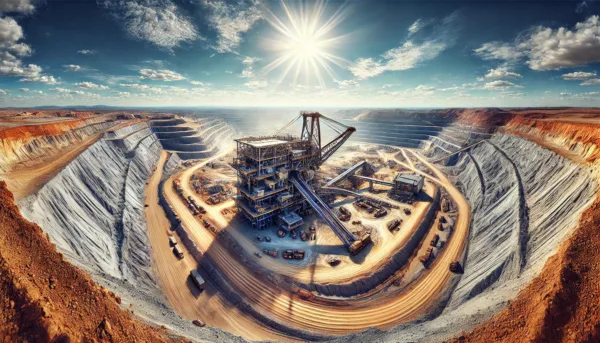


Critical Metals Corp confirmed that the Austrian Government has renewed the Wolfsberg lithium mining license for a further two years, extending regulatory certainty for one of Europe’s most advanced hard-rock lithium projects. The decision directly preserves development optionality at a time when lithium pricing has rebounded sharply and governments are intensifying efforts to secure non-Chinese critical minerals supply. Strategically, the extension buys time for capital discipline while aligning the project’s decision window with improving market fundamentals.
How does the Austrian Government’s Wolfsberg license renewal change Critical Metals Corp’s strategic timeline and risk profile?
The two-year extension of the Wolfsberg mining license materially reduces near-term regulatory risk while pushing the company’s most consequential capital decision further into a period of potentially stronger pricing and financing conditions. For Critical Metals Corp, this is not a symbolic regulatory update but a reset of its execution clock. The company now operates with a defined runway through 2028 to finalize financing structures, offtake frameworks, and downstream alignment without the pressure of an expiring permit.
From a risk perspective, the renewal eliminates one of the most binary uncertainties that often weighs on early-stage European mining assets. Wolfsberg is located in Austria, a jurisdiction known for stringent permitting standards and high environmental scrutiny. Continued approval signals that the project remains aligned with national regulatory expectations, which lowers the probability of disruptive permitting delays during the feasibility and financing phases.
The timing element is equally important. Lithium markets are emerging from a volatile downcycle that forced many developers globally to delay or shelve investment decisions. By extending the license during a price rebound, the Austrian Government has effectively allowed Critical Metals Corp to avoid committing capital at cycle lows while retaining the right to act decisively if the uptrend holds.
Why does Wolfsberg matter now as Europe accelerates its push for domestic lithium and battery supply chains?
Europe’s dependence on imported lithium chemicals and concentrates has become a strategic vulnerability as electric vehicle penetration, grid-scale battery energy storage systems, and industrial electrification accelerate. Wolfsberg stands out because it represents a rare hard-rock lithium asset within the European Union that has progressed beyond conceptual exploration into an advanced development stage.
The license extension comes as European policymakers are actively prioritizing domestic sources of critical raw materials under evolving industrial and security frameworks. Projects that already hold permits carry disproportionate strategic value because they can potentially shorten the timeline from investment decision to production. Wolfsberg’s continued regulatory standing positions it as a credible candidate within Europe’s broader effort to reduce reliance on Chinese processing and upstream supply.
For Critical Metals Corp, this policy backdrop enhances the strategic optionality of the asset. Even without immediate construction, the project’s status strengthens its relevance in discussions with potential strategic partners, including battery manufacturers, chemical processors, and sovereign-aligned capital seeking exposure to secure European lithium sources.
What does the current lithium price rebound signal for the economics and financing appeal of the Wolfsberg project?
Lithium prices have staged a notable recovery over the past six months, reversing the sharp correction seen through much of 2024. Battery-grade lithium carbonate prices in China have climbed to roughly CNY 168,000 to 170,000 per tonne, equivalent to approximately US$23,000 to US$24,000 per tonne, with some benchmarks posting year-over-year gains exceeding 100 percent. Spodumene concentrate pricing has also rebounded toward the US$2,000 per tonne range on a CIF China basis.
This rebound reflects tightening supply conditions after producers curtailed output and delayed expansions during the downturn. At the same time, demand growth from battery energy storage systems has accelerated faster than many forecasts anticipated, complementing steady electric vehicle demand rather than replacing it. Robotics, drones, and industrial automation are also emerging as incremental demand drivers.
For Wolfsberg, higher realized lithium pricing directly improves projected internal rates of return and reduces sensitivity to cost inflation. More importantly, stronger prices expand the universe of potential financing options. Project lenders, strategic investors, and offtake partners tend to re-engage once commodity prices stabilize above marginal cost levels. The license extension allows Critical Metals Corp to approach these conversations from a position of improved market leverage rather than forced urgency.
How does the planned decision-to-mine framework with Saudi partners shape execution discipline?
Critical Metals Corp has indicated that discussions with its Saudi hydroxide plant partners have resulted in an agreed framework targeting a decision to mine by the end of 2026, subject to sustained lithium pricing and viable financing conditions. The company’s chairman, Tony Sage, conveyed that the timing of this decision would remain conditional rather than automatic, reflecting a deliberate emphasis on capital discipline.
This approach signals a shift away from the growth-at-any-cost mindset that characterized parts of the lithium sector during earlier price spikes. By explicitly tying the decision to mine to market robustness and financing availability, management is attempting to preserve shareholder value while avoiding balance-sheet stress.
The Saudi partnership dimension adds a downstream integration angle that could prove strategically valuable. Access to hydroxide processing capacity outside China aligns with broader geopolitical efforts to diversify lithium value chains. If executed effectively, this structure could allow Wolfsberg concentrate to flow into a processing ecosystem that supports European and Middle Eastern battery markets, enhancing offtake security and pricing visibility.
How the Wolfsberg license extension reshapes competitive positioning among European lithium developers and global hard-rock producers
The Wolfsberg license renewal subtly shifts competitive dynamics among European lithium developers. Many projects across the continent remain in early exploration stages or face prolonged permitting uncertainty. Assets with active licenses and clear development pathways gain relative attractiveness as capital becomes more selective.
Globally, the extension underscores a broader industry recalibration. Developers are prioritizing optionality and timing flexibility rather than rapid capacity additions. This favors projects in stable jurisdictions with existing permits, even if their cost curves are not the lowest globally. In a market increasingly shaped by security of supply considerations, jurisdictional reliability can offset cost disadvantages.
For incumbents and diversified miners, Wolfsberg represents a potential acquisition or partnership target should European lithium consolidation accelerate. The license renewal keeps that strategic option open without forcing Critical Metals Corp to initiate such discussions prematurely.
How are investors likely to interpret the Wolfsberg extension in the context of Critical Metals Corp’s stock performance and sentiment?
Critical Metals Corp trades on Nasdaq under the ticker CRML and, like many early-stage mining companies, its share price has historically been sensitive to commodity cycles and regulatory milestones. The license renewal removes a key overhang that could have constrained valuation during a period of market recovery.
Investor sentiment toward lithium equities has begun to improve alongside price stabilization, although it remains cautious. Institutional investors are increasingly differentiating between projects with near-term regulatory clarity and those that remain speculative. Wolfsberg’s extended license positions Critical Metals Corp closer to the former category, even as execution risk remains.
Importantly, the market is unlikely to reward the renewal with sustained upside unless it is followed by tangible progress on financing, offtake, or downstream integration. The extension is best viewed as a necessary but not sufficient condition for rerating. It improves the narrative framework but does not, on its own, resolve capital intensity or development timelines.
What execution paths open for Critical Metals Corp if lithium prices strengthen or retreat before the 2026 decision window closes
If lithium prices continue to strengthen into 2026, Wolfsberg could transition from an option-value asset into an actionable development candidate. Higher prices would improve debt capacity, attract strategic capital, and potentially accelerate a final investment decision. In that scenario, the license extension will be seen as a pivotal enabler that allowed Critical Metals Corp to align execution with favorable market conditions.
Conversely, if prices weaken again due to renewed oversupply or demand disruptions, the extension still provides strategic insulation. The company would retain the ability to defer capital commitments without forfeiting its permit, preserving balance-sheet flexibility. This downside protection is particularly valuable in a sector prone to cyclical volatility.
In both outcomes, the extension reinforces a disciplined posture. Rather than forcing a binary outcome, Wolfsberg now sits within a controlled decision window that allows management to respond to external signals rather than react to regulatory deadlines.
Key takeaways on what the Wolfsberg license extension means for Critical Metals Corp, Europe, and the lithium sector
- The two-year license renewal materially reduces near-term regulatory risk and preserves development optionality through 2028.
- Wolfsberg’s permitted status enhances its strategic relevance as Europe seeks domestic lithium sources amid supply chain security concerns.
- The lithium price rebound improves project economics and financing appeal but does not eliminate execution and capital intensity risks.
- Management’s conditional decision-to-mine framework signals capital discipline rather than automatic expansion.
- The extension strengthens Wolfsberg’s positioning relative to less advanced European lithium projects.
- Investor sentiment may stabilize, but sustained valuation upside depends on follow-through milestones.
Discover more from Business-News-Today.com
Subscribe to get the latest posts sent to your email.