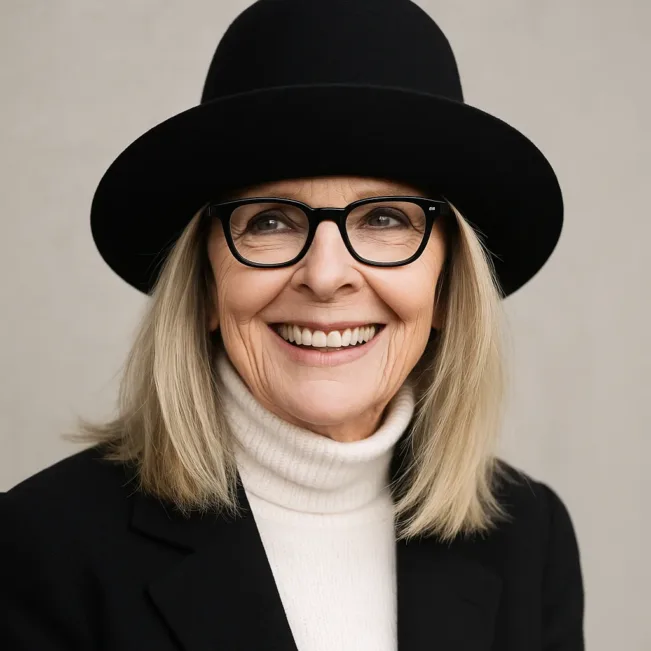
Diane Keaton, the Oscar-winning American actress whose singular style and unflinching portrayals of complex women reshaped Hollywood’s idea of the modern heroine, has died at 79. Her publisher Rizzoli confirmed her death to Reuters on October 11 2025, describing her as “an icon whose influence spanned film, fashion, and design.” People Magazine first broke the news.
Keaton’s passing closes a generational chapter for an industry that once revolved around her quirky authenticity. From the effortlessly neurotic yet magnetic Annie Hall to the stoic yet devastatingly human Kay Adams in The Godfather saga, Keaton embodied contradictions that made her unforgettable. She was, in every sense, the woman who made imperfection cinematic.
How Diane Keaton’s unconventional voice transformed the idea of a Hollywood leading lady
Long before “relatability” became a Hollywood marketing trope, Diane Keaton lived it. She arrived in the 1970s when studio icons like Faye Dunaway and Jane Fonda dominated screens with polish and precision. Keaton, by contrast, exuded vulnerability wrapped in irony. Her performances were intelligent but unscripted, emotionally raw yet never overwrought.
When Annie Hall premiered in 1977, the film was hailed not only for Woody Allen’s direction but for Keaton’s irresistible humanity. The movie’s offbeat rhythms—her laughter, hesitation, and awkward pauses—made audiences feel as though they were watching real life rather than performance. Critics often said she “didn’t act; she existed.” That approach won her the Academy Award for Best Actress, cementing her as a creative counterpoint to Hollywood’s idealized femininity.
Her name would later become shorthand for artistic sincerity. Costume designers credited her signature menswear—wide-leg trousers, neckties, and bowler hats—with triggering a wave of gender-neutral fashion decades before it went mainstream. Vogue once described her as “the woman who wore irony like couture.”
Why her influence reached far beyond the screen and shaped an era of female autonomy
By the time she starred in Reds (1981) opposite Warren Beatty, Keaton had evolved into a symbol of female self-definition. She rejected the studio system’s insistence on glamor conformity, turning down projects that didn’t align with her sensibilities. Her off-screen choices—never marrying, adopting two children as a single parent, and later writing best-selling memoirs—further reinforced her reputation as a Hollywood iconoclast.
Film historians often credit Keaton with bridging the feminist movement and mainstream entertainment. Her characters were rarely defined by male counterparts; they wrestled with ambition, self-doubt, and identity long before those themes became common in scripts. She was proof that a woman could be brilliant, flawed, and fashionable—sometimes in the same scene.
Even her comedic instincts had an intellectual weight. In Baby Boom (1987) and Something’s Gotta Give (2003), she reinvented middle-aged femininity, portraying women who navigated career success and romantic vulnerability with equal force. Those roles opened doors for later generations of actresses—Meryl Streep, Emma Thompson, and Frances McDormand among them—to demand multidimensional scripts.
How the film industry and fans are reacting to the loss of a generational storyteller
Within hours of the Reuters confirmation, tributes poured in from across Hollywood. Filmmakers described her as a creative partner who made dialogue breathe and silence eloquent. One studio executive said privately that “no director ever directed Diane Keaton—she directed the moment.”
Actors of every generation, from Al Pacino to Emma Stone, shared memories of working with or being inspired by her. Industry unions and guilds issued statements recognizing her contribution to American cinema, particularly her ability to turn eccentricity into mainstream appeal. The Academy of Motion Picture Arts and Sciences called her career “a blueprint for authenticity.”
Film schools, fashion houses, and even design institutes across Los Angeles and New York are reportedly planning retrospective showcases of her work, underscoring how deeply her influence cut across artistic disciplines. Social-media timelines filled with montages of her signature wide-brim hats, quick-witted interviews, and wry smiles that made late-night hosts laugh nervously.
What Diane Keaton’s passing reveals about Hollywood’s shifting relationship with authenticity
Keaton’s death comes at a time when Hollywood is grappling with questions about identity, transparency, and the erosion of mystery in celebrity culture. She belonged to a generation that cultivated depth over exposure. Her mystique—anchored in sincerity rather than self-promotion—feels increasingly rare in today’s algorithmic entertainment economy.
Analysts note that her body of work remains one of the most studied in film schools, not for box-office metrics but for its human texture. Keaton’s art was never about dominance or perfection; it was about emotional realism. In an era where AI can simulate everything from dialogue to facial expression, her natural unpredictability stands as a testament to the irreplaceable craft of human performance.
Her final public appearances, including an August 2024 talk at the Los Angeles County Museum of Art, reflected a reflective artist still engaged with questions of purpose and creative legacy. She reportedly told an audience that she was “still curious about what comes next,” a remark that now feels heartbreakingly prescient.
How her enduring legacy will continue to shape future generations of filmmakers and actors
Diane Keaton’s influence endures not only in reruns or retrospectives but in the DNA of contemporary storytelling. Directors cite her instinctive timing and fearless improvisation as precursors to modern screen naturalism. Younger actors mention her as a compass for career integrity—the rare performer who turned down fame’s excess to preserve artistic truth.
In academic circles, film theorists frequently pair her career with that of Katharine Hepburn and Greta Gerwig, tracing a through-line of women who subverted Hollywood’s structural expectations. Keaton’s artistry, however, remained uniquely personal. She was both participant and critic of the system that made her famous—a duality that made her performances feel alive even decades later.
For millions of fans worldwide, her death feels like losing a cultural friend. Viewers who grew up quoting her nervous laughter in Annie Hall or finding comfort in her grace in Something’s Gotta Give now mourn a woman who taught them that authenticity, no matter how awkward, could be its own form of beauty. Her passing also represents a quiet farewell to the improvisational freedom of 1970s American cinema—the era of handheld truth, before algorithmic storyboards and cinematic universes began dictating character arcs.
In the years ahead, Hollywood will continue invoking her name whenever actors dare to play truthfully rather than beautifully. Film students dissecting her scenes will note the rhythm of pauses, the refusal to over-explain, the subtle courage in letting silence do the acting. For many women in film, Keaton’s career will remain a north star—proof that charm can coexist with intellect, that eccentricity can be graceful, and that vulnerability can redefine power. As tributes pour in and retrospectives emerge, one certainty remains: Diane Keaton will continue to shape how the world sees women who live and love out loud, long after the curtain falls.
Discover more from Business-News-Today.com
Subscribe to get the latest posts sent to your email.