HiTHIUM has introduced an 8-hour-native lithium-ion energy storage system, the ∞Power8 6.9MW/55.2MWh, purpose-built for long-duration, all-weather renewable power supply. The move strengthens the company’s position in the lithium-based LDES space and signals a structural shift toward turnkey systems optimized for duration, efficiency, and safety at scale.
HiTHIUM’s latest launch aims to tackle one of the most stubborn bottlenecks in global energy transition: the cost, reliability, and performance limitations of long-duration energy storage (LDES). By unveiling what it calls the world’s first 8-hour-native solution, built from cell to system, the company has put down a marker for what it believes should be the new industry standard in renewable integration and grid stabilization.
The product, branded ∞Power8 6.9MW/55.2MWh, represents a vertical integration play around a dedicated 1300Ah cell design. The system is architected from the ground up to optimize for 8-hour charge–discharge cycles, with operational enhancements aimed at minimizing auxiliary losses, improving thermal performance, and withstanding extreme environmental conditions.

How is HiTHIUM’s 8-hour-native system designed to change grid-scale storage deployment models?
The strategic value proposition lies in the system’s optimization for grid-scale deployments where consistent, dispatchable power is required from renewable sources. Instead of retrofitting 2-hour or 4-hour systems to meet 8-hour requirements, HiTHIUM has built a turnkey configuration designed from inception for that target duration.
Each standard module delivers 6.9MW of power and 55.2MWh of energy capacity, and includes one medium-voltage power conversion unit and eight storage modules. This integrated architecture results in a deployment footprint that is 23 percent smaller than the company’s previous generation, with site preparation and hoisting demands reduced through simplified cabling and modularity.
The solution is pre-configured for standalone storage plants and large wind-solar hybrid facilities—particularly those located in remote or extreme-weather geographies. From a system integrator or project developer perspective, this reduces not only the soft costs of engineering and permitting, but also accelerates construction timelines and shortens the path to revenue generation.
What technological innovations support cost efficiency and system durability?
At the core of the platform is the 1300Ah ∞Cell, an ultra-high-capacity lithium-ion cell that surpasses the 587Ah and 1175Ah cells previously deployed by HiTHIUM. Compared to mainstream cells used in 2-hour storage solutions, this new cell reduces component count by more than 30 percent and slashes foil and ancillary power hardware costs by over 50 percent.
The cost and longevity advantages come from HiTHIUM’s proprietary ultra-thick electrode technology, which mitigates cracking, improves ion transport, and enables deeper electrolyte penetration. These are common failure modes in LDES applications, and HiTHIUM’s engineering approach appears to directly address them with operational tolerances designed for over 25 years of field life.
The cell also incorporates high-strength steel-belt confinement technology, a dual-valve pressure release system, and multilayer insulation rated for 800°C and 300 kPa—parameters that exceed most lithium-based systems currently certified for utility-scale use. Importantly, the design has passed an open-door fire test, allowing HiTHIUM to claim a new benchmark in thermal containment performance.
Why lithium may still dominate the LDES race despite pressure from alternatives
While alternatives such as iron-air, flow batteries, and thermal storage have received venture and regulatory backing in markets like the United States and Europe, lithium remains the dominant chemistry due to its high energy density, mature supply chain, and declining cost curve. The major criticism against lithium in LDES use cases has historically centered on cost per kilowatt-hour at long durations and safety under high thermal loads.
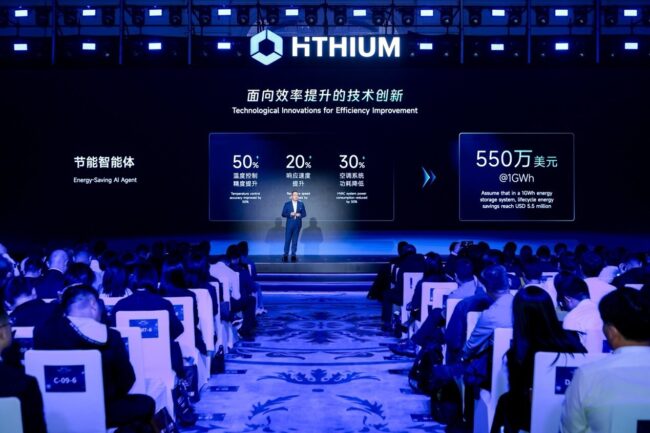
HiTHIUM’s design attempts to neutralize both concerns by increasing cell capacity and efficiency per square meter, while minimizing inactive materials and improving round-trip efficiency to over 97 percent. The company also claims its intelligent control and thermal balancing system reduces auxiliary consumption by 30 percent and enhances real-time response by 20 percent. If substantiated in field deployments, these metrics could materially shift the economics in favor of lithium for 6–10 hour deployments.
What risks and execution challenges lie ahead for mass adoption?
HiTHIUM has set an ambitious target of scaling mass production for the ∞Power8 system by Q4 2026. That timeline raises questions about manufacturing scalability, particularly for the 1300Ah cell format which is not yet widely adopted in global battery manufacturing lines. The company will need to demonstrate that supply chain partners, especially in electrode, foil, and separator components, can support the thermal and mechanical tolerances required for 8-hour performance at industrial volume.
Execution risk also lies in field reliability. Passing a fire test in a controlled lab environment is not a guarantee of long-term resilience in varied grid conditions. Developers and utilities will likely demand 12 to 18 months of operational data before placing large orders, particularly in markets where regulatory scrutiny around battery safety has increased due to incidents involving thermal runaway.
Moreover, with lithium prices still volatile due to global supply fluctuations, HiTHIUM’s cost competitiveness will depend on maintaining access to upstream materials while continuing to invest in process innovation.
Could this reshape policy and procurement dynamics in long-duration energy storage?
The launch comes at a time when multiple jurisdictions, including the United States Department of Energy, the European Union, and India’s MNRE, are prioritizing long-duration energy storage as a pillar of decarbonization strategies. However, procurement frameworks and incentives often lag behind technology, defaulting to hourly-duration metrics that disadvantage 6–10 hour solutions in favor of cheaper, shorter-duration lithium configurations.
If HiTHIUM can demonstrate that an 8-hour-native system delivers superior levelized cost of storage (LCOS), it may help trigger a shift in tender design and utility procurement logic. This could benefit not only the company but also open a pathway for other lithium incumbents to follow suit, further delaying the rise of alternative chemistries.
HiTHIUM’s positioning as an early mover in this segment allows it to influence both technical standards and procurement benchmarks. The company’s next strategic move may involve partnering with energy developers or digital infrastructure players to integrate LDES into hybrid or off-grid systems, particularly in emerging markets or data center-rich regions where power quality is a gating constraint.
Key takeaways: What HiTHIUM’s 8-hour-native battery system means for energy storage and renewables
- HiTHIUM has launched the first lithium-based energy storage system explicitly designed for 8-hour discharge, challenging retrofitted solutions that dominate today’s LDES landscape.
- The ∞Power8 6.9MW/55.2MWh platform incorporates a new 1300Ah cell with over four times the capacity of mainstream products, targeting reduced system cost and higher efficiency.
- Innovations include thick-electrode design, advanced thermal insulation, dual-valve safety systems, and modular deployment that cuts land use by 23 percent.
- The system claims a round-trip efficiency of over 97 percent and a lifespan of more than 25 years, potentially redefining lifecycle economics in the LDES market.
- Scheduled for mass production in Q4 2026, HiTHIUM’s execution success will depend on scaling component supply chains and proving field durability.
- If performance data validates the design, the solution could reshape procurement models that currently undervalue longer-duration lithium options.
- The move reinforces lithium-ion’s dominance in LDES despite hype around alternative chemistries, while raising the bar for integrated, duration-optimized architectures.
- Regulatory support, field deployments, and ecosystem partnerships will determine whether HiTHIUM’s design becomes the new baseline or remains a niche innovation.
Discover more from Business-News-Today.com
Subscribe to get the latest posts sent to your email.