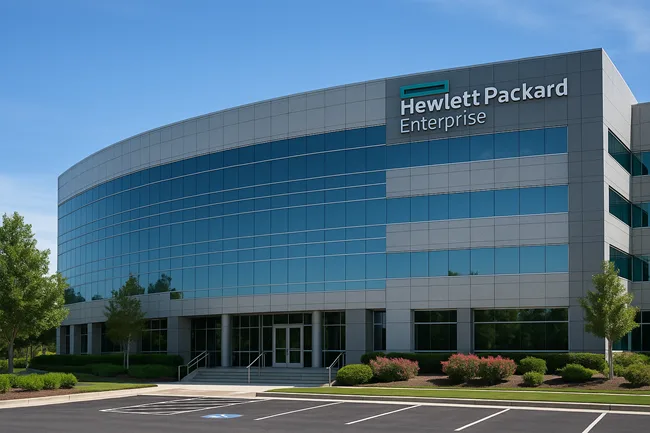
Hewlett Packard Enterprise Company (NYSE: HPE) closed fiscal 2025 on a high note operationally, posting its highest quarterly revenue to date and double-digit top-line growth across key segments. However, the market’s reaction painted a more cautious picture. Shares of HPE closed up 2.88% at $22.90 on December 4, but plummeted over 9% in after-hours trading, reflecting deeper concerns about the company’s earnings quality, margin pressures, and ongoing transformation costs.
Why investors sold off Hewlett Packard Enterprise stock despite record-setting revenue and cash flow
Hewlett Packard Enterprise reported $9.68 billion in revenue for the fourth quarter ended October 31, 2025, representing a 14% increase year-over-year. On a full-year basis, revenue hit $34.3 billion, also up 14% from FY24, supported by strong momentum in networking and AI-native infrastructure.
The company also delivered free cash flow of $1.92 billion for the quarter—an increase of $420 million from the same period last year—and declared a cash dividend of $0.1425 per share, payable in January 2026. Non-GAAP gross margin expanded to 36.4%, up more than 550 basis points year-over-year, while cash flow from operations grew to $2.46 billion.
But these positives were overshadowed by a sharp decline in GAAP diluted earnings per share, which fell to $0.11 from $0.99 in Q4 FY24. Non-GAAP EPS came in at $0.62, beating the company’s guidance range, but the nearly $0.50 spread between GAAP and adjusted earnings drew immediate market reaction.
The divergence in profitability metrics fueled investor skepticism around the sustainability of HPE’s reported margins, particularly in light of aggressive cost-reduction programs, impairment charges, and acquisition-related amortization stemming from its $14 billion Juniper Networks integration.
What the widening GAAP–non-GAAP gap reveals about Hewlett Packard Enterprise’s transformation pressures
Operating income swung to a GAAP loss of $8 million in Q4 FY25, compared to a profit of $693 million in the prior-year quarter. The culprit: a mix of $260 million in impairment charges, mostly linked to the Hybrid Cloud segment, and $298 million in restructuring and acquisition expenses, predominantly from the Juniper Networks acquisition. These costs more than offset strong product-level performance.
By contrast, non-GAAP operating profit totaled $1.18 billion, representing a 12.2% margin. The magnitude of the gap highlighted how dependent HPE has become on adjustments to demonstrate profitability—prompting sell-side analysts and institutional investors to reassess the company’s underlying earnings power heading into fiscal 2026.
How segment-level performance signals a changing strategic playbook inside HPE
Hewlett Packard Enterprise’s Networking segment emerged as the top growth engine, posting $2.81 billion in Q4 revenue, up 150% year-over-year. The boost came largely from the consolidation of Juniper Networks and demand for AI-optimized connectivity. Operating margins held strong at 23%, confirming the early traction of HPE’s unified AI-native networking strategy.
In contrast, Server revenue declined by 5% to $4.46 billion, and Hybrid Cloud fell 12% to $1.41 billion, reflecting enterprise hesitation amid a shift from virtualization-heavy environments to cloud-native AI deployments. Operating margin for Servers fell to 9.8% from 11.6%, while Hybrid Cloud margin dipped to 5% from 7.8%.
Financial Services revenue remained flat at $889 million, with operating margin improving to 11.5%, aided by disciplined underwriting and a 20.8% return on equity. However, HPE’s Corporate Investments and other segment shrank further, down 27% year-over-year, reflecting tighter internal capital allocation.
How AI infrastructure and NVIDIA partnerships are reshaping HPE’s product roadmap
The market reaction may have clouded the operational wins, but CEO Antonio Neri used HPE Discover Barcelona to reinforce the company’s long-term strategic bet: AI-native, hybrid, and autonomous infrastructure. The highlight was the unveiling of the AMD-powered “Helios” AI rack-scale architecture, designed for high-density inferencing with integrated Ethernet fabric.
HPE also deepened its partnership with NVIDIA through the NVIDIA AI Computing by HPE portfolio, bundling AI frameworks, GPUs, and orchestration software into scalable offerings for both edge and data center deployments. These initiatives directly align with customer feedback around simplifying AI deployment, cost control, and sovereign compute needs.
Additionally, product integrations across HPE Aruba Networking Central, HPE Juniper Networking Mist, OpsRamp, and GreenLake Intelligence suggest a coordinated push to bridge observability, AI operations, and enterprise automation.
Why HPE’s raised guidance for FY26 still triggered market anxiety
Despite the after-hours plunge, Hewlett Packard Enterprise raised its fiscal 2026 outlook, signaling internal confidence in execution. The company now expects revenue growth to range between 17 percent and 22 percent for fiscal 2026, reflecting confidence in the continued expansion of its networking and AI infrastructure portfolio. It has projected non‑GAAP earnings per share to fall between 2 dollars and 25 cents and 2 dollars and 45 cents, while GAAP earnings per share are expected to range from 62 cents to 82 cents as amortization, restructuring costs, and acquisition-related charges continue to influence reported profitability.
Free cash flow is anticipated to land between 1.7 billion dollars and 2 billion dollars for the full year, signalling disciplined capital management alongside ongoing investment in the Juniper Networks integration and AI‑native product ramp.
However, even with raised earnings guidance, the GAAP–non-GAAP spread remains unusually wide, and that continues to raise red flags. In FY25, full-year GAAP net income attributable to common shareholders was negative $59 million, while non-GAAP net income was $2.64 billion. The difference underscores the heavy role of amortization, impairment, and non-cash adjustments in reported profitability.
Sell-side analysts believe the divergence may persist into the first half of FY26, especially with ongoing integration work and internal cost restructuring yet to fully normalize.
Why did investor sentiment turn negative for Hewlett Packard Enterprise despite record quarterly revenue and stronger cash flow performance
Hewlett Packard Enterprise shares gained over 6% across the five trading days leading up to the Q4 earnings release, driven by anticipation of AI-driven momentum from Barcelona announcements. But after-hours trading saw a 9.31% decline, wiping out recent gains and dragging the stock back below its five-day moving average.
The reversal signals a tactical derisking by institutional desks, especially those prioritizing earnings quality and GAAP alignment. Hedge funds may see near-term valuation support around the $20 level given the company’s elevated cash flow yield, but long-only investors appear to be shifting to a wait-and-watch stance until margins stabilize and adjusted earnings flow more consistently into GAAP profitability.
That said, long-term investors may see the pullback as a strategic entry point, with the stock now trading at approximately 10x forward non-GAAP EPS. Execution on AI infrastructure, customer conversion from Juniper, and return to normalized hybrid cloud growth will determine whether that multiple holds—or compresses further.
Where the next inflection points lie in HPE’s fiscal 2026 trajectory
Heading into the first quarter of fiscal 2026, Hewlett Packard Enterprise will be under pressure to demonstrate operating leverage across both its networking and hybrid cloud segments. Investors will also be looking for incremental revenue contributions from its AI-native portfolio, particularly following the Juniper Networks integration and the rollout of new architectures unveiled at HPE Discover Barcelona.
A key area of focus will be whether the company can reduce its dependency on non-GAAP adjustments by improving GAAP profitability through cost discipline and normalized amortization rates. At the same time, the realization of synergies from the Juniper acquisition will be critical to proving that recent strategic investments can drive sustained earnings growth.
If HPE can convert early enthusiasm around its AI infrastructure offerings into monetizable enterprise wins, particularly in Europe and federal verticals, investor confidence may rebound quickly.
But with market sentiment now finely attuned to earnings quality, not just topline growth, Hewlett Packard Enterprise must strike a delicate balance between innovation and execution.
Key takeaways: HPE Q4 FY25 earnings and investor reaction explained
- Hewlett Packard Enterprise (NYSE: HPE) reported record Q4 FY25 revenue of $9.68 billion, up 14% year-over-year, driven by Networking and AI-native infrastructure.
- Despite the revenue beat, GAAP EPS dropped to $0.11 from $0.99 in Q4 FY24, triggering a 9.31% after-hours stock decline due to investor concern over profitability quality.
- Non-GAAP EPS came in at $0.62, beating guidance, but the nearly $0.50 GAAP–non-GAAP spread sparked doubts about ongoing transformation costs.
- Impairment charges of $260 million and $298 million in acquisition-related expenses weighed heavily on GAAP earnings, overshadowing strong cash flow.
- The Networking segment surged 150% year-over-year to $2.81 billion, with 23% margin, while Server and Hybrid Cloud declined and showed margin compression.
- Free cash flow hit $1.92 billion, up from $1.5 billion in Q4 FY24, supporting a dividend payout of $0.1425 per share.
- FY26 guidance was raised across the board: revenue growth of 17–22%, non-GAAP EPS of $2.25–$2.45, GAAP EPS of $0.62–$0.82, and free cash flow of $1.7–$2 billion.
- Institutional sentiment turned cautious as the stock erased five-day gains, with investors scrutinizing the sustainability of adjusted margins.
- AI infrastructure, Juniper Networks integration, and HPE’s partnership with NVIDIA remain central to the company’s long-term positioning.
- Analysts view the stock as a “hold” near-term, with potential upside if HPE demonstrates margin recovery and better GAAP–non-GAAP alignment in H1 FY26.
Discover more from Business-News-Today.com
Subscribe to get the latest posts sent to your email.