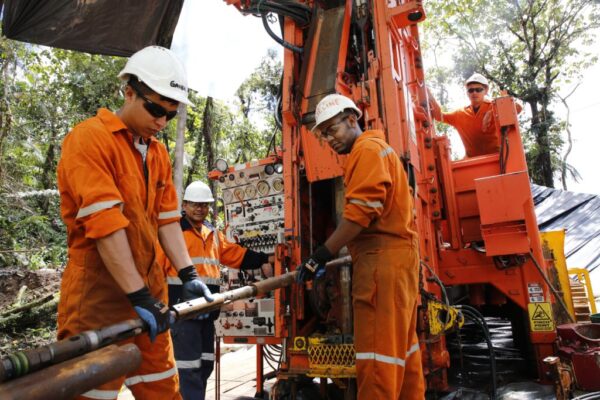




Havilah Resources Limited (ASX: HAV) has reported assay results from an 11-hole, 2,240-metre reverse circulation drilling program at its Birksgate prospect in northeastern South Australia, confirming the presence of copper mineralisation approximately 6 km east of the original 2014 discovery on the same prospective horizon. The company’s shares last traded at A$0.64, representing a gain of more than 195% over the past 12 months against a 52-week range of A$0.165 to A$0.655, with the stock sitting near its annual peak as exploration momentum builds. The drilling, conducted during November and December 2025 on the eastern limb of the Birksgate anticline, establishes that the stratabound copper system is distributed across a large area and may extend along more than 50 km of prospective strike length based on aeromagnetic interpretation. For a company whose market capitalisation has roughly tripled in 12 months to approximately A$219 million, the Birksgate results reinforce the broader resource thesis underpinning Havilah Resources as a multi-commodity explorer in one of Australia’s most mineral-rich geological provinces.
What did the Birksgate reverse circulation drilling program find, and why does 6 km of copper extent matter for Havilah Resources?
The two most significant holes from the November-December 2025 program were BKRC013 and BKRC014, drilled on the interpreted position of the K2 prospective horizon on the eastern limb of the Birksgate anticline. BKRC013 intersected 26 metres at 0.14% copper from 120 metres depth, including a higher-grade interval of 3 metres at 0.38% copper from 139 metres. BKRC014 returned two discrete mineralised sections: 5 metres at 0.16% copper from 136 metres and 10 metres at 0.12% copper from 153 metres, with the copper accompanied by elevated gold grading up to 1.32 parts per million over one metre. These are exploration-stage intercepts rather than resource-grade results, but their strategic significance lies not in the grades themselves but in what they demonstrate about the lateral continuity of the mineralised system.
Prior to this program, copper-gold-molybdenum mineralisation at Birksgate had been confirmed over a combined distance of approximately 2.5 km across both limbs of the Birksgate syncline, following Havilah’s 2023 reverse circulation drilling east of the original 2014 MMG-Havilah joint venture discovery. The latest holes extend that footprint a further 3.5 km eastward on the Birksgate anticline, pushing the total confirmed lateral extent of the stratabound system to roughly 6 km. Aeromagnetic interpretation suggests the prospective horizon may trace out more than 50 km of strike length across the syncline and anticline pair, a figure that places Birksgate in a different exploration category than a conventional single-target copper prospect.
The K2 horizon, which the drilling is targeting, is interpreted to be the lateral equivalent of the mineralised host unit at Havilah Resources’ flagship Kalkaroo copper-gold deposit, located approximately 50 km to the south-southeast. That correlation, if borne out by further drilling, would give Birksgate a pedigree within a proven regional mineralising system rather than treating it as an isolated anomaly. The geochemical fingerprint across holes is consistent: the mineralisation is accompanied by elevated molybdenum (up to 617 parts per million over one metre in BKRC013 and 394 ppm across 4 metres in BKRC012), uranium and vanadium, a signature that matches earlier drilling on the Birksgate syncline. Consistency of this geochemical package across 6 km of lateral distance is the kind of systematic evidence exploration geologists find compelling.
How does stratabound skarn geology shape the exploration challenge and the path to higher grades at Birksgate?
The mineralisation style at Birksgate is classified as stratabound skarn, a deposit type formed when metal-bearing hydrothermal fluids interact with carbonate or carbonaceous host rocks. At Birksgate, the process has resulted in the replacement of thinly bedded carbonate and graphitic layers by sulphide minerals, magnetite and fluorite, likely sourced from large diorite-monzogranite intrusions to the north and west. The significance of this geology is twofold: stratabound deposits tend to be predictable in their lateral continuity because they follow sedimentary layering, and skarns can exhibit considerable grade variation depending on proximity to fluid conduits and structural controls.
The current drilling grades at Birksgate, generally in the 0.12% to 0.38% copper range, are disseminated rather than concentrated. Technical Director Dr Chris Giles acknowledged this directly in the release, noting that future exploration will focus on locating structurally favourable areas where disseminated copper mineralisation could reach higher grades. This is the core exploration thesis: the broad stratabound system has been demonstrated to exist at scale, but the economically interesting question is whether structural complexity within the anticline-syncline pair has created zones of grade concentration. Without a higher-grade core or feeder structure, Birksgate remains a large low-grade exploration target rather than a near-term development prospect.
The western limb drilling in this program (holes BKRC007, BKRC008 and BKRC009) returned no significant mineralisation, though the geology was described as encouraging. The anticline core holes BKRC010 and BKRC011 encountered high manganese and elevated iron without meaningful metal anomalism. The company noted that the high manganese could indicate distal portions of the suspected skarn mineralising system, which would suggest the holes were drilled too far from the main fluid pathways. BKRC017, which tested the southern extent of skarn mineralisation established in earlier drilling 3.5 km to the north, encountered thicker than expected Neoproterozoic cover but returned copper values up to 730 parts per million in its final 12 metres before being terminated at 232 metres for technical reasons, leaving that vector incompletely tested.
How does the Birksgate discovery fit within Havilah Resources’ broader project portfolio and capital allocation priorities in South Australia?
Havilah Resources holds more than 16,000 square kilometres of exploration tenements in the Curnamona Craton in northeastern South Australia, a geological terrane that hosts the giant Broken Hill lead-zinc-silver orebody and has a long history of copper, gold and cobalt mineralisation. The company’s primary development-stage asset is the Kalkaroo copper-gold-cobalt project, which carries an ore reserve of more than 100 million tonnes and is positioned as one of Australia’s larger undeveloped open-pit copper-gold deposits. The Mutooroo copper-cobalt-gold project and the Grants and Maldorky iron ore projects round out the portfolio.
In this context, Birksgate occupies the early-stage exploration layer of the portfolio. Havilah Resources has confirmed at the end of the JORC appendix accompanying the release that no firm plans for follow-up drilling exist at this stage, with any additional work subject to drilling budget allocation and rig availability. That is candid language that reflects the capital constraints typical of an explorer without operating cash flow, and it sets realistic expectations about the pace at which Birksgate will advance relative to the flagship Kalkaroo project. The company generated revenue of A$3.53 million in its most recent trailing 12 months, a figure that reflects modest activity rather than production, and reported a net loss of A$2.12 million in the most recent half-year period.
The relationship between Birksgate and Kalkaroo is analytically important. If the K2 horizon at Birksgate is genuinely equivalent to the Kalkaroo mineralised host, the implication is that the same broad mineral system operating at Kalkaroo may be expressing itself at surface across a much larger regional footprint. That connection, which Havilah Resources has been building systematically through the 2023 syncline drilling and now the 2025 anticline program, is the kind of geological narrative that attracts institutional and strategic interest in junior explorer stocks. The stock’s 195% price appreciation over the past year, significantly outperforming the S&P/ASX 200 index return of roughly 9.6% in the same period, suggests the market is already pricing in some portion of this exploration narrative.
What do the Havilah Resources HAV share price performance and market capitalisation signal about investor sentiment following the Birksgate update?
Havilah Resources shares were trading at approximately A$0.64 following the release, up around 3.2% on the session, near the top of the 52-week range of A$0.165 to A$0.655. The stock has gained more than 195% over the past 12 months and outperformed the ASX All Ordinaries Index by roughly 190 percentage points over the same period. At a market capitalisation of approximately A$219 million, the company is being valued well above a sum-of-parts assessment based purely on its exploration-stage assets and limited revenue, which means investors are embedding a substantial option value for exploration success across the tenement package.
The 3.2% single-session gain on the Birksgate news aligns with the nature of the announcement: it is a confirmation of system-scale potential rather than a discovery of an economically defined resource. Markets typically respond more strongly to the latter, which means the measured reaction on the day is arguably appropriate. The more significant price catalyst for Havilah Resources HAV shares is likely to come from one of two directions: a financing or development decision on the flagship Kalkaroo copper-gold project, or a follow-up drilling program at Birksgate that returns higher-grade intercepts demonstrating structural grade concentration. Neither of those catalysts is imminent based on the current disclosure.
It is worth noting that Havilah Resources carries no analyst coverage from major brokers, which means the stock’s price discovery is driven primarily by retail investors and smaller specialist mining funds rather than institutional analyst consensus. That creates both upside and downside asymmetry: a positive re-rating from broker initiation or a strategic partnership announcement could move the stock sharply, while the absence of sell-side discipline can allow speculative enthusiasm to run ahead of fundamentals. The current proximity to the 52-week high, combined with a negative trailing profit margin and limited operating revenue, suggests the market is pricing this as an exploration play with significant optionality rather than a near-term cash flow story.
What are the execution risks and next steps that will determine whether Birksgate becomes a material asset for Havilah Resources?
The central execution risk at Birksgate is grade. Confirming the lateral extent of a stratabound copper system across 6 km is a meaningful exploration milestone, but stratabound low-grade copper mineralisation is not in itself a development-ready asset in today’s cost environment. Open-pit copper economics in Australia typically require sustained grades above 0.3% to 0.5% copper equivalent to support feasibility, and the current Birksgate intersections are largely sub-0.2% copper. The exploration logic, as articulated by Dr Giles, is that structural focusing within the anticline-syncline pair could generate higher-grade zones, but that hypothesis requires step-out drilling specifically targeting structurally favourable settings, work that has not yet been formally scheduled.
The incomplete testing of BKRC017, which was terminated at 232 metres for technical reasons after encountering 730 parts per million copper in its final interval, represents one of the clearest near-term follow-up targets in the program. Similarly, the negative results on the western limb of the anticline, where the geology was encouraging but no significant mineralisation was found, suggest the eastern limb is the more prospective structural setting for grade concentration. A targeted drilling program focused on the eastern anticline limb, particularly testing the southern extent of the skarn system and depth extensions below the current drill hole terminations, would provide the next meaningful data point for market assessment.
Tenure security appears sound: Havilah Resources holds exploration licence EL 5873 with 100% ownership, and a Native Title Exploration Agreement is in place with ATLA, the representative claimant organisation. No material impediments to further exploration have been identified. The tenement is in good standing. From an operational standpoint, the JORC-compliant reverse circulation program was executed to professional standards with rigorous quality control, sample security and independent assay validation through an Adelaide laboratory. The Competent Person, Dr Chris Giles, is a member of the Australian Institute of Geoscientists and a substantial shareholder, which creates alignment of interest with market participants but also warrants the usual caution about insider-directed commentary in investor-facing disclosures.
Key takeaways: what the Havilah Resources Birksgate drilling results mean for the company, its peers, and the Australian copper exploration sector
- Havilah Resources has confirmed stratabound copper-gold-molybdenum mineralisation on the K2 horizon across a 6 km lateral distance at Birksgate, establishing the system as one of genuine regional scale rather than a point-source anomaly.
- The mineralised horizon is interpreted to be laterally equivalent to the host unit at the flagship Kalkaroo copper-gold deposit 50 km to the south, which, if confirmed by further drilling, would substantially upgrade Birksgate’s geological pedigree within a proven mineralising system.
- Current drill grades of 0.12% to 0.38% copper are below typical open-pit development thresholds for Australian copper projects, and the company has explicitly acknowledged that finding higher-grade structurally controlled zones is the central exploration challenge going forward.
- Aeromagnetic interpretation suggests the prospective stratabound horizon may extend along more than 50 km of strike length across the Birksgate syncline and anticline pair, representing a very large untested target area that could underpin a multi-year drilling campaign.
- HAV shares were trading near their 52-week high of A$0.655 following the release, with the stock up approximately 195% over the past year against a market cap of roughly A$219 million, implying the market is pricing in significant exploration optionality rather than near-term cashflow.
- No follow-up drilling program has been formally scheduled, with additional work subject to budget allocation and rig availability, reflecting the capital constraints typical of an exploration-stage company without operating revenue.
- Drillhole BKRC017, terminated early at 232 metres after encountering elevated copper values in its final interval, represents the most compelling near-term follow-up target and an opportunity to test the southern extent of the skarn system.
- The absence of analyst coverage from major brokers means HAV’s valuation is driven primarily by retail and specialist investor sentiment, creating sharper upside and downside potential around exploration catalysts than would typically be seen in a well-covered mid-tier miner.
- For copper explorers across the Curnamona Province, the Birksgate result reinforces the under-explored nature of the broader regional terrane and will likely encourage renewed aeromagnetic and geochemical survey work by peers with adjacent or nearby tenements.
- The next material re-rating catalyst for Havilah Resources is likely to come either from a development decision on Kalkaroo or from targeted drilling at Birksgate that demonstrates grade concentration in structurally favourable settings, neither of which is expected in the near term based on current disclosures.
Discover more from Business-News-Today.com
Subscribe to get the latest posts sent to your email.