




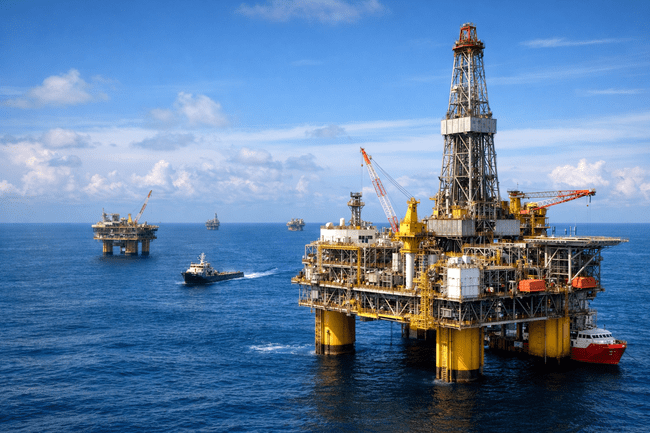
Harbour Energy plc reported an 84 percent year-on-year increase in production for the full year 2025, reaching 474,000 barrels of oil equivalent per day on the back of the full integration of Wintershall Dea assets and strong execution across its UK, Norwegian, and Argentinian portfolios. The company generated $1.1 billion in free cash flow, exceeding earlier guidance, and has set an ambitious trajectory to reach approximately 500,000 boepd by the end of 2026 contingent on the successful closure of three strategic transactions, including its $3.2 billion acquisition of LLOG Exploration in the United States Gulf of Mexico.
With capital expenditures totaling $2.3 billion and leverage reduced to 0.6 times despite currency translation losses, Harbour Energy plc has positioned itself as a cash-generating independent with both operating and tax optimization levers in motion. The company is also preparing to transition to a payout ratio-based distribution policy, with further details expected at its full-year results on March 5, 2026.
Is Harbour Energy building the next diversified upstream cash engine among independents?
Harbour Energy plc’s 2025 operational delivery was shaped by three clear themes: volume expansion via Wintershall Dea, cost optimization through rationalization and divestitures, and strategic optionality across Europe, Latin America, and now the United States. Production jumped to 474,000 boepd from 258,000 boepd in 2024, with the contribution from Wintershall Dea accounting for a significant portion of the uplift. The mix was nearly balanced, with 40 percent from liquids, 40 percent from European gas, and the remaining 20 percent from other gas assets. Unit operating costs dropped from $16.5 per barrel of oil equivalent in 2024 to $13.0 in 2025, a 20 percent reduction that signals tangible cost absorption gains and brownfield leverage.
The company’s emissions intensity also saw improvement, declining to 14 kilograms of CO2 per barrel of oil equivalent from 19 kilograms the previous year. Safety metrics held steady, with a total recordable injury rate of 1.1 per million hours. Production gains were underpinned by a wide footprint of onstream development wells across Norway, the United Kingdom, Argentina, Germany, and Egypt. These included the successful completion of the Fenix project in Argentina and Maria Phase 2 in Norway. Five subsea developments in Norway remain on schedule, with first gas from the Harbour-operated Dvalin North project targeted for mid-2026.
In Egypt, the company reached final investment decision on the Fayoum-Messinian development near the West Nile Delta infrastructure, targeting first gas by the end of 2026. Fast-cycle wins also featured in Egypt’s Dissouq basin, where the EZZ-1 well was brought onstream within two months of discovery, while appraisal drilling is progressing at the EZZ-2 prospect.
Beyond organic execution, Harbour Energy plc was awarded nine exploration licenses in Norway’s APA 2025 round, including four as operator. These licenses are all located near existing infrastructure, increasing development viability and capital return potential. Meanwhile, its carbon strategy advanced in Denmark with the Greensand Future project, where Harbour Energy plc holds a 40 percent stake. Commercial operations are targeted for the end of 2026, supported by an ongoing 3D seismic survey at the company’s operated Greenstore carbon capture and storage site.
How are the LLOG and Waldorf deals reshaping Harbour’s tax profile, free cash flow, and jurisdictional balance?
Harbour Energy plc’s $3.2 billion acquisition of LLOG Exploration represents a decisive entry into the Gulf of America, where the company will gain control of a fully operated, oil-weighted production portfolio characterized by long reserve life and a strong in-basin operational team. Management expects the deal to be free cash flow accretive on a per-share basis starting in 2027, positioning the acquisition as both a growth and return lever. Given its oil weighting and jurisdictional advantage, the LLOG portfolio is also expected to dampen the overall tax burden.
In parallel, the company’s $170 million acquisition of Waldorf Production in the United Kingdom offers a tax shield and liquidity unlock. Specifically, the deal releases approximately $350 million in trapped cash and brings $900 million in tax-effected UK tax losses into the fold. The timing of this acquisition is strategic, given the fiscal tightening in the UK North Sea and Harbour’s ongoing effort to preserve returns in a high-tax environment.
To sharpen its focus, Harbour Energy plc is exiting its Indonesia assets for $215 million and has taken steps to withdraw from several exploration licenses in Mexico, as well as non-core carbon capture and storage licenses in the Netherlands and the United Kingdom. Collectively, these moves point to a reallocation strategy aimed at higher-return zones and jurisdictional clarity.
What signals can be read from Harbour’s upgraded free cash flow and 2026 commodity price sensitivities?
In 2025, Harbour Energy plc reported revenue of $10.3 billion, up from $6.2 billion in 2024. EBITDAX reached $7.1 billion compared to $4.0 billion a year earlier. Realized oil prices fell to $69 per barrel from $82, while European gas rose to $13 per thousand cubic feet from $11. Other gas prices remained flat at $4 per thousand cubic feet.
Despite the softer oil pricing environment, Harbour delivered $1.1 billion in free cash flow, which was approximately $100 million higher than its updated November 2025 guidance and $500 million ahead of its original January 2025 outlook. This result came after accounting for commodity price normalization and was driven by execution across multiple basins.
Net debt declined from $4.7 billion to $4.4 billion, even with a $600 million foreign exchange headwind linked to European-denominated senior bonds. Leverage dropped from 0.7 times to 0.6 times. Harbour Energy plc closed the year with a strong hedge position, capturing a mark-to-market gain of $500 million. For 2026, 50 percent of its economic exposure to European gas is hedged at $11 per mscf, and 40 percent of Brent oil is hedged at $71 per barrel.
Looking ahead, Harbour’s 2026 guidance assumes average production between 435,000 and 455,000 boepd, unit operating costs of $13.5 per barrel of oil equivalent, and total capital expenditures between $1.7 billion and $1.9 billion. The company expects $600 million in free cash flow at a base case of $65 Brent and $11 European gas. These figures exclude the pending acquisitions and divestitures.
Once the LLOG, Waldorf, and Indonesia transactions close as expected, Harbour forecasts production to reach around 500,000 boepd by year-end. Operating costs are expected to remain below $15 per barrel of oil equivalent. The effective tax rate is also anticipated to fall, reflecting the limited near-term US tax obligations and the benefit of acquired UK tax losses.
Will Harbour’s LNG and Mexico plays pay off or complicate execution?
Harbour Energy plc is investing in long-duration, high-impact strategic projects in both Argentina and Mexico. In Argentina, the company holds a 15 percent stake in the Southern Energy LNG venture, which comprises two floating LNG vessels with a combined capacity of approximately 6 million tonnes per annum. The first vessel is already progressing through commissioning, while conversion of the second and pipeline infrastructure are underway. The target for first operations is the end of 2027.
In Mexico, Harbour now operates the 750 million barrel oil equivalent Zama field, having secured operatorship from Petróleos Mexicanos (Pemex). The company has submitted a phased development plan that is said to be more capital-efficient. Simultaneously, front-end engineering design work is planned for 2026 on the Kan oil field, where Harbour holds a 70 percent stake.
While both projects offer substantial long-term growth, they also present execution risks. The LNG value chain in Argentina involves two floating production vessels, onshore infrastructure, and export logistics. In Mexico, Harbour must navigate a complex regulatory environment, historically slow permitting, and the integration of Pemex infrastructure. The success of these plays will depend on Harbour’s ability to replicate its UK-Norway execution model across different regulatory and geopolitical contexts.
What does Harbour’s portfolio say about how independents are adapting in a capital-constrained energy market?
The Harbour Energy plc of 2026 is not the same company that came into being through the Premier Oil and Chrysaor merger. It is now a diversified upstream player with exposure to mature cash engines in the North Sea, scalable growth assets in Latin America, and oil-weighted production in the United States. Its investments in CCS also provide optionality for future compliance regimes and carbon management monetization.
The strategy appears to hinge on three elements: production stability and reinvestment discipline in Europe, asset transformation through M&A in North America, and optional long-cycle upside in Latin America. If executed well, Harbour could emerge as a free cash flow leader among mid-cap independents. However, the complexity of integrating a US portfolio, maintaining tax shields, and delivering on LNG and CCS timelines means the company must remain nimble, even as it scales.
What are the key takeaways from Harbour Energy plc’s 2025 trading update and its strategic outlook for 2026?
- Harbour Energy plc delivered an 84 percent year on year increase in production to 474,000 barrels of oil equivalent per day in 2025, driven primarily by the full year contribution of the Wintershall Dea assets and strong operational execution across core regions including Norway, the United Kingdom, and Argentina.
- Unit operating costs fell sharply to $13 per barrel of oil equivalent, reflecting scale benefits from higher production, portfolio high grading, and tighter cost discipline, reinforcing Harbour Energy plc’s positioning as a low cost upstream independent.
- Free cash flow reached $1.1 billion despite weaker oil prices, exceeding both the company’s original and revised 2025 guidance and enabling a reduction in leverage to 0.6 times, even after absorbing foreign exchange headwinds.
- The $3.2 billion acquisition of LLOG Exploration marks a strategic entry into the United States Gulf of Mexico, adding an operated, oil weighted portfolio with long reserve life that management expects to be free cash flow accretive on a per share basis from 2027.
- The acquisition of Waldorf Production in the United Kingdom provides a meaningful financial and tax lever by unlocking approximately $350 million of trapped cash and introducing around $900 million of tax effected UK tax losses at a time of elevated fiscal pressure in the North Sea.
- Portfolio rationalisation through the divestment of Indonesian assets and the exit from non core exploration and carbon capture and storage licences signals a sharper focus on capital efficiency and jurisdictional clarity.
- Harbour Energy plc’s 2026 guidance reflects continued capital discipline, with lower planned capital expenditure, operating costs expected to remain below $15 per barrel of oil equivalent, and base case free cash flow of approximately $600 million at conservative commodity price assumptions.
- The company’s long cycle growth options in Argentina LNG and Mexico’s Zama and Kan fields offer material reserve and production upside beyond 2026, but also introduce execution, regulatory, and geopolitical complexity that will test management’s delivery capabilities.
- Progress on carbon capture and storage projects in Denmark and reductions in greenhouse gas intensity indicate a selective but pragmatic approach to decarbonisation that aligns with infrastructure readiness and commercial timelines.
- The planned shift to a payout ratio based distribution policy, to be detailed with full year results in March 2026, is likely to be closely watched by investors seeking greater clarity and predictability on capital returns.
Discover more from Business-News-Today.com
Subscribe to get the latest posts sent to your email.


