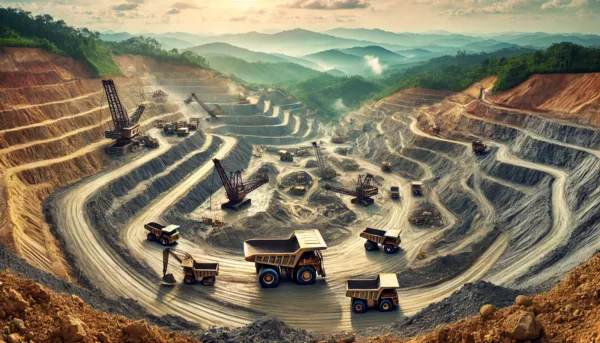
Greenland Resources Inc. (Cboe CA: MOLY | FSE: M0LY) has officially secured a 30-year exploitation license from the Government of Greenland for its flagship Malmbjerg project, a high-grade molybdenum and magnesium deposit located in east Greenland. The Canadian mineral exploration company, through its Greenlandic subsidiary Greenland Resources A/S, signed the exploitation agreement with Greenland’s Minister for Business, Mineral Resources, Energy, Justice and Gender Equality, Naaja H. Nathanielsen, during a formal ceremony on June 19, 2025. The license, which may be extended to 50 years, authorizes commercial extraction of both molybdenum and magnesium from the site now designated as Piiaaffik Høstakken.
The announcement marks a critical step in Greenland Resources Inc.’s ambition to become a long-term supplier of strategic raw materials to the European Union, with the Malmbjerg mine positioned to cover up to 25% of EU molybdenum needs and 100% of its defense sector molybdenum demand.
Founded with a focus on environmentally responsible resource extraction, Greenland Resources Inc. has moved steadily through feasibility and regulatory milestones since acquiring full control of the Climax-type deposit, which sits on Greenland’s largely undeveloped east coast.
What role does the Malmbjerg mine play in the European Union’s strategic mineral supply chain for molybdenum and magnesium?
The Malmbjerg deposit is uniquely situated to support Europe’s rising demand for molybdenum and magnesium, two strategic minerals currently dominated by Chinese production. According to the International Molybdenum Association, the EU consumes roughly 122 million pounds of molybdenum annually, representing 19% of global demand, but it has no domestic extraction capabilities. The EU is similarly dependent on Chinese imports for magnesium, using approximately 145,000 tonnes per year, or 15% of global consumption, with 97% sourced from China.
Greenland Resources Inc. plans to position its Malmbjerg mine as a secure and environmentally responsible source of both minerals. In particular, molybdenum is a critical alloying element used in steel production for automotive, construction, and most notably, defense industries—sectors that collectively account for a significant portion of the EU’s GDP. Magnesium, prized for its lightweight properties and strength-to-weight ratio, is essential in electric vehicle manufacturing and aerospace components.
The company’s feasibility study, completed by Tetra Tech in 2022, confirms the project’s capability to produce an average of 32.8 million pounds of molybdenum annually during the first decade of operation, nearly one-fourth of the EU’s annual molybdenum demand. The mine also targets downstream extraction of magnesium, both from saline water and concentrate, with ongoing innovation in recovery technologies to enhance byproduct economics.
How have Greenlandic authorities justified the license issuance in terms of economic and community impact?
In her remarks at the signing event, Minister Naaja H. Nathanielsen emphasized the broader economic significance of the exploitation license. The Greenlandic government views projects like Malmbjerg as pivotal in achieving economic self-sufficiency and job creation across local communities. She highlighted the company’s engagement with the Impact Benefit Agreement (IBA) framework, a tripartite structure involving Greenland Resources A/S, the local municipality, and Greenland’s self-government that ensures mining benefits extend to the regional population.
Minister Bentiaraq Ottesen, who oversees social affairs and the environment, noted that mineral development must proceed with full transparency and environmental care. He stressed that while mining can deliver jobs and infrastructure, it must not compromise Greenland’s fragile ecosystems. Institutional support for this vision appears high, with officials endorsing the company’s modular mine design, low aquatic disturbance, and reduced water usage—all key features in its environmentally sensitive approach.
Greenland Resources Inc. projects that the Malmbjerg mine could contribute close to USD 1 billion in tax revenues over its 20-year operational life. The project is also expected to foster skills development and infrastructure enhancements in Greenland’s east coast regions.
What is the financial outlook for the Malmbjerg project in terms of capital costs, IRR, and payback timeline?
The Malmbjerg project is backed by a 2022 NI 43-101 Definitive Feasibility Study that outlines a capital expenditure of USD 820 million, a levered after-tax internal rate of return (IRR) of 33.8%, and a projected payback period of 2.4 years based on a molybdenum price of USD 18 per pound. The mineral reserves include 245 million tonnes at 0.176% MoS₂, amounting to 571 million pounds of contained molybdenum metal.
The mine will primarily operate as an open-pit venture with a modularized footprint to reduce its environmental impact. Analysts note that the initial years will benefit from high-grade output averaging 0.23% MoS₂, which bolsters early cash flow and shortens return horizons. Institutional sentiment has been broadly supportive, especially following the 10-year offtake agreement Greenland Resources Inc. signed with several of Europe’s largest specialty steel companies earlier this year.
Investors are closely watching the upcoming updates on the company’s debt and equity financing strategy. Greenland Resources Inc. has indicated that it is in advanced discussions with strategic investors to fund the capital build-out, with financing announcements expected in the near term.
How does Greenland Resources plan to address Europe’s defense sector dependency on imported molybdenum?
With geopolitical uncertainty and defense spending on the rise, particularly within NATO-aligned countries, molybdenum’s strategic role has intensified. More than 80% of metallic materials used in defense applications require molybdenum alloying. Yet, Europe currently lacks any primary molybdenum production capacity, relying almost exclusively on imports from China and the United States.
Greenland Resources Inc. aims to disrupt this dependency by supplying 100% of the EU’s molybdenum requirements for defense applications through the Malmbjerg mine. Given its low deleterious element content and high-quality ore, Malmbjerg is considered ideal for the fabrication of high-performance steel used in defense, aerospace, and critical infrastructure. Analysts note that this vertical alignment with EU defense priorities enhances the project’s long-term commercial resilience, especially as the bloc contemplates increasing defense spending from 1.5% to as high as 4% of GDP in the coming years.
Support from the European Raw Materials Alliance (ERMA), part of the EU’s broader raw materials security initiative, signals institutional validation for the project’s role in Europe’s critical mineral strategy.
What are the next regulatory and operational milestones following the exploitation license issuance?
With the exploitation license in hand, Greenland Resources Inc. is now focused on completing several post-license requirements including the Environmental Impact Assessment (EIA) and public consultations related to the Social Impact Assessment (SIA). Mining operations must commence by December 31, 2028, unless an extension is granted.
The company has committed to regular disclosure on its progress toward financing and permitting milestones. It is also advancing technical development of magnesium extraction techniques, which could be added to a revised feasibility study. By integrating magnesium economics into the project, Greenland Resources Inc. aims to further strengthen the financial viability of the Malmbjerg operation.
Industry observers anticipate that once financing is secured, construction could proceed swiftly given the modular infrastructure plan and established resource profile. As the only advanced molybdenum project within EU-associated territory, Malmbjerg is well positioned to benefit from strategic sourcing trends and green transition policies in Europe.
What is the long-term outlook for Greenland Resources and its Malmbjerg mining operation?
Greenland Resources Inc. appears poised to emerge as a central player in Europe’s efforts to secure independent access to critical minerals. Institutional investors and analysts point to the project’s strong fundamentals, government backing, and geographic relevance as key advantages.
The mine’s potential to deliver high-grade molybdenum for both industrial and defense use, combined with magnesium byproduct extraction, positions it as a multi-commodity solution to some of the EU’s most urgent raw material needs. With a scalable design, robust returns, and active stakeholder engagement in Greenland, the Malmbjerg project is viewed as a leading example of sustainable Arctic resource development.
Pending final financing and operational approvals, analysts expect construction to begin within the next two years, setting the stage for first production in line with Europe’s rising demand curve for critical minerals.
Discover more from Business-News-Today.com
Subscribe to get the latest posts sent to your email.