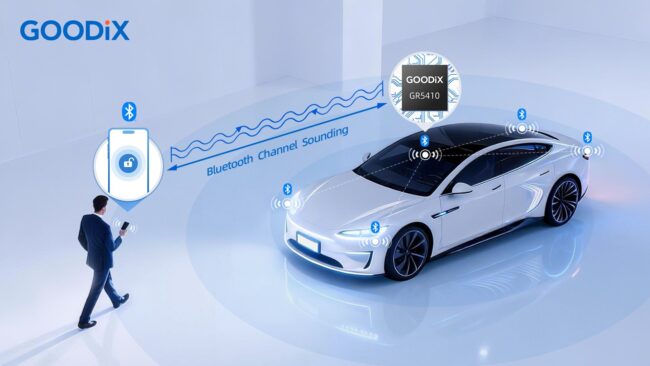
Shenzhen Goodix Technology Co. Ltd. has initiated development and validation of digital car key applications based on Bluetooth Core Specification 6.1. The company has also unveiled its next-generation automotive-grade Bluetooth Low Energy system-on-chip, the GR5410, positioning itself among the earliest silicon vendors to align product roadmaps with the newly released specification. The move signals a calculated attempt to shape how high-precision ranging and hands-free vehicle access evolve as automakers push digital keys from premium add-ons into mainstream vehicle platforms.
The timing matters. Digital car keys are no longer a speculative feature tied to flagship electric vehicles or experimental smartphone integrations. They are becoming a baseline expectation as automakers seek frictionless user experiences, reduce dependency on physical key fobs, and prepare vehicles for software-defined architectures where access, personalization, and security are tightly integrated. Bluetooth 6.1, particularly with Channel Sounding support, offers a more deterministic and secure ranging method than legacy RSSI-based approaches, which have struggled with reliability and spoofing concerns in real-world automotive environments.

Why Bluetooth 6.1 Channel Sounding changes the economics of digital car keys for automakers and suppliers
The introduction of Channel Sounding in Bluetooth 6.1 is not a marginal upgrade. It addresses one of the fundamental weaknesses of earlier Bluetooth-based ranging systems: inconsistent distance estimation in complex radio environments. By enabling phase-based measurements across multiple frequencies, Channel Sounding allows devices to determine relative distance with significantly higher accuracy and resistance to relay attacks.
For automakers, this has direct commercial implications. High-precision ranging reduces false unlock events, improves security certification outcomes, and allows digital keys to function reliably without requiring ultra-wideband hardware in every configuration. That matters in cost-sensitive vehicle segments where bill-of-materials discipline still dictates platform decisions. A Bluetooth-based solution that can approach sub-meter accuracy begins to compete credibly with more expensive alternatives, especially when paired with vehicle-side intelligence and sensor fusion.
By securing both Bluetooth 6.1 BQB certification and Channel Sounding certification early, Shenzhen Goodix Technology Co. Ltd. is signaling to original equipment manufacturers and Tier 1 suppliers that it intends to be specification-aligned rather than retrofitted. In automotive procurement cycles, early compliance often translates into design wins that persist across multiple model years.
How the GR5410 architecture reflects a shift toward integrated, security-first automotive connectivity silicon
The GR5410 is positioned as more than a Bluetooth radio upgrade. It integrates a high-performance wireless microcontroller unit, a dedicated Channel Sounding unit, and a CAN FD interface on a single chip. This level of integration reflects how in-vehicle connectivity is evolving from peripheral functionality into a core system capability.
Automotive digital key systems sit at the intersection of wireless communication, vehicle networking, and cybersecurity. By embedding CAN FD support, the GR5410 allows tighter coupling between access authorization and in-vehicle systems, reducing latency and architectural complexity. This matters for use cases such as personalized driver profiles, conditional access, and secure vehicle handover in shared mobility scenarios.
Security architecture is another notable emphasis. The GR5410 is powered by Arm China’s STAR-MC1 core and supports secure boot, protected debugging, encrypted storage, and a one-chip-one-key hardware security module model. In practical terms, this aligns the chip with emerging regulatory and industry expectations around in-vehicle cybersecurity, including requirements under UNECE WP.29 and evolving OEM security frameworks.
Rather than treating security as a software-layer concern, the design embeds it at the silicon level. That is increasingly non-negotiable as vehicles become rolling networks of addressable endpoints.
What multi-node passive ranging reveals about where in-vehicle wireless systems are heading next
One of the more forward-looking claims around the GR5410 is early support for passive anchor multi-node ranging, with synchronized ranging across nodes completed in approximately 200 milliseconds. This capability suggests that Goodix is not only targeting door-unlock scenarios but also broader spatial awareness inside and around the vehicle.
Multi-node ranging opens the door to use cases such as occupant detection, proximity-based feature activation, and enhanced safety functions that rely on knowing not just whether a device is present, but where it is relative to the vehicle. When combined with proprietary AI-based ranging algorithms, Goodix claims accuracy of up to plus or minus 50 centimeters at distances exceeding 50 meters.
While such performance figures will ultimately need to be validated across diverse automotive environments, the strategic intent is clear. Wireless connectivity chips are being positioned as spatial sensing platforms rather than simple communication modules. That shift could redefine how Bluetooth competes with ultra-wideband and other short-range technologies in the automotive stack.
Why automaker adoption signals matter more than specification claims at this stage
Goodix states that the GR5410 has already been selected for projects by multiple automakers and Tier 1 suppliers, with pilot production scheduled for the first quarter of 2026. While specific customers are not disclosed, this claim is significant in an industry where qualification cycles are long and supplier churn is costly.
Automotive silicon adoption is less about headline specifications and more about trust, tooling, and long-term support. Suppliers that can demonstrate roadmap alignment, certification readiness, and integration support tend to outlast those that merely chase performance metrics. Goodix’s existing footprint in digital car key deployments across more than a dozen vehicle models in China provides a credibility base that newer entrants lack.
This also reflects a broader trend in the global automotive supply chain. Chinese semiconductor firms are increasingly moving beyond commodity roles into system-level innovation, particularly in areas like connectivity, human-machine interfaces, and vehicle access systems. As geopolitical pressures reshape sourcing strategies, such capabilities are becoming strategically relevant beyond domestic markets.
How Bluetooth-led digital keys could reshape competition with ultra-wideband in mass-market vehicles
The digital key landscape has often been framed as a contest between Bluetooth and ultra-wideband. In practice, the outcome is likely to be more nuanced. Ultra-wideband offers superior spatial precision, but at higher cost and complexity. Bluetooth, particularly with Channel Sounding, offers a more economical path to acceptable accuracy for most consumer use cases.
Goodix’s approach suggests a belief that Bluetooth 6.1 can capture a large portion of the addressable market by delivering sufficient precision, strong security, and seamless smartphone compatibility. For automakers, the ability to deploy a single wireless technology across trims and regions simplifies validation and inventory management.
If Bluetooth-based solutions can meet security and reliability benchmarks previously associated only with ultra-wideband, the competitive balance could shift, especially in mid-range and high-volume vehicle platforms. That would have ripple effects across the semiconductor ecosystem, influencing investment priorities and partnership strategies.
What this launch signals about the next phase of smart vehicle connectivity
Beyond digital keys, the GR5410 points toward a future where in-vehicle wireless chips are expected to support multiple roles simultaneously: access control, spatial awareness, low-latency communication, and secure integration with vehicle networks. The line between connectivity, sensing, and control continues to blur.
For Shenzhen Goodix Technology Co. Ltd., the strategic bet is that early alignment with Bluetooth 6.1 and aggressive integration will translate into durable positions in next-generation vehicle architectures. The risk, as always, lies in execution. Automotive customers will scrutinize real-world ranging performance, security robustness, and long-term software support before committing at scale.
Still, the direction of travel is clear. As vehicles become more software-defined and user experience driven, the humble wireless chip is becoming a strategic component. Companies that recognize this early are positioning themselves not just as suppliers, but as enablers of the connected mobility ecosystem.
Key takeaways: What Goodix’s Bluetooth 6.1 move means for automakers, suppliers, and the connectivity stack
- Bluetooth 6.1 Channel Sounding materially improves ranging accuracy, strengthening Bluetooth’s position in digital car key systems
- The GR5410 reflects a shift toward integrated, security-first connectivity silicon tailored for automotive lifecycles
- Early certification and reported design wins increase the likelihood of multi-year adoption across vehicle platforms
- Bluetooth-based digital keys may narrow the gap with ultra-wideband in cost-sensitive, high-volume vehicles
- Multi-node ranging capabilities hint at broader spatial sensing applications beyond simple access control
- Chinese semiconductor firms are increasingly shaping system-level innovation in automotive connectivity
Discover more from Business-News-Today.com
Subscribe to get the latest posts sent to your email.