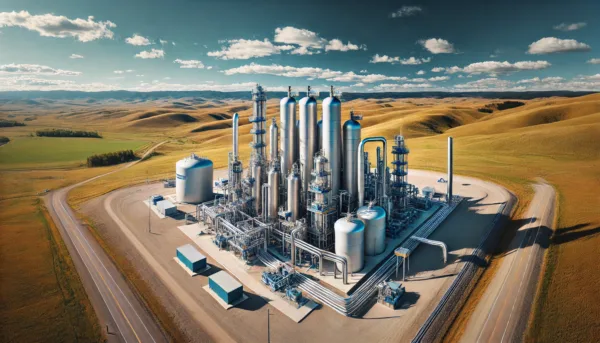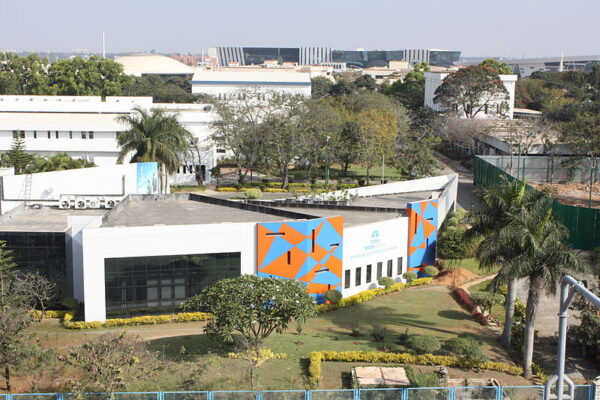




Glenfarne Group, the Houston-based private energy infrastructure developer, has confirmed that Kiewit Offshore Services will fabricate the liquefaction, pretreatment, and pipe rack modules for the Texas LNG export terminal at Port of Brownsville, Texas, once a Notice to Proceed is issued. The selection of Kiewit Offshore Services’ fabrication yard in Ingleside, Texas, keeps the entire module production loop within the state and caps a sequence of contract and financing milestones that has positioned the project for a second-quarter 2026 final investment decision. The move is explicitly framed by Glenfarne as a tariff-avoidance and risk-reduction strategy, sidestepping heavy-lift shipping, Panama Canal transit, and offshore geopolitical exposure that have complicated rival projects. For a facility still privately held and targeting a $5.7 billion debt financing close, the sourcing decision carries meaningful cost-certainty implications at precisely the moment lenders are scrutinising project risk profiles.
Why did Glenfarne choose in-state fabrication over offshore module yards for Texas LNG?
The logic behind selecting Kiewit Offshore Services over lower-cost offshore fabrication yards is layered, and Glenfarne has been unusually explicit about it. Fabricating modules in Asia or the Middle East, as many LNG projects have historically done, introduces risks that are difficult to price during execution: tariff regimes that can shift mid-project, heavy-lift vessel availability, Panama Canal transit scheduling, and quality control challenges that multiply with geographic distance. Each of those variables is a contingency that lenders and insurers must account for in their models.
By anchoring fabrication at Ingleside, Texas, roughly 170 kilometres from the Port of Brownsville, Glenfarne eliminates the shipping leg entirely. The proximity advantage is not trivial. Texas LNG’s liquefaction modules, pretreatment systems, and pipe rack assemblies represent some of the most capital-intensive and schedule-critical components of the facility. A delay or defect in an offshore-fabricated module can cascade across an entire construction programme. Domestic fabrication, with in-person supervision throughout, materially reduces that tail risk.
There is also a current political dimension. The announcement lands at a moment when the U.S. administration has been vocal about domestic manufacturing and tariff escalation on imported goods. Glenfarne framing the decision as an investment in Texas craft labour and U.S. manufacturing is strategically sound, both for regulatory goodwill and for investor optics, particularly among lenders and government agencies that may participate in the financing syndicate.
What does the Kiewit Offshore Services yard at Ingleside, Texas bring to the Texas LNG project?
Kiewit Offshore Services operates a significant industrial fabrication yard at Ingleside, near Corpus Christi, that has a track record across complex offshore and onshore energy infrastructure. The yard has previously supported fabrication work for offshore platforms, subsea infrastructure, and onshore processing facilities, giving it demonstrated capability with the kind of large, engineered steel assemblies that LNG liquefaction modules require.
The selection of Kiewit Offshore Services sits within the broader Kiewit Energy Group engagement, which holds the overall lump-sum turnkey engineering, procurement, and construction contract for Texas LNG. That contract, executed earlier in March 2026 following fourteen months of embedded pre-FID engineering work, assigns Kiewit Energy Group full responsibility for delivering a completed and operational facility to Glenfarne. Routing module fabrication through Kiewit Offshore Services keeps the fabrication scope within the same corporate family, simplifying interface management, contractual accountability, and quality assurance protocols across the construction programme.
How does the Texas LNG module fabrication decision affect project cost and schedule certainty ahead of FID?
Texas LNG is targeting a final investment decision in the second quarter of 2026. At that stage, lenders committing to a $5.7 billion senior debt package will require a high degree of confidence in the construction cost envelope and schedule. The lump-sum turnkey contract structure with Kiewit Energy Group already transfers significant price and completion risk from Glenfarne and its lenders onto the contractor. Locking in domestic module fabrication reinforces that risk transfer by removing the commodity tariff and logistics variables that would otherwise sit as unhedged exposures within the LSTK price.
The financing backdrop is substantive. Texas LNG assembled an initial bank group in late January 2026 to lead the $5.7 billion senior facility, drawing on interest that exceeded $10 billion from prospective lenders. That oversubscription suggests genuine appetite from global financial institutions, but it does not guarantee terms. The conditions attached to the initial commitments will likely include confirmations of EPC contract execution, module fabrication agreements, and progress toward offtake coverage. Glenfarne has now addressed several of those conditions in rapid succession, signalling deliberate staging of pre-FID milestones.
What offtake agreements underpin the Texas LNG project and how does the commercial structure hold together?
Texas LNG is a four-million-tonnes-per-annum facility, and Glenfarne has signed fully binding long-term offtake agreements covering the project’s entire capacity. Counterparties include EQT Corporation, Germany’s RWE Supply and Trading, Swiss trading house Gunvor Group, and Macquarie Energy, a unit of Macquarie Group. EQT, the largest U.S. natural gas producer in the Marcellus and Utica shales, committed to liquefy two million tonnes per annum of its own gas output, effectively functioning as both supplier and customer. RWE signed a 20-year agreement for one million tonnes per annum in January 2026, completing the conversion of all previously announced heads of agreement into binding contracts.
That offtake structure is among the most complete seen at the pre-FID stage for any U.S. LNG project in recent memory. Full contracted capacity before financial close reduces merchant risk to near zero, which is precisely the signal that project finance lenders require to commit capital at this scale. The mix of European utilities and global trading houses also provides geographic diversification in the buyer base, limiting concentration risk should any single counterparty face credit deterioration.
Where does Texas LNG sit in the competitive landscape of U.S. Gulf Coast LNG projects seeking FID in 2026?
The U.S. LNG development pipeline is crowded, and not every project that targets a final investment decision will achieve one. What distinguishes Texas LNG from several peers is the degree to which Glenfarne has resolved the three critical FID dependencies simultaneously: offtake contracts, EPC contract, and debt financing. Many rival projects have one or two of those elements in place but not all three, which limits their ability to actually pull the trigger.
Texas LNG’s four million tonnes per annum capacity positions it as a mid-scale project relative to giants like Sabine Pass or Calcasieu Pass, but that scale also reduces complexity and capital concentration risk. The facility’s design, centred on electric motor drives for liquefaction rather than gas turbine compression, gives it a lower-emissions profile that aligns with the preferences of European buyers operating under carbon reporting obligations. That design choice is not merely environmental window dressing; it is a commercial differentiator with material bearing on which counterparties are prepared to sign 20-year agreements.
Commercial operations are targeted for late 2028 or early 2029, with full facility completion by November 2029. If FID lands in the second quarter of 2026 as scheduled, construction will commence in the second half of 2026. The Kiewit Offshore Services module fabrication work at Ingleside would likely begin in parallel with site preparation activities at Brownsville, since liquefaction module fabrication is typically a long-lead activity running concurrently with civil construction rather than sequentially.
What are the execution risks that remain for Texas LNG before and after a 2026 final investment decision?
The picture is more de-risked than most comparable projects at this stage, but execution risk does not disappear with contract signing. The lump-sum turnkey structure with Kiewit Energy Group transfers cost overrun and schedule risk to the contractor, but Glenfarne’s interests are still directly affected if Kiewit encounters material delays. LSTK contracts provide financial protection, but prolonged disputes or construction interruptions create cascading consequences for debt service schedules, offtake delivery commitments, and the developer’s reputation with future financing counterparties.
Permitting stability is another variable. Texas LNG holds its export authorisations, but the broader U.S. LNG permitting environment has been subject to administrative review and political pressure. Any regulatory reversal or additional conditions imposed on the project’s FERC or Department of Energy authorisations could complicate the FID timeline. Glenfarne’s management team has navigated a prolonged permitting process to reach this point, and the project’s environmental design choices were partly strategic in anticipating regulatory scrutiny.
The financing syndication process also requires completion. Oversubscription in lender interest does not automatically translate into executed loan agreements at acceptable terms. Interest rate environments, credit spreads, and individual institution appetites can shift between the initial group formation and financial close. Glenfarne will need to manage that process carefully through the second quarter of 2026 to ensure the financing package is available when the FID vote is called.
Key takeaways: what the Texas LNG module fabrication decision means for Glenfarne, Kiewit, and the U.S. LNG sector
- Glenfarne has selected Kiewit Offshore Services’ Ingleside, Texas yard to fabricate liquefaction, pretreatment, and pipe rack modules for Texas LNG, keeping the entire module supply chain within the state and approximately 170 kilometres from the project site.
- The decision eliminates tariff exposure, heavy-lift shipping risk, Panama Canal transit dependency, and offshore quality control variability, all of which represent unpriced contingencies in rival projects sourcing modules from Asian fabrication yards.
- Module fabrication sits within the broader lump-sum turnkey EPC contract awarded to Kiewit Energy Group Inc. in March 2026, following fourteen months of embedded pre-FID engineering. Routing fabrication through the same corporate family simplifies contractual accountability.
- Texas LNG is targeting a Q2 2026 final investment decision on a $5.7 billion debt financing package. Lender interest exceeded $10 billion, but financial close remains subject to satisfaction of conditions that the EPC signing and module award help address.
- Offtake capacity is fully contracted with EQT Corporation (2 MTPA), RWE Supply and Trading (1 MTPA), Gunvor Group, and Macquarie Energy across 20-year binding agreements, one of the most complete pre-FID commercial structures in the current U.S. LNG pipeline.
- The facility’s electric motor drive design, which makes it one of the lowest-emitting LNG terminals under development, is a commercial differentiator that underpins European buyer participation and aligns with carbon reporting obligations facing offtake counterparties.
- Commercial operations are targeted for late 2028 or early 2029, with full facility completion by November 2029, contingent on a second-quarter 2026 FID.
- The principal residual risks are LSTK contractor execution, financing syndication completion at acceptable terms, and the stability of the U.S. LNG permitting environment through construction.
- For Kiewit, the Texas LNG engagement, spanning EPC contract, module fabrication, and commissioning, represents a major integrated LNG project win that reinforces its position on the U.S. Gulf Coast at a time when competing contractors are vying for a limited set of large-scale LNG mandates.
- The domestic fabrication decision carries political economy value in the current U.S. manufacturing policy environment, a factor that may influence regulatory disposition and government-linked lender participation in the financing syndicate.
Discover more from Business-News-Today.com
Subscribe to get the latest posts sent to your email.