


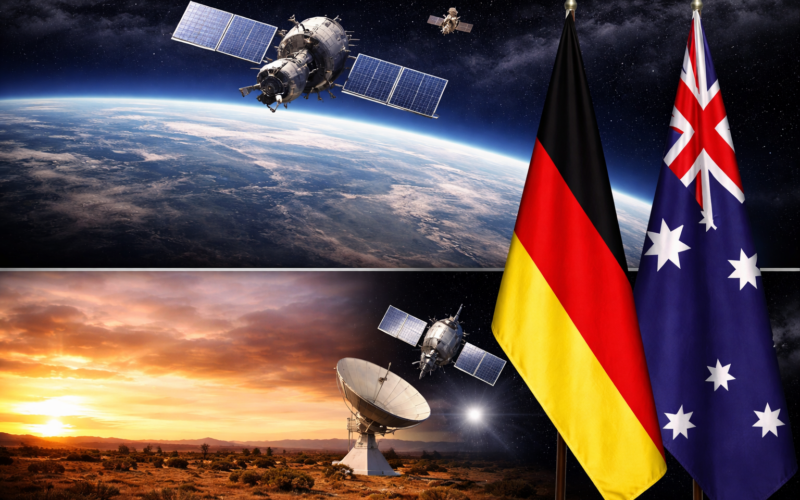
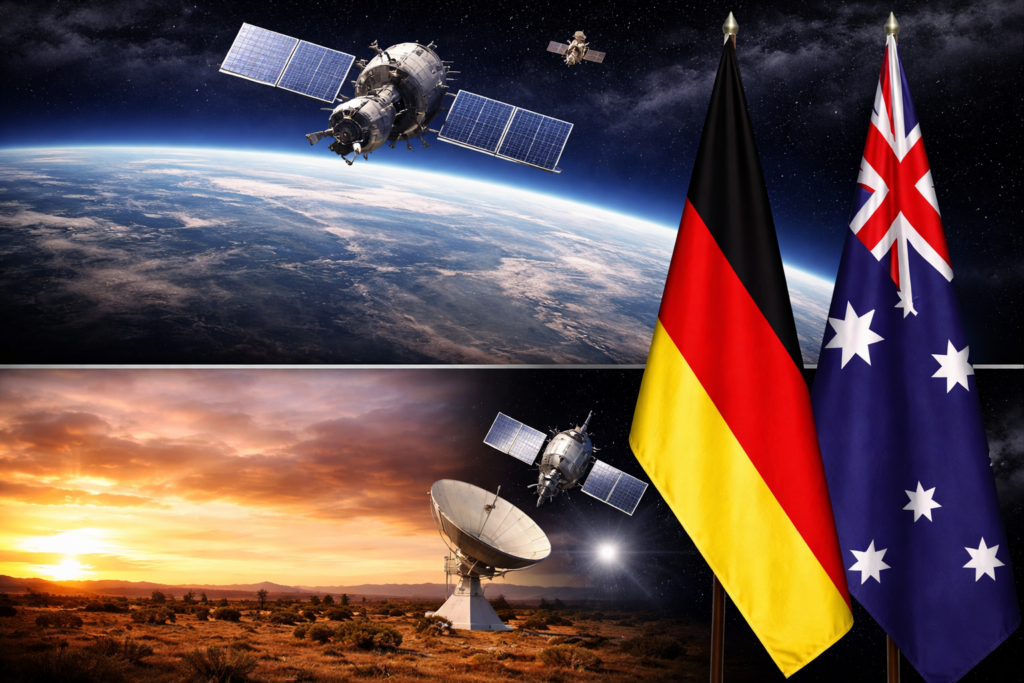
Germany and Australia signed a letter of intent on 26 March 2026 to cooperate on the development of a space-based early warning and surveillance network, marking a substantive advance in bilateral defence relations between Berlin and Canberra. The agreement was announced at a joint press conference at the Australian Parliament in Canberra following talks between German Federal Minister of Defence Boris Pistorius and Australian Deputy Prime Minister and Minister for Defence Richard Marles.
The letter of intent covers the stationing of space surveillance sensors in Australia, which both governments described as the foundational step toward a jointly developed capability to monitor activities in orbital space. Pistorius stated that Germany intended to deploy an independent global network of surveillance sensors, and framed the initiative as a direct response to Russia and China’s expanding ability to blind, jam, and destroy satellites. Pistorius stated that Germany and its partners needed to be aware of what was happening in space in order to protect their own systems.
Marles described the talks as a significant step in the bilateral relationship, stating that in a challenging world he fundamentally felt safer having had the kind of conversation the two ministers conducted. Both ministers characterized the agreement as a response to deteriorating space domain security, and Marles confirmed that Australia would join Germany’s space-based early warning system initiative.
How have Russia and China’s space capabilities changed the strategic calculus for Germany and Australia?
Germany’s stated concern about adversarial space capabilities is grounded in documented operational incidents and intelligence assessments. Russia’s Luch Olymp satellites have repeatedly maneuvered into close proximity with commercial Intelsat satellites used by Germany and other North Atlantic Treaty Organization allies, a form of orbital shadowing that allows signals intelligence collection and raises the prospect of interference. In the opening hours of Russia’s full-scale invasion of Ukraine in February 2022, Russian forces launched a cyberattack against the Viasat satellite network used by the Ukrainian government, which caused cascading effects across Europe, including the disruption of approximately 5,800 German wind turbines.
China’s integration of satellite reconnaissance, positioning, and timing capabilities into its military command and control systems has been identified in Western intelligence assessments as a direct challenge to the information advantages held by the United States and its partners. The United States Office of the Director of National Intelligence noted in its 2023 Annual Threat Assessment that China’s military would continue to integrate space services into its weapons and command systems with the objective of eroding the United States military’s information advantage. Against this backdrop, both Germany and Australia have concluded that independent space domain awareness capabilities, developed in coordination with partners rather than relying exclusively on the United States, are a strategic priority.
What does Germany’s broader space investment programme mean for the global sensor network announced with Australia?
Germany’s investment in space defence capabilities has accelerated substantially following its November 2025 national space security strategy, the first of its kind published by the German government. That strategy charged the German Federal Ministry of Defence with fielding a global sensor network for space situational awareness as a core operational mandate. The letter of intent signed with Australia is a direct operational output of that strategic framework.
The German military is set to invest more than 35 billion euros in space systems in the coming years, covering the development of the global surveillance network, new satellite constellations, reconnaissance systems, and supporting sensor infrastructure. In December 2025, the German Armed Forces awarded a contract worth approximately 1.7 billion euros to Rheinmetall ICEYE Space Solutions for development of a synthetic aperture radar satellite constellation designated the SAR Space System for Persistent Operational Tracking Stage 1. Germany is also developing a constellation of more than 100 satellites modelled on the United States Space Development Agency architecture for combined communications and missile tracking. The stationing of sensors in Australia, made possible by the letter of intent, would extend the geographic coverage of this emerging German-led network into the southern hemisphere and the Indo-Pacific region.
Why does Germany regard Australia as a critical node in its Indo-Pacific security strategy?
Germany’s Federal Ministry of Defence characterizes Australia as one of its key security partners in the southern Indo-Pacific. The bilateral strategic partnership between the two countries was established in 2013 and formally expanded in 2021. German defence firm Rheinmetall maintains production facilities and maintenance capabilities in Australia, where it develops, manufactures, and services military vehicles, platforms, and turrets for the Australian armed forces and for export.
Pistorius arrived in Canberra as the final stop of a regional tour that also included Japan and Singapore. The delegation included senior executives from major German defence firms, reflecting the industrial dimension of the visit alongside its diplomatic objectives. Meetings in Canberra also included discussions with Australian defence company Electro Optic Systems, which manufactures a containerized laser weapon designed to counter unmanned aerial vehicles. The Electro Optic Systems weapon operates in the 50 to 150 kilowatt power range and is marketed as capable of destroying drones at distances of up to 3 kilometres and disrupting them at distances of up to 15 kilometres.
In a speech at the National Press Club in Canberra, Pistorius asserted that security in Europe and security in the Indo-Pacific were two sides of the same coin. He highlighted Beijing’s support for Russia’s war in Ukraine as a central element of his argument for deepening ties between mid-sized democratic nations across the two regions.
How does the Germany-Australia space agreement fit within Australia’s existing space domain awareness architecture?
Australia has been building its space domain awareness capabilities through multiple parallel frameworks. Under Pillar Two of the AUKUS trilateral security arrangement among Australia, the United Kingdom, and the United States, Canberra and Washington are collaborating on the United States Deep-Space Advanced Radar Capability project, which is designed to provide continuous global monitoring of geosynchronous orbits. The Australian Defence Space Command signed an Enhanced Space Cooperation Memorandum of Understanding with the United States Space Command, and Australia joined the United States-led Joint Task Force-Space Defence Commercial Operations Cell in September 2023.
The Germany-Australia space cooperation letter of intent adds a new bilateral layer to Australia’s expanding space domain awareness network, one that is separate from but complementary to its AUKUS commitments. Hosting German space sensors on Australian territory would extend Germany’s independent global surveillance reach into the southern hemisphere while enhancing Australia’s situational awareness through access to additional sensor data and a partner network outside the Anglo-American intelligence alliance.
What other defence agreements did Germany and Australia reach during the Pistorius visit to Canberra?
In addition to the space cooperation letter of intent, Germany and Australia agreed to work toward a Status of Forces Agreement, which Marles described as a framework that would make it considerably easier for the defence forces of each country to operate from the other’s territory. Status of Forces Agreements are standard instruments of deepening bilateral military cooperation, formalizing the legal status, rights, and responsibilities of foreign military personnel deployed in a host country. Australia holds such agreements with several partner nations, most notably the United States, and the agreement with Germany would place Berlin on a comparable formal footing within the bilateral relationship.
Australia also confirmed it would incorporate missiles produced by German company TDW into its domestic manufacture of guided weapons, a measure intended to reduce supply vulnerabilities in the Indo-Pacific as ongoing conflicts in Ukraine and the Middle East continue to place strain on global defence supply chains. Pistorius acknowledged that Germany had in the past relied too heavily on single sources for critical capabilities, naming China for certain supply chain components and the United States for certain weapons systems. He stated that Berlin’s strategic priority was to diversify partnerships to ensure that affordable defence equipment could be produced and made available at scale.
What is the significance of this being the first German defence minister visit to Australia in eight years?
The eight-year gap since a German defence minister last visited Australia reflects the historically limited operational depth of the bilateral defence relationship, which has until recently remained largely a political and trade-focused partnership rather than a substantive security arrangement. The visit by Pistorius, conducted in the context of a broader Indo-Pacific regional tour and accompanied by senior defence industry executives, signals a deliberate German effort to build defence relationships in the Indo-Pacific that do not rely exclusively on traditional European or North Atlantic partners.
Germany’s broader strategic messaging during the tour, including Pistorius’s emphasis on shared interests among mid-sized democratic nations in Europe and the Indo-Pacific to uphold international rules and protect trade routes, energy supplies, and security, reflects Berlin’s assessment that the strategic environment requires it to deepen partnerships beyond its traditional geographic orbit.
Key takeaways on what the Germany-Australia space defence agreement means for both countries and the broader Indo-Pacific security environment
- Germany and Australia signed a letter of intent on 26 March 2026 to station space surveillance sensors in Australia as part of Germany’s plan to build an independent global network for space situational awareness, with both countries citing Russia and China’s growing offensive space capabilities as the primary driver.
- The two governments also agreed to pursue a Status of Forces Agreement to simplify and formalize troop deployments between their respective countries, and Australia confirmed it would incorporate missiles from German company TDW into its domestic guided weapons manufacturing programme.
- The letter of intent expands Australia’s space domain awareness architecture beyond its existing AUKUS and United States Space Command cooperation frameworks, adding a bilateral German dimension that extends Germany’s sensor reach into the southern hemisphere.
- German Federal Minister of Defence Boris Pistorius’s visit to Canberra was the first by a German defence minister to Australia in eight years and formed part of a broader Indo-Pacific tour including Japan and Singapore, accompanied by senior German defence industry executives.
- Germany’s space investment programme, underpinned by a commitment of more than 35 billion euros, is developing multiple satellite constellations and a global sensor network; the Australia agreement represents a key geographic node in that emerging architecture.
Discover more from Business-News-Today.com
Subscribe to get the latest posts sent to your email.