






Genentech, a member of the Roche Group (SIX: RO, ROG; OTCQX: RHHBY), confirmed that the U.S. Food and Drug Administration (FDA) has issued a Complete Response Letter (CRL) for its supplemental Biologics License Application (sBLA) seeking to expand Columvi® (glofitamab-gxbm) use in combination with gemcitabine and oxaliplatin (GemOx) for adults with relapsed or refractory diffuse large B-cell lymphoma (DLBCL). The FDA determined that the Phase III STARGLO trial, designed to demonstrate the regimen’s survival benefit in transplant-ineligible patients, did not meet the evidentiary threshold required for approval in the U.S. second-line setting.
Columvi remains available under its accelerated approval for adults with third-line or later DLBCL, where it is administered as a monotherapy. Discussions with U.S. regulators are ongoing as Genentech seeks to position the Phase III SKYGLO trial as the new confirmatory study that could convert accelerated approval to full approval and potentially support use in earlier treatment lines.
Why did the FDA issue a Complete Response Letter for Genentech’s Columvi GemOx regimen despite positive global regulatory outcomes?
The FDA’s decision reflects its increasingly conservative approach to postmarketing confirmatory studies in oncology. While the STARGLO trial demonstrated a significant overall survival benefit, U.S. regulators cited data limitations, noting that the trial’s patient population and endpoints did not sufficiently address the agency’s standards for earlier-line approval. Historically, accelerated approvals in oncology have been subject to heightened scrutiny, especially in hematologic malignancies where surrogate endpoints have often been used to justify conditional approvals.
The CRL also underscores the agency’s shift toward requiring robust randomized evidence for bispecific antibodies. Since its U.S. accelerated approval in 2023, Columvi has been a key treatment option for heavily pretreated DLBCL, but the FDA’s rejection highlights the challenge of translating global regulatory success into U.S. approval. Columvi GemOx is already approved in more than 35 countries, including the European Union, where the same STARGLO data were deemed sufficient for marketing authorization.
Analysts familiar with U.S. regulatory trends noted that the FDA’s decision aligns with recent oncology precedents, where confirmatory trials have been closely evaluated for endpoint selection, trial design, and long-term durability of response. In this context, the CRL does not necessarily reflect concerns about Columvi’s clinical efficacy but rather the agency’s insistence on higher evidentiary standards for label expansion.
What were the STARGLO Phase III results that drove global approvals of Columvi GemOx in relapsed or refractory diffuse large B-cell lymphoma?
The STARGLO Phase III study [GO41944; NCT04408638] enrolled adults with relapsed or refractory DLBCL who were ineligible for autologous stem cell transplant or had received two or more prior lines of therapy. Patients were randomized to receive Columvi plus GemOx or Rituxan® (rituximab) plus GemOx. The trial reported a 41% reduction in the risk of death in the Columvi arm (hazard ratio=0.59; 95% CI: 0.40–0.89; p=0.011), marking a statistically significant and clinically meaningful improvement in overall survival.
Two-year follow-up data presented at the 61st American Society of Clinical Oncology Annual Meeting in June 2025 reinforced the durability of the regimen’s benefit, with sustained progression-free survival, higher complete response rates, and improved objective response rates compared to the control arm. The results were simultaneously published in The Lancet, which analysts described as a key endorsement of the regimen’s global clinical relevance.
These findings contributed to the rapid approval of Columvi GemOx in Europe, Asia-Pacific markets, and Latin America. The regimen has also been incorporated into major clinical practice guidelines, including recommendations by the U.S. National Comprehensive Cancer Network (NCCN). However, analysts pointed out that NCCN endorsements, while influential in physician decision-making, do not directly impact FDA regulatory decisions.
How are institutional investors interpreting the FDA rejection and what does it mean for Genentech’s hematology portfolio?
Institutional investors and analysts are treating the FDA’s CRL as a strategic, rather than existential, setback for Genentech’s hematology portfolio. Although the rejection delays broader U.S. adoption of Columvi, analysts remain confident in the drug’s long-term commercial trajectory, given its established use in third-line DLBCL and ongoing global sales momentum.
Investor sentiment has been tempered by the fact that Genentech retains a strong foothold in hematologic malignancies through its diverse portfolio, including Polivy, which is already approved as part of a first-line DLBCL regimen in combination with rituximab, cyclophosphamide, doxorubicin, and prednisone. This portfolio synergy provides Genentech with opportunities to explore novel combination regimens, potentially strengthening its competitive position against other bispecific antibody developers.
Some analysts have noted that the delayed second-line approval could marginally impact near-term U.S. revenue projections for Columvi, but the overall outlook remains positive. According to market sentiment, the key determinant of Columvi’s commercial expansion in the U.S. will be the success of the SKYGLO trial and the company’s ability to secure a full label expansion in frontline or second-line settings.
What is the future outlook for Genentech’s Columvi development program and when could U.S. regulatory approval for earlier-line use be expected?
Genentech has confirmed its commitment to expanding Columvi’s indications, with the Phase III SKYGLO trial [GO44145; NCT06047080] now positioned as the primary confirmatory study for regulatory discussions with the FDA. SKYGLO is evaluating Columvi in combination with Polivy, Rituxan, cyclophosphamide, doxorubicin, and prednisone in previously untreated large B-cell lymphoma. The trial’s primary endpoints include overall survival and progression-free survival, with secondary endpoints assessing complete response rate and duration of response.
Analysts expect topline results from SKYGLO by mid-2026, with potential U.S. filing for earlier-line use in late 2026 or early 2027, depending on data maturity. If positive, SKYGLO could unlock access to a significantly larger patient population, as frontline and second-line DLBCL settings represent the highest incidence segments.
Meanwhile, Genentech is also conducting additional studies investigating Columvi in mantle cell lymphoma and other B-cell malignancies, as well as real-world evidence programs designed to supplement regulatory submissions. Market observers believe that Genentech’s diversified clinical development strategy reduces the risk of overreliance on a single trial outcome.
How does Genentech’s Columvi strategy fit within the competitive landscape of bispecific antibodies in diffuse large B-cell lymphoma?
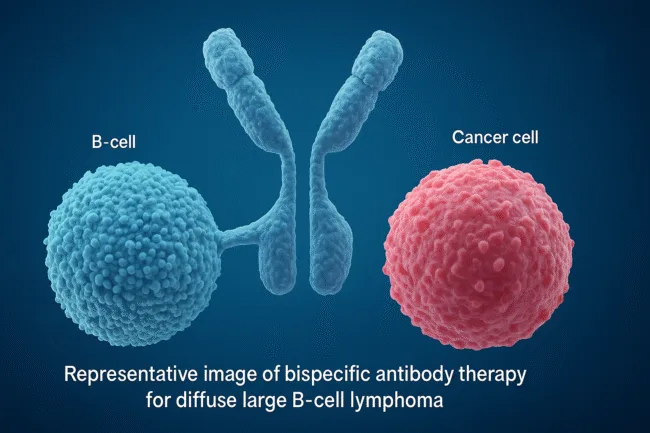
Columvi is part of a competitive pipeline of CD20xCD3 T-cell engaging bispecific antibodies targeting B-cell malignancies. Its 2:1 structural format, designed to engage T cells via CD3 while binding to B cells through CD20, allows for potent immune-mediated tumor cell killing. This design differentiates Columvi from some rival bispecifics, which use alternative configurations or target different antigens.
However, the delayed U.S. second-line approval gives competitors additional time to advance their clinical programs. Several bispecific antibodies are currently in late-stage trials for earlier-line DLBCL, creating a potential race for frontline positioning. Genentech’s strategic advantage lies in its extensive hematology infrastructure and ability to combine Columvi with other agents in its portfolio, such as Polivy, to develop differentiated regimens.
Institutional analysts believe that Genentech’s long-term competitive positioning will depend on maintaining leadership in bispecific innovation and delivering confirmatory data that meet U.S. regulatory expectations. If successful, Columvi could establish itself as a backbone therapy in DLBCL treatment, particularly in transplant-ineligible patients.
Discover more from Business-News-Today.com
Subscribe to get the latest posts sent to your email.


